CIDR IPv4 Firewall Matching
Asked of: Software Engineer
Last updated
What's being tested
Candidates must demonstrate precise IPv4/CIDR arithmetic and set reasoning: convert between dotted quad and 32-bit integers, compute CIDR start/end, and test containment or overlap. Interviewers also probe algorithmic design for ordered first‑match firewall semantics and scalable lookup/update structures that keep matching low‑latency.
Patterns & templates
-
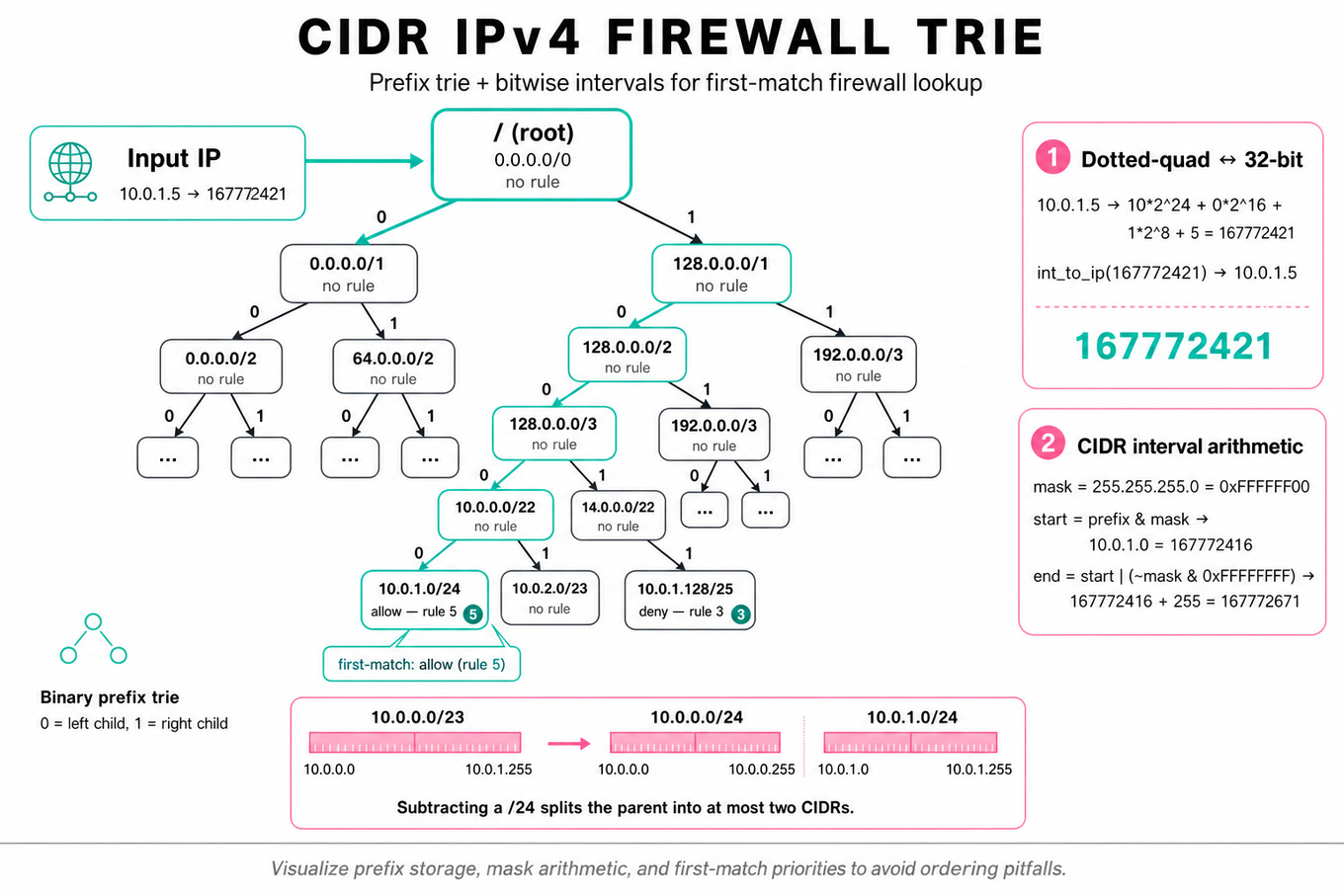
Convert dotted-quad ↔ 32-bit with
`ip_to_int`/`int_to_ip`and apply masks via(ip & mask) == (prefix & mask)for prefix containment. -
Represent a CIDR as a closed integer interval
[start, end]using start = prefix & mask, end = start | (~mask & 0xFFFFFFFF). -
Prefix containment = single mask equality; overlap = interval intersection check with O(1) bit ops.
-
Subtracting one CIDR from another: split into at most two smaller CIDRs using bitwise prefix shrink; repeated subtraction is interval-set difference.
-
Ordered first-match firewall: evaluate rules sequentially until a match; for block queries, require full coverage of the block by an allowed rule (or absence of earlier deny).
-
Use a prefix trie / binary radix tree for O(W) lookup where W ≤ 32; for N large, compress to a Patricia/radix trie to reduce memory and hops.
Tip: store rules at trie nodes with priority index to resolve first-match without linear scan.
Common pitfalls
Pitfall: confusing network vs broadcast addresses — treat CIDR ranges as inclusive
[start, end]using 32-bit arithmetic.
Pitfall: assuming disjoint CIDRs — overlapping rules with ordering change semantics; always respect rule index priority.
Pitfall: using string parsing (regex) in hot path — convert once to ints/masks; runtime must be bitwise, not text-based.
Practice these
the practice cards below cover the canonical variants — solve all of them and time yourself
Practice questions
- First-Match CIDR Firewall: Status of an IP Address or a Whole CIDR BlockDatabricks · Software Engineer · Onsite · medium
- Implement firewall matching with CIDR rulesDatabricks · Software Engineer · Onsite · hard
- Check if CIDR is fully canceled by rulesDatabricks · Software Engineer · Technical Screen · medium
- Find first CIDR block covering IPDatabricks · Software Engineer · Technical Screen · medium
- Design IP/CIDR rule matcherDatabricks · Software Engineer · Technical Screen · medium
- Implement CIDR firewall matcherDatabricks · Software Engineer · Technical Screen · medium
- Design an IP filter using CIDR rulesDatabricks · Software Engineer · Technical Screen · medium
Related concepts
- IPv4 CIDR Rule MatchingCoding & Algorithms
- Cloud Networking, CIDR, And Secure InfrastructureSystem Design
- Linux Networking And Performance Fundamentals
- Array, Grid, And Prefix/Suffix ReasoningSoftware Engineering Fundamentals
- Interval Merging And Range ManipulationCoding & Algorithms
- Intervals, Line Sweep, And Range UpdatesCoding & Algorithms