Content Moderation ML System Design
Asked of: Software Engineer
Last updated
What's being tested
Interviewers are probing whether you can design a large-scale safety-critical backend system that uses ML inference without turning the answer into a model-research discussion. For a Software Engineer, the focus is on distributed system architecture, latency/throughput tradeoffs, failure handling, human-review workflows, and operational correctness under massive content volume. Bytedance cares because short-video, comment, livestream, and image systems require moderation decisions at global scale, often before content reaches users. A strong answer shows you can combine synchronous checks, asynchronous pipelines, durable queues, policy enforcement, and auditability while respecting strict `p99` latency and availability constraints.
Core knowledge
-
Clarify the moderation surface first: uploads, comments, profile photos, DMs, livestream frames, audio, and re-shares have different latency budgets. A video upload may tolerate seconds of processing, while a comment or livestream frame may need sub-100ms to low-second decisions.
-
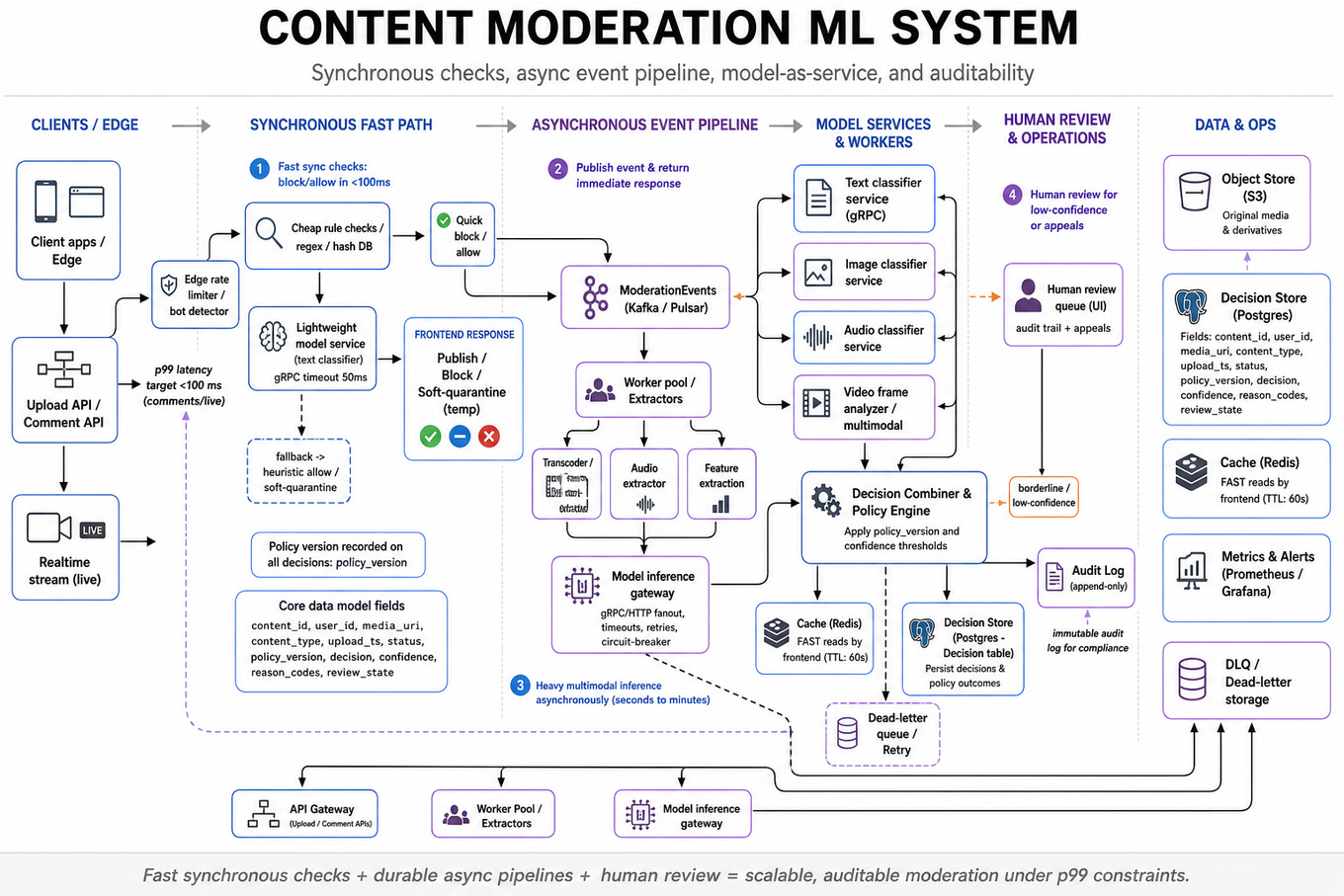
Separate decision paths by risk and latency. Use synchronous moderation for cheap, high-confidence checks before publishing, and asynchronous moderation for expensive multimodal analysis after temporary quarantine or limited distribution. A common pattern is: block obvious violations, allow obvious safe content, queue borderline cases.
-
Model inference should be treated as a service dependency, not the center of the SWE design. The platform calls specialized classifiers for text, image, audio, and video through
`gRPC`or HTTP, with timeouts, retries, circuit breakers, and fallback policies. Discuss model outputs as labels plus confidence, not architecture internals. -
Use an event-driven pipeline for expensive or long-running work. Content metadata is written to a durable store, an event is published to
`Kafka`or`Pulsar`, workers perform extraction/inference, and moderation results are stored in a decision table. This prevents upload APIs from blocking on video transcoding or frame analysis. -
Define the core data model explicitly:
`content_id`,`user_id`,`media_uri`,`content_type`,`upload_ts`,`status`,`policy_version`,`decision`,`confidence`,`reason_codes`, and`review_state`. Keep policy versioning because appeals, audits, and retroactive policy changes require knowing which rule set produced a decision. -
Design state transitions carefully. A typical lifecycle is
`UPLOADED`→`PENDING_REVIEW`→`APPROVED`|`REJECTED`|`LIMITED_DISTRIBUTION`|`HUMAN_REVIEW`→`APPEALED`→`FINAL`. State transitions should be idempotent, monotonic where possible, and protected against stale workers overwriting newer decisions. -
Capacity planning should be explicit. If daily uploads are and peak factor is , estimate Then multiply by fanout: one video may produce 30 sampled frames, an audio transcript, OCR text, and metadata checks. Queue sizing can use Little’s Law: where
`L`is queue depth,`λ`arrival rate, and`W`average processing time. -
Prioritize cheap filters before expensive inference. Run hash matching, URL/domain blocklists, language detection, metadata rules, and duplicate detection before video-frame inference. Perceptual hashing such as
`pHash`or locality-sensitive hashing can catch known-bad images/videos faster than full model inference. -
Human review is part of the system design. Borderline or high-impact cases should enter a reviewer queue with priority based on severity, virality, user trust, region, and SLA. The platform needs assignment, locking, escalation, reviewer decisions, audit logs, and a way to prevent duplicate reviewers from racing.
-
Failure policy must be explicit: fail-open, fail-closed, or degrade. For low-risk content, you might publish with limited reach if inference times out. For high-risk categories like child safety, terrorism, or livestream abuse signals, you may fail-closed or quarantine. The right answer depends on harm severity and product latency.
-
Observability needs decision-level and system-level signals. Track
`p50`/`p95`/`p99`moderation latency, queue lag, timeout rate, decision distribution, false-positive appeal rate, reviewer backlog, model-service error rate, and content takedown delay. For SWE, emphasize dashboards, logs, traces, alert thresholds, and runbooks. -
Abuse resistance matters. Attackers may slightly crop videos, overlay text, use coded language, or upload bursts to overwhelm review queues. System-level mitigations include rate limits with
`Redis`, per-user trust scores, deduplication, backpressure, regional throttling, and priority queues for viral or risky content.
Worked example
For Design a content moderation platform, a strong candidate would start by clarifying content types, scale, latency target, and enforcement semantics: “Are we moderating videos only, or also comments and livestreams? Do we need pre-publish blocking, post-publish takedown, or both? What are the expected upload QPS and `p99` decision SLA?” Then they would declare assumptions, such as 10M uploads/day, 5x peak traffic, videos stored in object storage, and a requirement to block high-confidence violations before broad distribution.
The answer skeleton should have four pillars: ingestion and content storage, moderation orchestration, decision storage/enforcement, and human review/observability. The upload API writes metadata to a database such as `MySQL` or `Postgres`, stores media in object storage like `S3`-style blob storage, and emits a moderation event to `Kafka`. A moderation orchestrator fans out to text, image, audio, and video workers, collects results, applies policy rules, and writes a final decision to a moderation table. Enforcement services check that table before ranking, search indexing, notifications, sharing, or livestream continuation.
A specific tradeoff to flag is synchronous versus asynchronous moderation: synchronous checks reduce exposure to harmful content but increase upload latency and dependency risk; asynchronous processing improves UX but may allow brief harmful exposure unless content is quarantined or distribution-limited. A strong close would mention: “If I had more time, I’d go deeper on reviewer queue prioritization, policy versioning, multi-region failover, and abuse patterns like adversarial reuploads.”
A second angle
A common variant is real-time moderation for livestreams or comments, where the same architecture must be optimized for much tighter latency. Instead of waiting for full video processing, the system samples frames every few seconds, transcribes audio chunks, and makes rolling decisions that can warn, throttle, or terminate the stream. The main design shift is from batch-like upload moderation to stream processing with bounded delay, using tools like `Flink` or consumer groups over `Kafka`. The failure policy also changes: if livestream risk signals are severe, the system may interrupt immediately and send the case to human review afterward. The core principles remain the same: durable events, fast-path checks, policy-based decisions, human escalation, and strong observability.
Common pitfalls
Pitfall: Designing only the ML classifier and ignoring the platform.
A tempting but weak answer is: “Use a multimodal model to classify content as safe or unsafe.” That misses what the SWE interviewer wants: APIs, queues, storage, state transitions, latency, retries, enforcement, and operational failure modes. Treat the model as one component inside a larger moderation control plane.
Pitfall: Assuming every item can wait for human review.
Human review does not scale linearly with Bytedance-level traffic, and reviewer delay can create either harmful exposure or terrible creator experience. A better answer uses confidence thresholds, automated decisions for obvious cases, prioritized queues for borderline/high-risk cases, and appeal workflows for false positives.
Pitfall: Not defining enforcement semantics.
Many candidates say “store the moderation result” but never explain how feed ranking, search, notifications, sharing, or comments actually consume it. A stronger answer makes moderation status a hard dependency for distribution systems, with caching, invalidation, and clear behavior when the moderation service is unavailable.
Connections
Interviewers may pivot from this topic into news feed system design, video upload/transcoding pipelines, real-time stream processing, rate limiting, or distributed workflow orchestration. They may also ask about A/B-safe rollout, but for a SWE answer, keep the focus on service reliability, policy enforcement, and operational safeguards rather than experimental methodology.
Further reading
-
Designing Data-Intensive Applications — strong foundation for logs, streams, storage, replication, and distributed system tradeoffs.
-
Google SRE Book — practical treatment of SLIs, SLOs, error budgets, alerting, and operational reliability.
-
Kafka: The Definitive Guide — useful background for event-driven moderation pipelines and durable asynchronous processing.
Featured in interview prep guides
Practice questions
Related concepts
- Harmful Content Moderation Measurement
- ML Evaluation, Uncertainty, And Safety GuardrailsML System Design
- Production ML Systems, Evaluation, And SafetyML System Design
- Harmful Content Measurement And ModerationAnalytics & Experimentation
- ML System Design, Recommenders, Forecasting And AllocationMachine Learning
- Multimodal LLM System Design