Bytedance Software Engineer Interview Prep Guide
Everything Bytedance actually asks Software Engineer candidates — concept walkthroughs, worked examples, and the real interview questions, drawn from candidate reports. Free to read.
Last updated
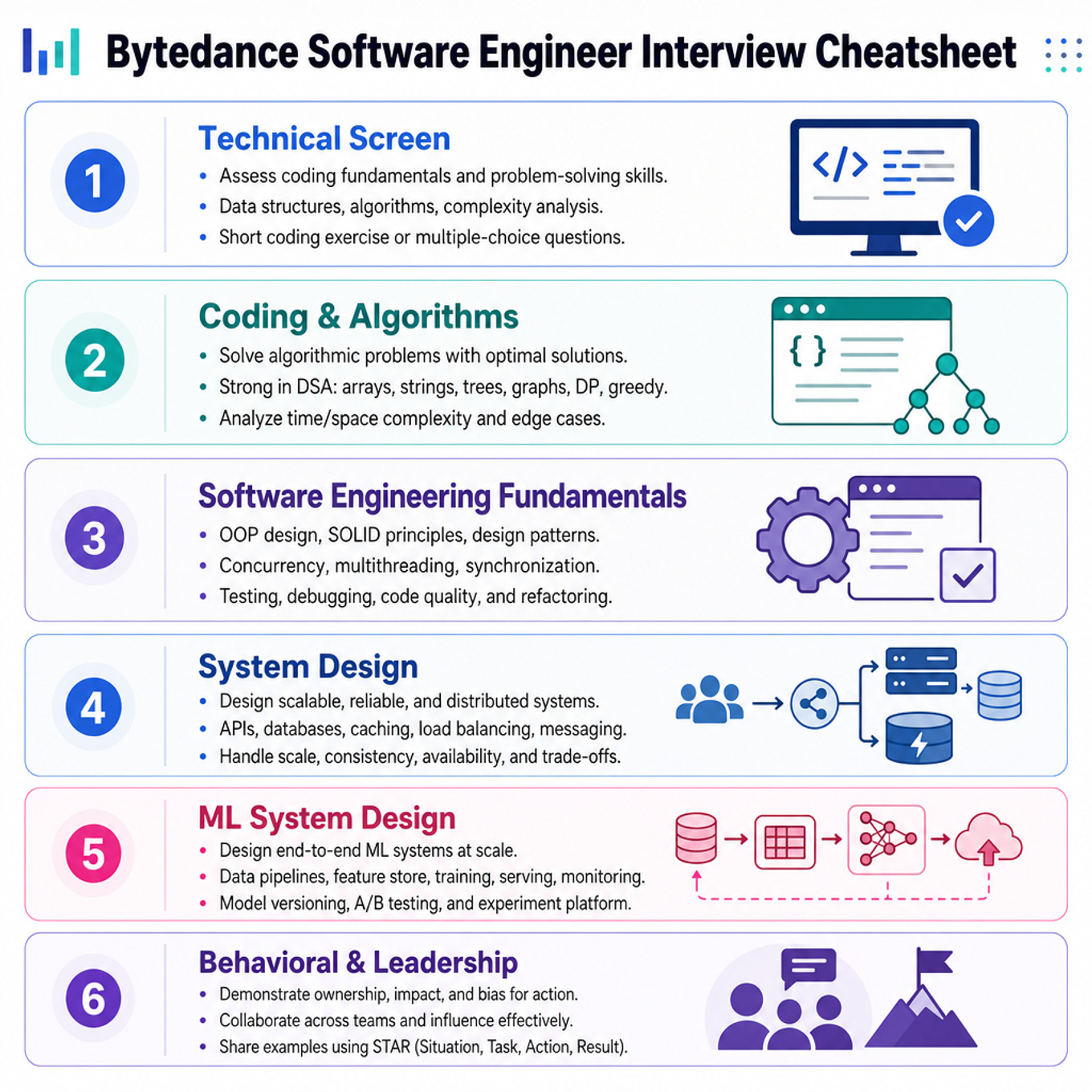
Technical Screen
Coding & Algorithms
- LRU Cache — covered in depth under Onsite below.
![Editorial infographic with two left-to-right algorithm traces: (left) 4-step interval boundary scan showing sentinel prev and emitted missing ranges for nums=[0,1,3,7], lower=0 upper=9; (right) 4-step monotonic increasing stack trace for histogram heights [2,1,5,6,2,3] showing pushes, pops, sentinel](https://ik.imagekit.io/9osfw19dn/cheatsheets/concepts/interval-boundary-and-monotonic-stack-algorithms_FO3QFPfRo.png?tr=w-1360,q-95)
What's being tested
Tests interval boundary reasoning over sorted inputs and monotonic stack construction for nearest-smaller/greater relationships. You must show careful handling of inclusive bounds, empty gaps, merging semantics, and O(n) stack-based area computation rather than brute force.
Patterns & templates
-
Sentinel boundaries for missing ranges — scan from
lowertoupper, usingprev = lower - 1; avoid overflow withlong. -
Maximal interval detection — when
nums[i] - prev > 1, emit[prev + 1, nums[i] - 1]; skip duplicates cleanly. -
Interval merging — sort by start, then merge if
curr.start <= last.end;O(n log n)time,O(n)output space. -
Boundary convention clarity — state whether intervals are inclusive
[l, r]or half-open[l, r)before coding comparisons. -
Monotonic increasing stack for histogram area — push indices with increasing heights; pop when current height is smaller to finalize rectangles.
-
Histogram sentinel bar — append virtual height
0or loop tonso all remaining stack bars are popped and evaluated. -
Width formula after popping index
mid—width = stack.empty ? i : i - stack.top() - 1; area isheight[mid] * width.
Common pitfalls
Pitfall: Using
intforlower - 1,upper + 1, ornums[i] - prevcan overflow atInteger.MIN_VALUE/Integer.MAX_VALUE.
Pitfall: Treating adjacent intervals like
[1,2]and[3,4]as mergeable when the problem only merges overlapping intervals.
Pitfall: In histogram area, popping on the wrong comparison can mishandle equal heights; choose
>=or>deliberately and stay consistent.
Practice these
The linked practice cards below cover the canonical variants — solve all of them and time yourself.
Practice questions
- String Parsing, Tokenization, And Validation — covered in depth under Onsite below.
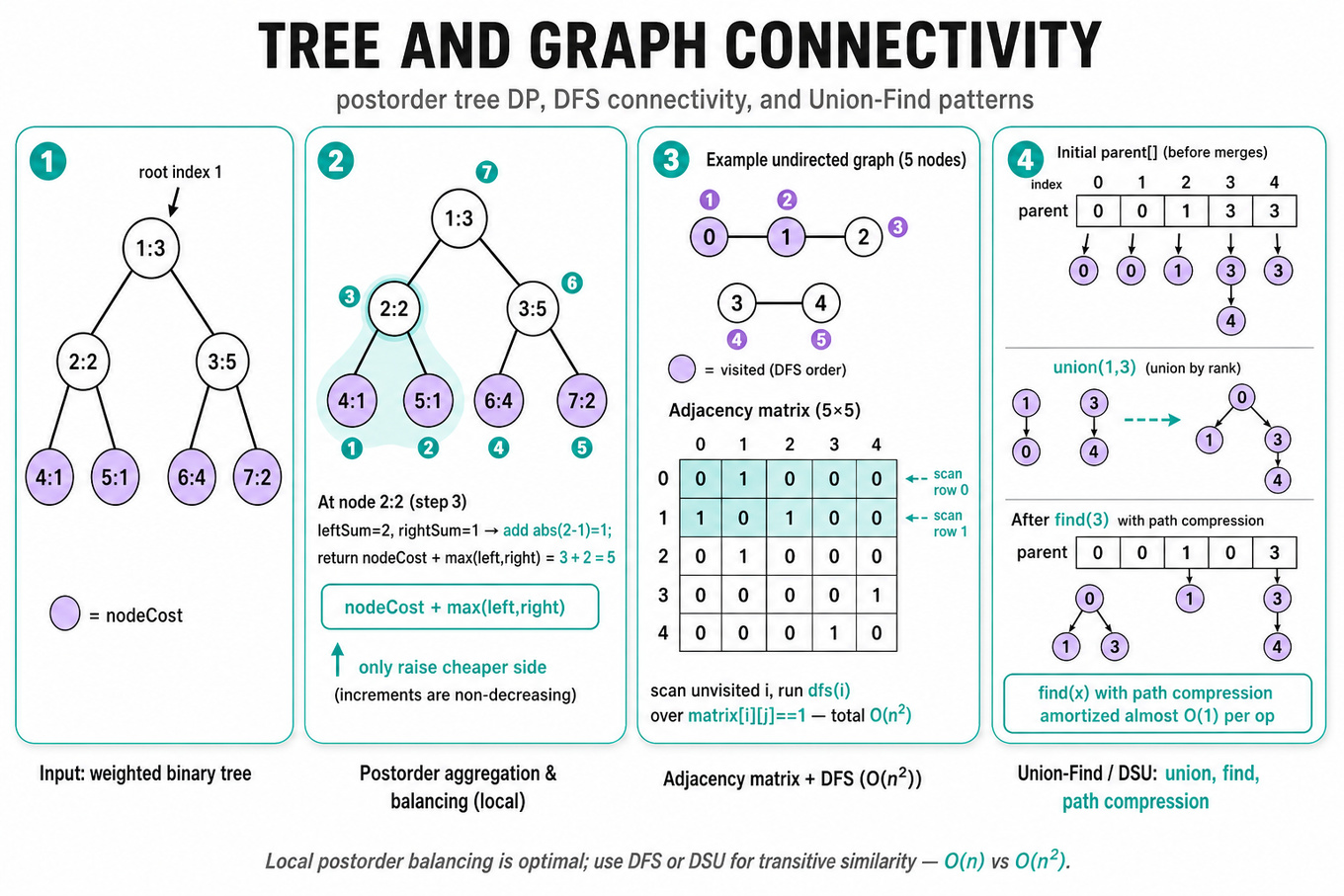
What's being tested
Tests tree dynamic programming for aggregating root-to-leaf costs and graph connectivity for grouping items under transitive similarity. Interviewers are checking whether you can map a story problem to DFS, postorder aggregation, or Union-Find, then reason cleanly about correctness and O(n) or O(n^2) bounds.
Patterns & templates
-
Postorder tree DP — compute child path sums first; return
nodeCost + max(left, right)while accumulating balancing work. -
Path equalization — when two child subtrees differ, minimum added cost is
abs(leftSum - rightSum); never decrement, only raise the cheaper side. -
DFS over adjacency matrix — scan each unvisited node, run
dfs(i)over alljwherematrix[i][j] == 1; totalO(n^2). -
Union-Find / DSU —
find,union, path compression, union by rank; ideal for pairwise similarity components and repeated merges. -
Connected components — count roots after unions or count
DFSlaunches; similarity is treated as transitive even if not directly connected. -
Indexing discipline — tree arrays may be 1-indexed or 0-indexed; binary children are often
2*i+1,2*i+2or2*i,2*i+1. -
Complexity statement — tree balancing is
O(n)time,O(h)recursion space; adjacency matrix connectivity isO(n^2)time,O(n)space.
Common pitfalls
Pitfall: Equalizing every root-to-leaf path globally first is overcomplicated; local subtree balancing in postorder gives the minimum increments.
Pitfall: Treating photo similarity as only direct pairs misses transitive groups; use connected components, not pair counting.
Pitfall: Forgetting recursion depth limits on skewed trees; mention iterative
DFSor stack-size concerns whenncan be large.
Practice these
The practice cards below cover the canonical variants — solve all of them and time yourself.
Practice questions
Software Engineering Fundamentals
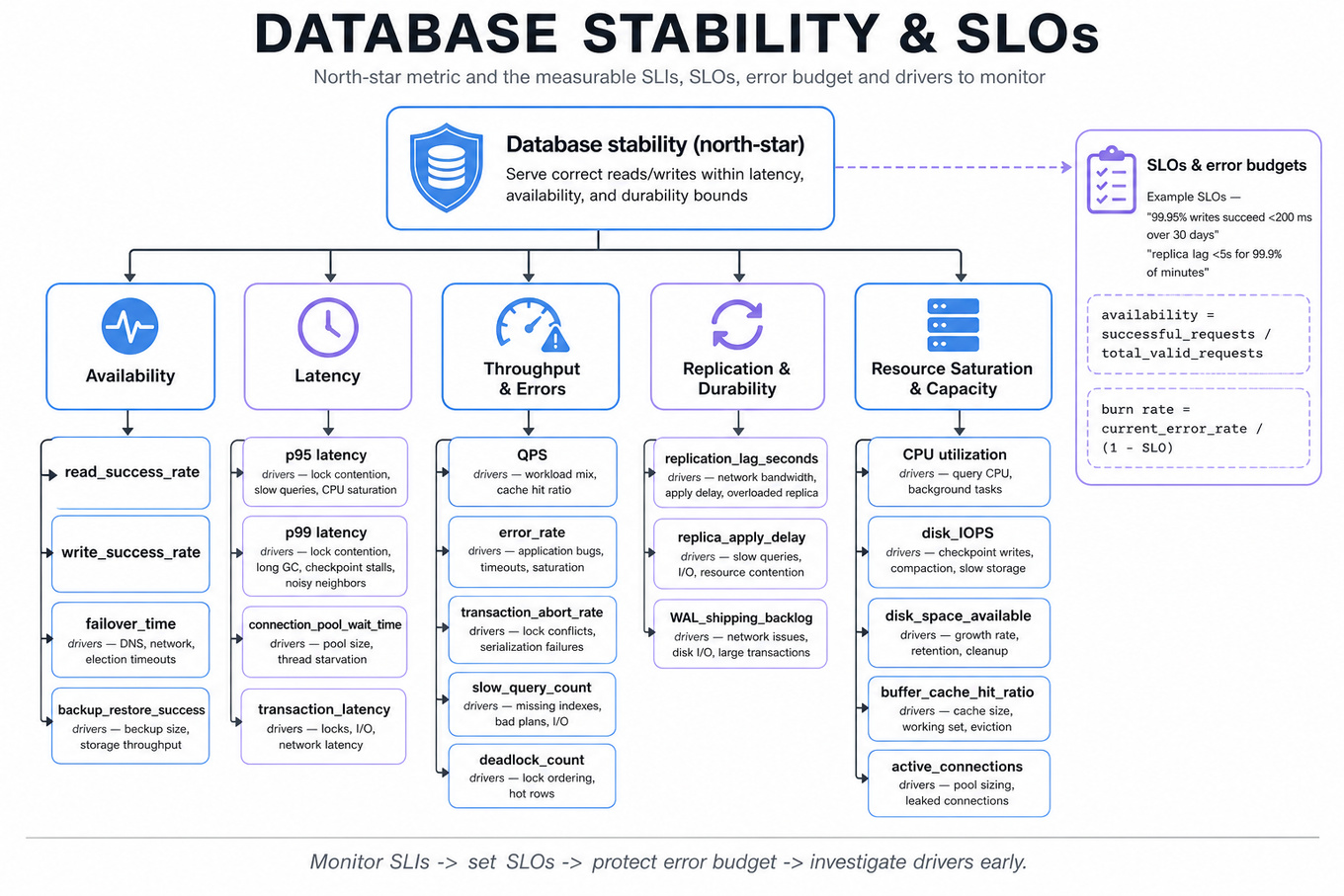
What's being tested
A strong Software Engineer should be able to reason about database stability as an operational property, not just “is the database up.” Interviewers are probing whether you can define meaningful SLIs, set realistic SLOs, detect degradation early, and connect symptoms like latency spikes, replication lag, lock contention, or disk saturation to concrete engineering actions. Bytedance cares because high-traffic systems depend on databases staying reliable under bursty load, regional failures, schema changes, and deploys. The expected answer is not DBA trivia; it is how a backend/system engineer designs, observes, and operates database-dependent services safely.
Core knowledge
-
Stability means the database continues serving correct reads/writes within expected latency, durability, and availability bounds under normal and stressed conditions. Assess it across
availability,latency,throughput,error rate,replication lag,resource saturation, anddata safety. -
SLIs should be user-visible or service-visible, not only host-level. Good examples:
read_success_rate,write_success_rate,p95/p99query latency, transaction abort rate, connection pool wait time, deadlock count, replication lag seconds, backup restore success, and failover time. -
SLOs turn SLIs into commitments over a window. For example: “99.95% of writes succeed within 200 ms over 30 days” or “replica lag remains below 5 seconds for 99.9% of minutes.” Availability is often computed as
-
Error budgets make reliability tradeoffs explicit. If the SLO is 99.9%, the monthly error budget is 0.1% of valid requests or time. A burn rate can be approximated as Fast burn alerts catch acute incidents; slow burn alerts catch chronic degradation.
-
Latency percentiles matter more than averages. Averages hide tail pain:
p99may spike because of lock waits, cache misses, checkpoint stalls, garbage collection, or noisy neighbors while mean latency looks fine. For user-facing services,p95andp99usually drive perceived reliability. -
Capacity signals should cover both database internals and client pressure. Watch CPU, memory, disk IOPS, disk space, buffer cache hit ratio, active connections, connection pool saturation, queue depth, QPS, slow queries, row scans, index usage, lock waits, and transaction duration.
-
Scaling decisions depend on workload shape. Read-heavy systems may use read replicas, caching via
Redis, or materialized views; write-heavy systems may need batching, partitioning, sharding, denormalization, or reducing transaction scope. Replicas do not solve primary write bottlenecks. -
Replication improves availability and read scalability but introduces lag and consistency tradeoffs. With asynchronous replication, a failover can lose recent writes; with synchronous replication, write latency and availability may suffer. Track
replication_lag_seconds, replica freshness, and promotion safety. -
Backups are only useful if restores are tested. Stability assessment should include recovery point objective, RPO, and recovery time objective, RTO. For example, “RPO < 5 minutes, RTO < 30 minutes” implies continuous WAL/binlog archiving and regular restore drills.
-
Incident response should connect alerts to runbooks. A useful alert says what user impact is happening, likely causes, and first checks: recent deploys, traffic spikes, slow query logs, lock graphs, connection pools, disk saturation, replication lag, and failover status.
-
Schema and query changes are common instability sources. Dangerous changes include full-table scans, missing indexes, long migrations, blocking DDL, unbounded pagination, N+1 queries, and new high-cardinality indexes. Prefer online migrations, backfills in batches, feature flags, and query plans checked with
EXPLAIN. -
Graceful degradation protects the database during overload. Techniques include request throttling, circuit breakers, load shedding, bounded retries with exponential backoff and jitter, cache fallback, read-only mode, and idempotency keys for retried writes.
Worked example
For “How do you assess database system stability?”, a strong candidate first clarifies scope: “Are we assessing a single Postgres/MySQL instance, a replicated cluster, or a sharded service backing a user-facing product?” They should also ask whether the goal is ongoing monitoring, pre-launch readiness, or post-incident diagnosis, because each emphasizes different signals.
A clean answer can be organized around four pillars: service-level behavior, database health, data safety, and operational readiness. For service-level behavior, define SLIs such as read/write success rate, p95/p99 latency, timeout rate, and connection pool wait time, then compare them to SLOs over a rolling window. For database health, inspect CPU, memory, disk I/O, lock waits, transaction duration, slow queries, index hit rate, deadlocks, and saturation trends rather than only current utilization.
For data safety, mention replication health, backup freshness, restore testing, RPO/RTO, and whether failover has been exercised. For operational readiness, cover alert quality, runbooks, dashboards, on-call escalation, load testing, capacity forecasts, and safe deployment practices for schema/query changes.
One explicit tradeoff to flag: pushing for very tight p99 latency SLOs may require overprovisioning, aggressive caching, or simpler consistency guarantees, while looser SLOs may be acceptable for internal or asynchronous workloads. A strong close would be: “If I had more time, I’d compare recent SLO burn against deploy history and traffic growth, then run a restore/failover drill to validate that our reliability assumptions are real.”
A second angle
If the interviewer reframes the topic as “how would you improve an unstable database-backed service,” the answer should shift from assessment to prioritization. Start with the highest user-impacting SLI breach: for example, write timeouts or p99 latency, not generic CPU usage. Then isolate whether the bottleneck is client-side connection pooling, bad queries, lock contention, disk I/O, replication lag, or insufficient capacity. The same SLO framework still applies, but now it guides mitigation order: stop the bleeding with throttling or rollback, then fix root causes with indexing, query changes, partitioning, caching, or capacity changes. The best answers separate short-term mitigation from durable prevention.
Common pitfalls
Pitfall: Saying “I would monitor CPU, memory, and disk” and stopping there.
That answer is too infrastructure-centric. Better: start from user-visible SLIs like success rate and tail latency, then use host and database metrics to explain why those SLIs are degrading.
Pitfall: Treating backups, replication, and availability as the same thing.
Replication helps with failover and read scaling, but it can replicate corrupt writes or lag behind the primary. Backups protect against deletion, corruption, and disaster recovery, but only if restore procedures are tested against RPO/RTO targets.
Pitfall: Giving a list of tools without an operating model.
Mentioning Prometheus, Grafana, Datadog, or CloudWatch is not enough. Interviewers want to hear what you alert on, which thresholds are tied to SLOs, how you avoid noisy alerts, and what action an engineer takes when the alert fires.
Connections
This topic often pivots into distributed systems reliability, capacity planning, database indexing/query optimization, caching strategy, incident management, and consistency tradeoffs. Be ready to discuss how retries can amplify load, how read replicas affect consistency, and how schema migrations can destabilize production systems.
Further reading
-
Google SRE Book — Service Level Objectives — canonical treatment of SLIs, SLOs, error budgets, and alerting philosophy.
-
Google SRE Workbook — Alerting on SLOs — practical multi-window burn-rate alerting patterns.
-
Designing Data-Intensive Applications by Martin Kleppmann — deep coverage of replication, consistency, partitioning, transactions, and failure modes.
Practice questions
System Design

What's being tested
This tests whether you can design a read-heavy distributed service with low latency, high availability, and clean failure handling. The interviewer is probing for practical decisions around API design, key generation, collision avoidance, storage modeling, caching, TTL semantics, and how the system behaves under traffic spikes or partial failures. ByteDance cares because link resolution resembles many high-QPS backend paths: a tiny request, a strict `p99` latency target, global traffic, abuse risk, and correctness requirements that are simple to state but subtle at scale. A strong SWE answer should move from requirements to capacity estimates to architecture, then defend tradeoffs rather than listing components.
Core knowledge
-
Functional requirements should be explicit: create short URL, redirect short URL, optionally support custom aliases, expiration, deletion, and analytics counters. The core path is
`POST /urls`for creation and`GET /{code}`returning`301`or`302`redirect. -
Non-functional requirements usually dominate: reads may exceed writes by or more, redirects need low
`p99`latency, created links must be durable, and duplicate short codes must not map to different long URLs. Availability is often prioritized over rich analytics on the redirect path. -
Capacity estimation guides design choices. For 100M new URLs/day over 5 years, total records are roughly . With Base62 encoding, code space is ; 7 chars gives about combinations, while 8 chars gives about .
-
Key generation is the central design decision. Common options are auto-increment IDs encoded as Base62, Snowflake-style IDs, random codes with collision retries, or pre-generated key pools. Auto-increment is simple but centralizes allocation; random is easy to distribute but needs collision handling.
-
Base62 uses
`0-9`,`a-z`,`A-Z`to create compact URL-safe strings. If using numeric IDs, encode the integer into Base62. If using random codes, compute collision probability with the birthday effect; as utilization rises, retry rate increases, so keep code space much larger than expected records. -
Collision handling must be deterministic and safe. For random code generation, enforce a unique index on
`short_code`in`MySQL`,`Postgres`,`DynamoDB`, or`Cassandra`-like storage, then retry on conflict. Do not rely only on an in-memory “already used” check across distributed workers. -
Storage schema can start with
`short_code`,`long_url`,`created_at`,`expires_at`,`owner_id`, and`status`. The read path is a point lookup by`short_code`, so the primary key should be`short_code`. Secondary access by user or creation time belongs off the redirect hot path. -
Caching is critical because redirects are read-heavy. Use
`Redis`,`Memcached`, or CDN/edge caching for`short_code -> long_url`. Cache positive results with TTL and consider negative caching for missing or expired codes to protect the database from repeated invalid requests. -
Redirect semantics matter.
`301`is permanent and may be cached aggressively by browsers and intermediaries;`302`or`307`is safer if links can expire, be edited, disabled, or measured. For most interview designs, choose`302`unless immutability is a stated requirement. -
Expiration and deletion require clear semantics. If
`expires_at < now`, return`404`or`410 Gone`; keep the record for audit/abuse handling or asynchronously purge it. If caching is used, cache TTL must not exceed remaining link lifetime:`cache_ttl = min(default_ttl, expires_at - now)`. -
High availability is achieved by stateless API servers behind a load balancer, replicated storage, and multi-AZ deployment. On read, if cache misses and the primary datastore is unavailable, decide whether to fail closed with
`503`or use a stale cache value depending on correctness expectations. -
Hot keys and abuse are realistic edge cases. A celebrity or campaign link can create a hot key; cache replication, CDN edge caching, and request coalescing help. Also validate long URLs, apply rate limits, block malware/phishing domains, and avoid open redirect surprises in internal services.
Worked example
For Design a TinyURL-like short link service, start by clarifying: expected read/write QPS, whether custom aliases are required, whether links expire, whether URLs are mutable, and whether global availability is expected. Then declare assumptions such as “reads are 100x writes, generated links are immutable, expiration is optional, and redirect `p99` should be under 50 ms excluding external network time.” Organize the answer around four pillars: API contract, key generation, storage/cache design, and reliability/edge cases. For APIs, propose `POST /v1/shorten` with `long_url`, optional `expires_at`, and optional `custom_alias`, and `GET /{code}` for redirect. For ID generation, choose either Snowflake-style numeric IDs encoded with Base62 or random 8-character Base62 codes with a unique constraint and retry loop; explain why the chosen approach fits the scale. For storage, use a durable key-value or wide-column store keyed by `short_code`, with `Redis` in front for the hot redirect path. For TTL, check `expires_at` on both cache population and database reads, and cap cache TTL to the remaining lifetime. One tradeoff to flag explicitly is sequential Base62 IDs versus random codes: sequential IDs are collision-free but predictable, while random codes are less guessable but require collision retries. Close by saying that with more time you would cover multi-region routing, abuse detection, rate limiting, observability, and operational playbooks for cache or datastore outages.
A second angle
If the interviewer changes the framing to emphasize custom aliases, the design shifts from pure generation to conflict management and authorization. A custom alias like `/tiktok-sale` must be checked with an atomic conditional write, not with a separate read-then-write race. If the framing emphasizes expiration, then TTL correctness becomes central: cache entries must expire no later than the link, and expired links should consistently return `404` or `410`. If the framing emphasizes global scale, the hardest part becomes ID allocation and replication: Snowflake-style IDs avoid coordination, while a single auto-increment database becomes a bottleneck and a single-region availability risk. The same core design applies, but the “best” choice depends on whether the constraint is uniqueness, latency, customizability, or multi-region resilience.
Common pitfalls
Pitfall: Designing only the happy path.
A common weak answer is “store long URL in database, generate hash, redirect,” with no discussion of collisions, expiration, cache invalidation, or datastore failure. A stronger answer names the exact invariant: one `short_code` must never resolve to two different destinations, and every write path must preserve that invariant under concurrency.
Pitfall: Using a hash of the long URL without explaining consequences.
Hashing the long URL can make duplicate long URLs map to the same code, but collisions still exist and identical URLs from different users may need different expiration, ownership, or analytics. If you propose hashing, add a collision suffix or unique constraint strategy, and clarify whether deduplication is desired.
Pitfall: Over-indexing on exotic infrastructure before requirements.
Jumping immediately to `Kafka`, global consensus, or complex sharding can sound unfocused for a simple redirect service. Start with the read/write ratio, data volume, and latency target; then introduce cache, replication, sharding, or multi-region only when the numbers or availability goal justify them.
Connections
Interviewers may pivot from this design to distributed ID generation, cache consistency, rate limiting, or database sharding. They may also ask about adjacent read-heavy systems such as pastebins, object metadata stores, feature flag services, or CDN-backed redirect services. Be ready to explain the same tradeoffs in terms of correctness invariants, latency, and operational failure modes.
Further reading
-
Designing Data-Intensive Applications — excellent grounding for replication, partitioning, consistency, and storage tradeoffs.
-
Dynamo: Amazon’s Highly Available Key-value Store — useful for understanding highly available key-value storage under failure.
-
Twitter Snowflake — classic reference for distributed, time-sortable unique ID generation.
Practice questions
ML System Design
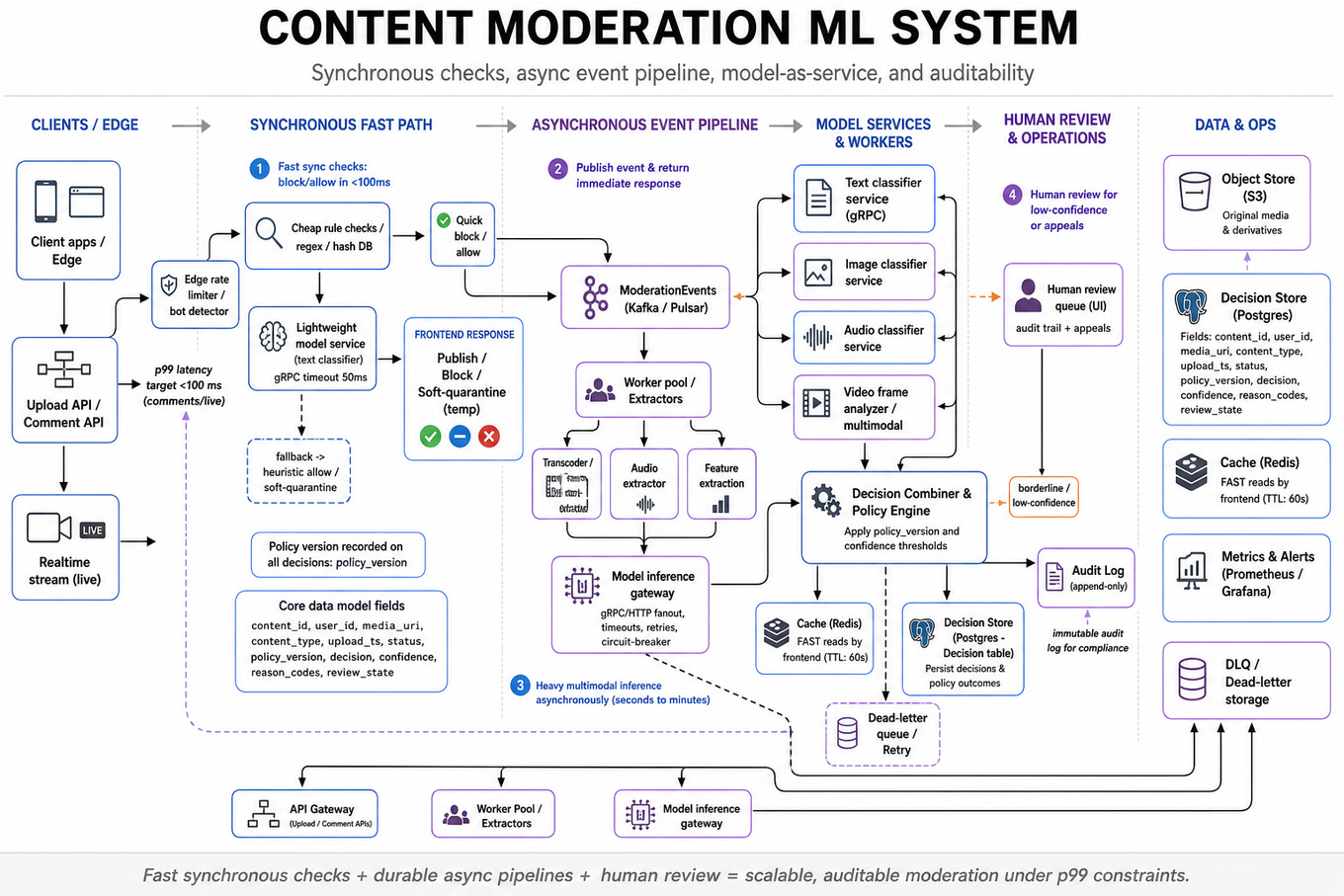
What's being tested
Interviewers are probing whether you can design a large-scale safety-critical backend system that uses ML inference without turning the answer into a model-research discussion. For a Software Engineer, the focus is on distributed system architecture, latency/throughput tradeoffs, failure handling, human-review workflows, and operational correctness under massive content volume. Bytedance cares because short-video, comment, livestream, and image systems require moderation decisions at global scale, often before content reaches users. A strong answer shows you can combine synchronous checks, asynchronous pipelines, durable queues, policy enforcement, and auditability while respecting strict `p99` latency and availability constraints.
Core knowledge
-
Clarify the moderation surface first: uploads, comments, profile photos, DMs, livestream frames, audio, and re-shares have different latency budgets. A video upload may tolerate seconds of processing, while a comment or livestream frame may need sub-100ms to low-second decisions.
-
Separate decision paths by risk and latency. Use synchronous moderation for cheap, high-confidence checks before publishing, and asynchronous moderation for expensive multimodal analysis after temporary quarantine or limited distribution. A common pattern is: block obvious violations, allow obvious safe content, queue borderline cases.
-
Model inference should be treated as a service dependency, not the center of the SWE design. The platform calls specialized classifiers for text, image, audio, and video through
`gRPC`or HTTP, with timeouts, retries, circuit breakers, and fallback policies. Discuss model outputs as labels plus confidence, not architecture internals. -
Use an event-driven pipeline for expensive or long-running work. Content metadata is written to a durable store, an event is published to
`Kafka`or`Pulsar`, workers perform extraction/inference, and moderation results are stored in a decision table. This prevents upload APIs from blocking on video transcoding or frame analysis. -
Define the core data model explicitly:
`content_id`,`user_id`,`media_uri`,`content_type`,`upload_ts`,`status`,`policy_version`,`decision`,`confidence`,`reason_codes`, and`review_state`. Keep policy versioning because appeals, audits, and retroactive policy changes require knowing which rule set produced a decision. -
Design state transitions carefully. A typical lifecycle is
`UPLOADED`→`PENDING_REVIEW`→`APPROVED`|`REJECTED`|`LIMITED_DISTRIBUTION`|`HUMAN_REVIEW`→`APPEALED`→`FINAL`. State transitions should be idempotent, monotonic where possible, and protected against stale workers overwriting newer decisions. -
Capacity planning should be explicit. If daily uploads are and peak factor is , estimate Then multiply by fanout: one video may produce 30 sampled frames, an audio transcript, OCR text, and metadata checks. Queue sizing can use Little’s Law: where
`L`is queue depth,`λ`arrival rate, and`W`average processing time. -
Prioritize cheap filters before expensive inference. Run hash matching, URL/domain blocklists, language detection, metadata rules, and duplicate detection before video-frame inference. Perceptual hashing such as
`pHash`or locality-sensitive hashing can catch known-bad images/videos faster than full model inference. -
Human review is part of the system design. Borderline or high-impact cases should enter a reviewer queue with priority based on severity, virality, user trust, region, and SLA. The platform needs assignment, locking, escalation, reviewer decisions, audit logs, and a way to prevent duplicate reviewers from racing.
-
Failure policy must be explicit: fail-open, fail-closed, or degrade. For low-risk content, you might publish with limited reach if inference times out. For high-risk categories like child safety, terrorism, or livestream abuse signals, you may fail-closed or quarantine. The right answer depends on harm severity and product latency.
-
Observability needs decision-level and system-level signals. Track
`p50`/`p95`/`p99`moderation latency, queue lag, timeout rate, decision distribution, false-positive appeal rate, reviewer backlog, model-service error rate, and content takedown delay. For SWE, emphasize dashboards, logs, traces, alert thresholds, and runbooks. -
Abuse resistance matters. Attackers may slightly crop videos, overlay text, use coded language, or upload bursts to overwhelm review queues. System-level mitigations include rate limits with
`Redis`, per-user trust scores, deduplication, backpressure, regional throttling, and priority queues for viral or risky content.
Worked example
For Design a content moderation platform, a strong candidate would start by clarifying content types, scale, latency target, and enforcement semantics: “Are we moderating videos only, or also comments and livestreams? Do we need pre-publish blocking, post-publish takedown, or both? What are the expected upload QPS and `p99` decision SLA?” Then they would declare assumptions, such as 10M uploads/day, 5x peak traffic, videos stored in object storage, and a requirement to block high-confidence violations before broad distribution.
The answer skeleton should have four pillars: ingestion and content storage, moderation orchestration, decision storage/enforcement, and human review/observability. The upload API writes metadata to a database such as `MySQL` or `Postgres`, stores media in object storage like `S3`-style blob storage, and emits a moderation event to `Kafka`. A moderation orchestrator fans out to text, image, audio, and video workers, collects results, applies policy rules, and writes a final decision to a moderation table. Enforcement services check that table before ranking, search indexing, notifications, sharing, or livestream continuation.
A specific tradeoff to flag is synchronous versus asynchronous moderation: synchronous checks reduce exposure to harmful content but increase upload latency and dependency risk; asynchronous processing improves UX but may allow brief harmful exposure unless content is quarantined or distribution-limited. A strong close would mention: “If I had more time, I’d go deeper on reviewer queue prioritization, policy versioning, multi-region failover, and abuse patterns like adversarial reuploads.”
A second angle
A common variant is real-time moderation for livestreams or comments, where the same architecture must be optimized for much tighter latency. Instead of waiting for full video processing, the system samples frames every few seconds, transcribes audio chunks, and makes rolling decisions that can warn, throttle, or terminate the stream. The main design shift is from batch-like upload moderation to stream processing with bounded delay, using tools like `Flink` or consumer groups over `Kafka`. The failure policy also changes: if livestream risk signals are severe, the system may interrupt immediately and send the case to human review afterward. The core principles remain the same: durable events, fast-path checks, policy-based decisions, human escalation, and strong observability.
Common pitfalls
Pitfall: Designing only the ML classifier and ignoring the platform.
A tempting but weak answer is: “Use a multimodal model to classify content as safe or unsafe.” That misses what the SWE interviewer wants: APIs, queues, storage, state transitions, latency, retries, enforcement, and operational failure modes. Treat the model as one component inside a larger moderation control plane.
Pitfall: Assuming every item can wait for human review.
Human review does not scale linearly with Bytedance-level traffic, and reviewer delay can create either harmful exposure or terrible creator experience. A better answer uses confidence thresholds, automated decisions for obvious cases, prioritized queues for borderline/high-risk cases, and appeal workflows for false positives.
Pitfall: Not defining enforcement semantics.
Many candidates say “store the moderation result” but never explain how feed ranking, search, notifications, sharing, or comments actually consume it. A stronger answer makes moderation status a hard dependency for distribution systems, with caching, invalidation, and clear behavior when the moderation service is unavailable.
Connections
Interviewers may pivot from this topic into news feed system design, video upload/transcoding pipelines, real-time stream processing, rate limiting, or distributed workflow orchestration. They may also ask about A/B-safe rollout, but for a SWE answer, keep the focus on service reliability, policy enforcement, and operational safeguards rather than experimental methodology.
Further reading
-
Designing Data-Intensive Applications — strong foundation for logs, streams, storage, replication, and distributed system tradeoffs.
-
Google SRE Book — practical treatment of SLIs, SLOs, error budgets, alerting, and operational reliability.
-
Kafka: The Definitive Guide — useful background for event-driven moderation pipelines and durable asynchronous processing.
Practice questions
Behavioral & Leadership
What's being tested
Interviewers are probing whether you can drive technical leadership without relying on formal authority: clarify an ambiguous problem, choose a pragmatic design, align engineers, execute under constraints, and measure impact. For a Software Engineer at ByteDance, this matters because many systems operate at high traffic, tight latency budgets, and fast iteration cycles where poor trade-offs can create cascading reliability, cost, or user-experience issues. Strong answers show ownership, engineering judgment, and measurable outcomes, not just “I worked hard” or “we shipped a feature.” The interviewer is listening for how you reasoned through alternatives, what you personally contributed technically, how you handled disagreement, and what changed because of your work.
Core knowledge
-
STAR framing is useful, but for engineering leadership use a stronger variant: Situation → Technical problem → Alternatives → Decision → Execution → Impact → Reflection. The “alternatives” and “decision” parts are where seniority shows; do not skip them.
-
Impact metrics should connect engineering work to observable outcomes:
p95/p99latency, error rate, crash-free sessions, CPU utilization, cloud cost, build time, deployment frequency, incident count, or user-facing metrics like page load time. Prefer “reducedp99from 1.8s to 650ms” over “made it faster.” -
Trade-off analysis should name at least two viable options and compare them on latency, complexity, correctness, reliability, cost, and delivery time. For example,
Rediscaching may reduce read latency from 100ms to 5ms, but introduces invalidation, memory cost, and consistency risk. -
Technical leadership includes decomposing work into interfaces, milestones, and risk areas. A strong SWE answer might mention defining an API contract, writing an RFC, isolating a migration behind a feature flag, creating rollout dashboards, and mentoring teammates through implementation.
-
System reliability trade-offs often use SLOs and error budgets. If an API has a 99.9% availability SLO, monthly downtime budget is roughly minutes. This helps justify slowing feature work to fix reliability.
-
Performance leadership requires knowing where time goes. Use profiling and tracing, not guesses:
pprof,perf,OpenTelemetry,Jaeger, browserPerformancetraces, query plans, or flame graphs. A credible story distinguishes CPU-bound, I/O-bound, lock-contention, and network-latency bottlenecks. -
Scalability decisions should be proportional to expected load. A single
Postgrestable with proper indexes can handle millions of rows and thousands of QPS for many workloads; jumping immediately to sharding, event sourcing, or microservices may be over-engineering unless growth or isolation demands it. -
Migration strategy is a common leadership signal. Safer patterns include shadow reads, dual writes, backfills, canary releases, and feature flags. For high-risk changes, describe rollback criteria: “if
5xxexceeded 0.5% for 10 minutes, we reverted.” -
Over-engineering usually appears as unnecessary abstraction, premature generalization, too many services, custom frameworks, or complex consistency models. A good engineer can say, “We chose a boring monolith module and
Postgresindex because the expected scale was 10K daily writes, not 10M.” -
User-experience wins for a SWE should be grounded in implementation levers: reducing interaction latency, preventing layout shift, improving offline behavior, simplifying error states, or making retries idempotent. Avoid drifting into product strategy; explain the engineering change and measurable UX effect.
-
Decision quality is not the same as outcome quality. A good answer can include a decision that had partial failure if you explain your assumptions, signals you monitored, how you corrected course, and what engineering principle you learned.
-
Scope control is a leadership skill. Strong candidates explicitly say what they cut: “We deferred multi-region active-active because the incident history showed read latency was the bottleneck, not regional availability, and the added conflict-resolution complexity was not justified.”
Worked example
For “Describe your most challenging project and leadership,” a strong candidate first frames the answer in the first 30 seconds: “I’ll use a project where I led the redesign of a high-QPS notification service; the challenge was reducing p99 latency and incident rate without stopping feature delivery.” They should briefly clarify the scale, constraints, and their role: QPS, team size, deadline, ownership boundary, and whether they were tech lead, module owner, or primary implementer. The answer can then follow four pillars: problem diagnosis, design options, execution leadership, and measurable impact.
For diagnosis, they might say they used distributed tracing and found that fan-out calls to three downstream services dominated tail latency. For design options, they compare synchronous fan-out, async queue processing with Kafka, and selective caching in Redis, explaining why they chose one or combined them. One explicit trade-off could be: “We moved non-critical enrichment to async processing, which improved user-visible latency but introduced eventual consistency for secondary metadata; we documented that the UI could show stale metadata for up to 30 seconds.” For execution, they should mention how they led: wrote the design doc, split work into milestones, reviewed tricky concurrency code, set rollout gates, and coordinated with dependent service owners. Impact should be numeric: “p99 dropped from 2.4s to 780ms, timeout rate fell from 3.2% to 0.4%, and on-call pages decreased by 60% over the next month.” Close with reflection: “If I had more time, I’d add load-shedding earlier and invest in automated capacity tests before peak events.”
A second angle
For “Describe Over-Engineering and UX Wins,” the same leadership concept applies, but the interviewer is testing judgment more than scale. A strong answer might describe replacing a proposed microservice-based personalization layer with a simpler server-side configuration table and cached API response. The trade-off is not “simple is always better”; it is that the expected traffic, team size, and change frequency did not justify distributed ownership, deployment pipelines, and cross-service failure modes. The UX win should still be measurable, such as reducing first interaction latency, decreasing form abandonment, or cutting client-side errors. The key is to show that you can protect users and the team from unnecessary complexity while still leaving an upgrade path if scale increases.
Common pitfalls
Pitfall: Giving a project tour instead of a leadership story.
A tempting answer is to describe the architecture in detail: “We used Kafka, Redis, MySQL, and Kubernetes,” without explaining what decision you made or how you influenced the outcome. A better answer names the conflict or ambiguity, explains your specific technical contribution, and shows how others changed direction because of your reasoning.
Pitfall: Claiming impact without measurement.
Saying “performance improved a lot” or “users liked it” sounds weak because it gives the interviewer no way to calibrate scope. Use before/after metrics, even if approximate: latency percentiles, error rates, deployment time, incident count, cost per request, crash-free sessions, or support-ticket volume.
Pitfall: Treating trade-offs as obvious.
Many candidates say, “We chose caching because it was faster,” which misses the real engineering question. Stronger answers discuss invalidation, stale reads, cache stampede protection, memory limits, observability, and fallback behavior when Redis is unavailable.
Connections
Interviewers may pivot from this topic into system design, incident debugging, performance optimization, or code quality and maintainability. Be ready to go one layer deeper on the architecture you mention: data model, concurrency risks, rollout strategy, observability, and failure handling.
Further reading
-
Staff Engineer by Will Larson — practical examples of technical leadership, scope, influence, and operating beyond assigned tickets.
-
Accelerate by Nicole Forsgren, Jez Humble, and Gene Kim — evidence-backed software delivery metrics such as deployment frequency, lead time, change failure rate, and MTTR.
-
Google SRE Book — strong grounding in SLOs, error budgets, incident response, and reliability trade-offs.
Practice questions
Onsite
Coding & Algorithms
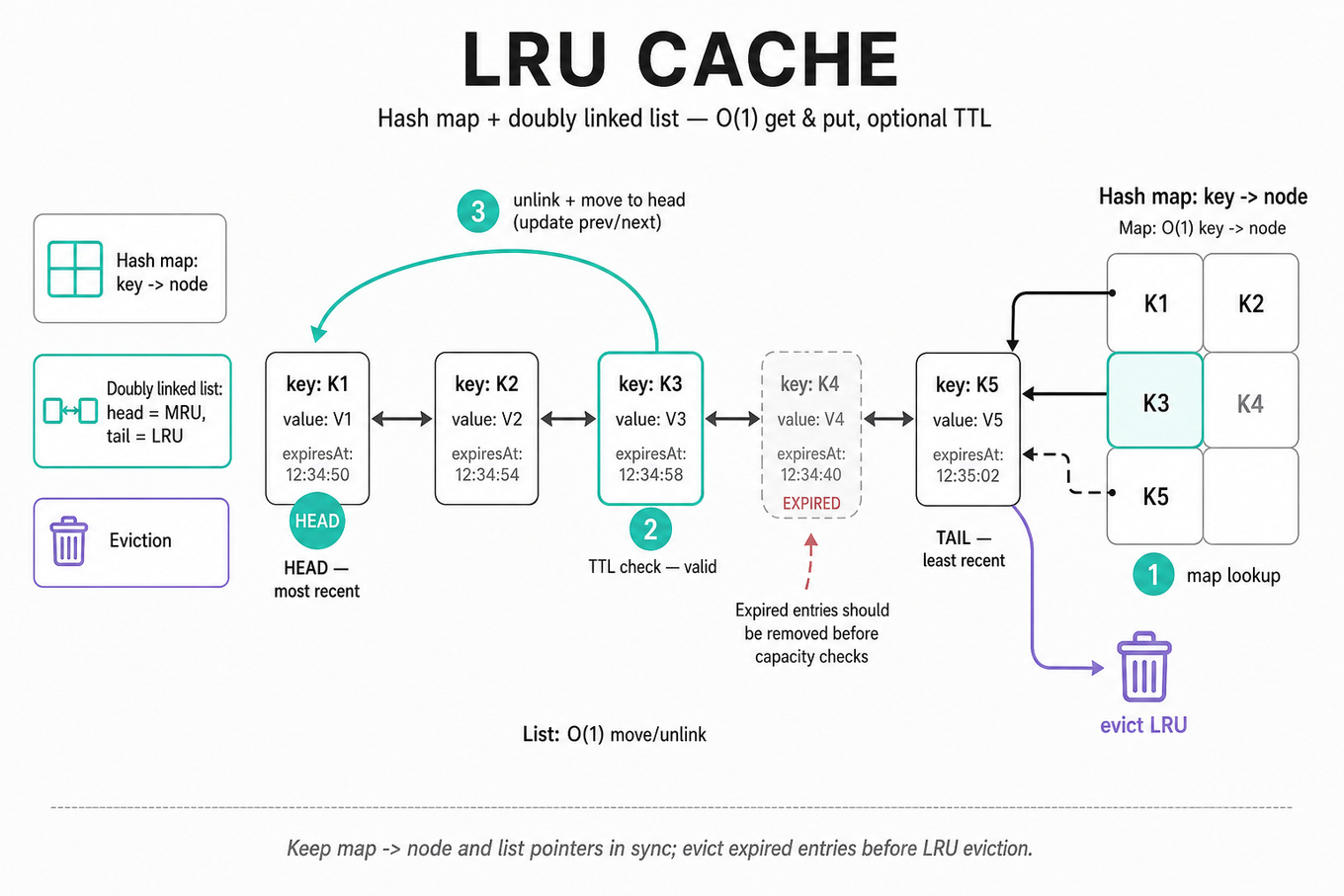
What's being tested
LRU cache problems test whether you can combine a hash map with a doubly linked list to support get and put in O(1) time. TTL variants add expiration semantics, requiring careful cleanup without breaking LRU ordering, capacity eviction, or edge-case correctness.
Patterns & templates
-
Hash map + doubly linked list — map
key -> node; list stores recency withheadas most recent andtailas least recent. -
get(key)template — check existence, validate TTL, delete expired nodes, move live node to front, return value inO(1). -
put(key, value)template — update existing live node or insert new node; evict expired entries first, then evict LRU if over capacity. -
TTL timestamping — store
expiresAt = now + ttl; avoid storing remaining TTL because access should not mutate expiration unless explicitly asked. -
Lazy expiration — remove expired entries only during
get/put; simple and usually acceptable, but stale nodes may occupy memory until touched. -
Eager expiration option — use a min-heap by
expiresAtfor cleanup; improves expired eviction but addsO(log n)heap maintenance. -
Concurrency control — for thread-safe variants, guard map and list mutation with a lock; reads are writes because they update recency.
Common pitfalls
Pitfall: Updating the hash map but forgetting to unlink the old linked-list node creates duplicate keys and corrupts eviction behavior.
Pitfall: Treating expired entries as valid during capacity checks can evict the wrong LRU item instead of first removing dead entries.
Pitfall: Assuming
getis read-only; in LRU it must move the node to most-recent position, so it mutates internal state.
Practice these
The practice cards below cover the canonical variants — solve all of them and time yourself.
Practice questions
![Four-frame horizontal infographic tracing a sliding-window over [A, B, C, A, B, A] with left/right pointers, highlighted window, frequency map counts, a deletion when a count reaches zero, and one-line captions.](https://ik.imagekit.io/9osfw19dn/cheatsheets/concepts/sliding-window-frequency-maps_D4F5tHOQ8.png?tr=w-1360,q-95)
What's being tested
These problems test sliding window reasoning over contiguous arrays/strings with a mutable frequency map that tracks whether the current window satisfies constraints. Interviewers are looking for clean O(n) two-pointer code, correct shrinking logic, and awareness of when a hash map, counter, or fixed-size array is the right state structure.
Patterns & templates
-
At-most-k distinct window — expand
right, incrementfreq[x], shrink whilelen(freq) > k; update answer after restoring validity. -
Bounded flips / replacements — track invalid count, e.g. zeros flipped; shrink while
zeros > k; answer ismax(ans, right-left+1). -
Frequency map cleanup — when
freq[x] == 0, deletex; stale keys makedistinctconstraints fail silently. -
Longest vs maximum sum window — for length, update after shrink; for sum/count objectives, maintain rolling aggregate alongside
freq. -
2D-to-1D reduction — for matrix variants, fix row/column boundaries, compress into arrays, then apply the same window logic.
-
LRU cache contrast — use hash map + doubly linked list for
get/putinO(1); do not confuse this with sliding-window frequency state.
Common pitfalls
Pitfall: Shrinking only once with
ifinstead of repeatedly withwhileleaves the window invalid when multiple removals are required.
Pitfall: Updating the answer before enforcing the constraint can record an impossible window with too many distinct types or flips.
Pitfall: Forgetting to delete zero-count entries causes
len(freq)to overcount distinct elements.
Practice these
The practice cards below cover the canonical variants — solve all of them and time yourself.
Practice questions
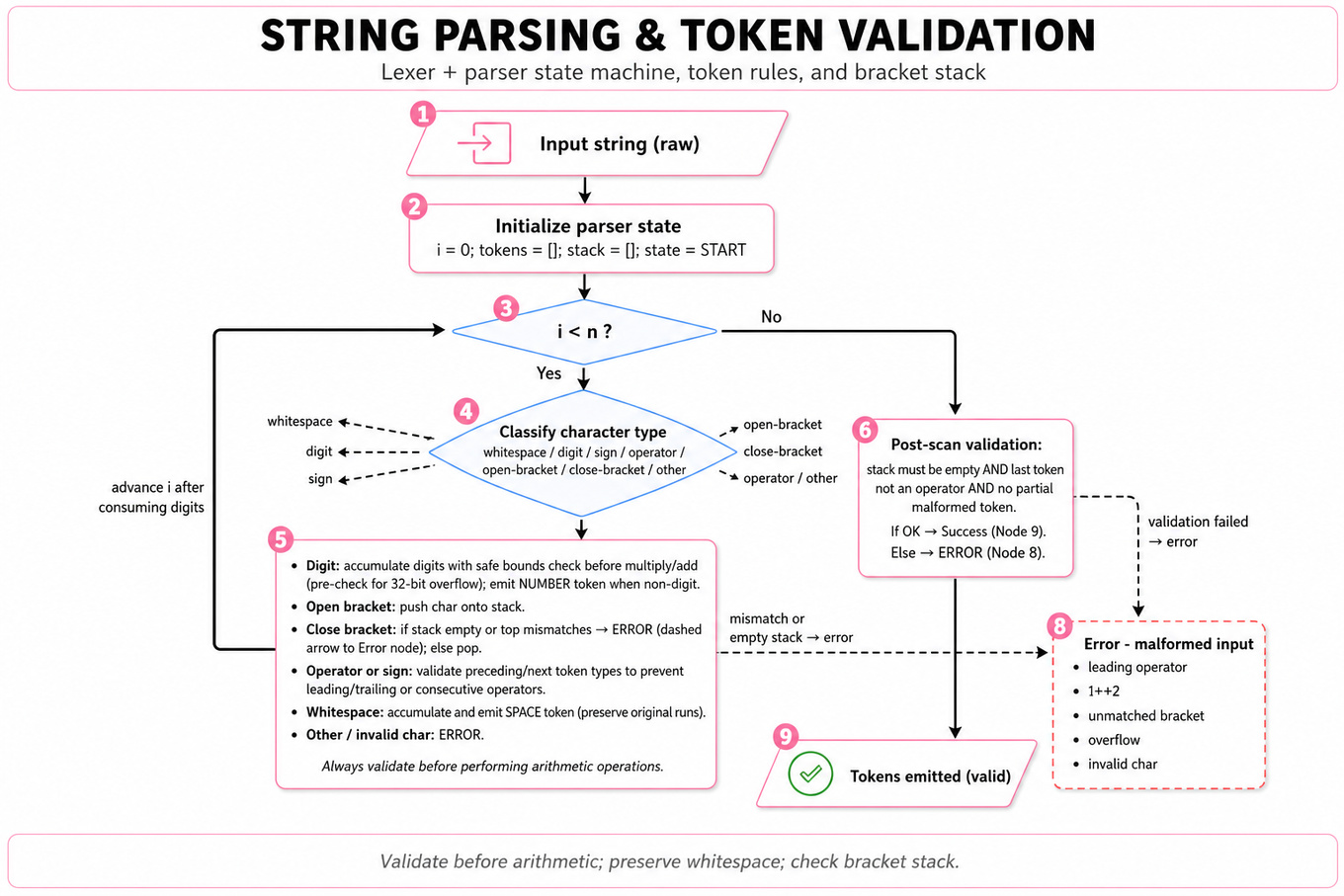
What's being tested
String parsing under strict format rules: splitting input into meaningful tokens while rejecting malformed cases early. Interviewers probe whether you can combine tokenization, validation, and simple data structures like stacks without losing edge cases around whitespace, signs, overflow, or delimiters.
Patterns & templates
-
Single-pass lexer — scan with index
i, emit tokens, validate state transitions;O(n)time,O(1)orO(n)space. -
Parser state machine — track expected token type: number, operator, bracket, word, or end; catches
1++2,+1, and trailing operators. -
Safe integer accumulation — build numbers digit by digit using bounds checks before
value = value * 10 + digit; enforce 32-bit range. -
Stack matching for brackets — push opening chars, pop on closing chars, compare via map;
O(n)time,O(n)worst-case space. -
Whitespace-preserving tokenization — separate word tokens from space runs; reverse only words or rebuild with original spacing rules.
-
Two-pointer in-place string/array edits — compact, reverse, or swap segments without extra copies; watch mutable vs immutable language constraints.
-
Backtracking subsets — sort first for duplicate handling, recurse with
startindex; skip duplicates usingif i > start && nums[i] == nums[i-1].
Common pitfalls
Pitfall: Treating parsing as
split()only; strict validators usually require character-level control over empty tokens, leading zeros, signs, and spaces.
Pitfall: Checking overflow after arithmetic; in fixed-width languages, validate before multiply/add to avoid undefined or wrapped results.
Pitfall: Normalizing whitespace accidentally when the requirement says preserve original spaces, tabs, or relative spacing positions.
Practice these
The practice cards below cover the canonical variants — solve all of them and time yourself.
Practice questions