C++ STL Performance And Interview Idioms
Asked of: Software Engineer
Last updated
What's being tested
Interviewers probe practical mastery of the C++ Standard Library: picking the right container/algorithm, understanding performance costs (time, memory, cache behavior), and exposing tradeoffs under real constraints. Optiver cares because low-latency, high-throughput systems require predictable resource use and micro-optimizations that change real P&L risk. Expect questions that validate you can measure, reason about, and communicate those tradeoffs clearly.
Core knowledge
-
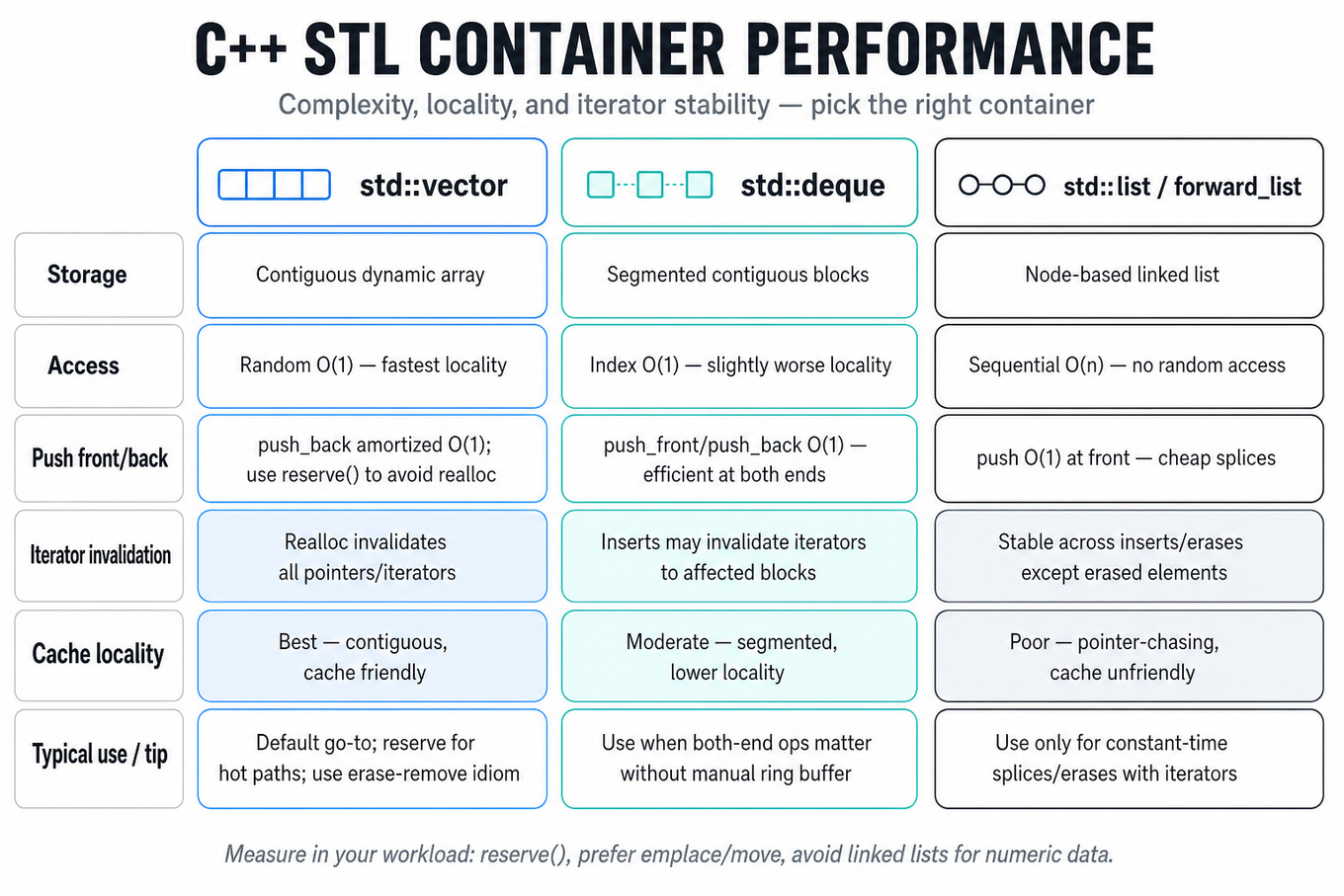
std::vector: amortizedO(1)push_back, contiguous storage, cheap random accessO(1), reallocation invalidates pointers/iterators; usereserve()to eliminate reallocations and control growth costs. -
std::deque: segmented contiguous blocks; constant-timepush_front/push_back, non-contiguous memory so pointers may be stable across some ops but not guaranteed; index access isO(1)with slightly worse locality thanvector. -
std::list/std::forward_list: node-based linked lists; constant-time splice/erase given iterator, poor cache locality; avoid for large-scale numeric data or frequent random access. -
std::mapvsstd::unordered_map: ordered treeO(log n)vs hashO(1)average;unordered_mappays hashing cost and cache-randomness; usereserve()/max_load_factor()to avoid rehash thrash on hot paths. -
Iterator invalidation rules: each container has precise rules —
vectorandstringinvalidate on reallocation,dequeinvalidates on insert/erase at ends for iterators to affected blocks, associative containers keep iterators stable except for erased elements. -
Erase-remove idiom: use
v.erase(std::remove_if(...), v.end())for predicate removals invector;erasein the middle isO(n)because elements shift — account for that cost. -
emplacevsinsert/push_back: preferemplace_back()for in-place construction to avoid copies/moves, especially for heavy types; but measure: modern compilers optimize many cases. -
std::sortcomplexity: typically introsortO(n log n)average and worst-case, stable sort isstd::stable_sort(O(n log n)with extra memory); avoid repeatedly sorting when incremental updates suffice. -
Move semantics and swap:
std::moveenables cheap transfers of resources; swapping containers isO(1)for most standard containers — useswapinstead of element-wise moves when you can. -
Cache locality and profiling: contiguous containers (
vector) have superior cache behavior; hash tables and linked structures scatter memory; profile with realistic workloads (perf,callgrind) rather than microbenchmarks.
Worked example — "Optimize in-place removal of duplicates from a large unsorted std::vector<T>"
Start by clarifying constraints: must preserve relative order? Is extra memory allowed? Is T hashable or only comparable? A strong candidate states assumptions and two main approaches: (1) preserve order using a hash-set scan and in-place compaction, (2) drop order and sort+unique. Skeleton: choose algorithm based on memory/time tradeoff; implement carefully to avoid unnecessary allocations. For preserve-order: create a std::unordered_set<T> with reserve(v.size()*1.3) to avoid rehashes, iterate vector writing unseen elements to write-index (index overwrite pattern), then resize(write_index). For unordered approach: sorting uses O(n log n) time, less extra memory, but destroys order. Tradeoff to flag: unordered_set uses more memory and random-memory accesses hurting cache; sort is CPU-bound but benefits from contiguous memory. Close by saying: if more time, I'd benchmark realistic input distributions, consider a robin-hood hash or parallelize with partitioned hashing, and measure allocator behavior.
A second angle — "Choose between std::vector and std::deque for a high-throughput queue"
Frame the need: do you need frequent push_front and push_back, stable pointers to elements, or contiguous memory for memcpy/SIMD? If the priority is raw throughput with mostly tail operations, std::vector with a circular-index ring buffer (manual head/tail indices and reserve) often outperforms std::deque because of better locality. If you need guaranteed cheap front insertions with unpredictable size and don't need contiguous blocks, std::deque fits. Mention iterator invalidation: vector reallocation invalidates pointers; deque can keep element references valid across some operations. Close by recommending microbenchmarks for your typical element size and access patterns.
Common pitfalls
Pitfall: assuming
erasefrom the middle of astd::vectoris cheap — it’sO(n)due to element shifting; for repeated deletions prefer compaction or a different data structure.
Pitfall: using
std::unordered_mapwithoutreserve()and expecting stable performance — growing and rehashing will spike latency; pre-reserve based on expected cardinality.
Pitfall: optimizing micro-level operations without profiling — changing from
vectortodequeor swapping algorithms can worsen overall throughput because of cache effects; always validate with representative workloads.
Connections
Interviewers may pivot to concurrency (thread-safety of containers, lock-free structures) or custom allocators (pooling to reduce allocation overhead). They might also connect to profiling/benchmarking practices and memory-leak/UB diagnostics.
Further reading
-
[Effective Modern C++ — Scott Meyers] — guidance on move semantics,
emplace, and modern idioms. -
[C++ Standard Library: A Tutorial and Reference — Nicolai Josuttis] — deep reference for container guarantees and complexity.
-
cppreference.com — authoritative, up-to-date reference for iterator invalidation and function semantics.
Related concepts
- C++ Concurrency And Memory Model
- C++ Concurrency, Memory Ownership, And RAII
- Core Data Structures, Caches, And Clean ImplementationCoding & Algorithms
- C++ Systems, Memory, Concurrency, And VirtualizationSoftware Engineering Fundamentals
- C++ Systems Programming For Infrastructure
- Performance Profiling And Capacity Planning For C++ Services