C++ Systems, Memory, Concurrency, And Virtualization
Asked of: Software Engineer
Last updated
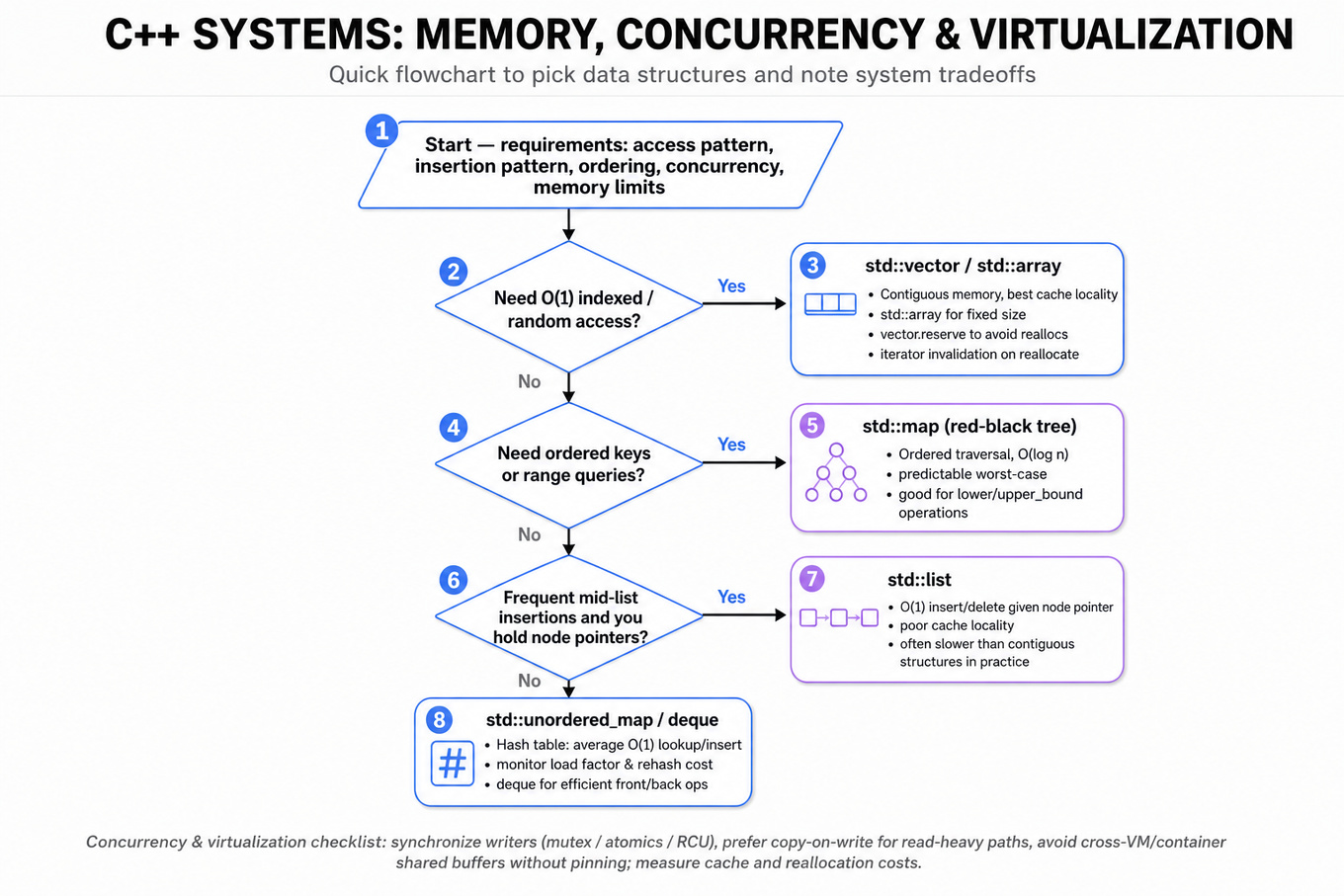
What's being tested
Interviewers are probing whether you can reason from first principles about low-level software behavior: memory layout, asymptotic complexity, concurrency correctness, and virtualization tradeoffs. For NVIDIA, this matters because performance-sensitive systems often sit close to hardware, GPUs, drivers, containers, schedulers, and distributed services where “it works” is not enough. A strong Software Engineer answer connects data structure choice, C++ object semantics, cache behavior, thread safety, and virtualized execution to concrete latency, throughput, memory, and correctness outcomes. The interviewer is not looking for trivia; they are checking whether you can explain tradeoffs, identify edge cases, and make implementation decisions under constraints.
Core knowledge
-
Arrays provide contiguous memory,
O(1)indexed access, excellent cache locality, and cheap iteration. Insert/delete in the middle isO(n)because elements must shift. They are ideal when size is fixed or append-heavy with predictable access patterns. -
Dynamic arrays such as
`std::vector`grow by allocating a larger buffer and moving/copying elements. Appending is amortizedO(1), but a resize isO(n). Capacity growth is often geometric, so wasted memory is traded for fewer reallocations. -
Linked lists provide
O(1)insertion/deletion only when you already have the node pointer. Searching remainsO(n), and poor cache locality often makes them slower than arrays in practice despite favorable theoretical insertion costs. -
Hash tables such as
`std::unordered_map`target averageO(1)lookup, insert, and delete, but degrade towardO(n)under heavy collisions or poor hashing. Key concerns include load factor, rehashing cost, iterator invalidation, and whether ordering is required. -
Trees trade constant-time hashing for ordering and range operations.
`std::map`is typically a red-black tree withO(log n)operations. Balanced trees are preferred for ordered traversal, lower/upper bound queries, and predictable worst-case behavior. -
Sorting algorithm choice depends on data size, stability, memory, and worst-case guarantees.
`std::sort`is usually introsort, combining quicksort, heapsort, and insertion sort for average speed andO(n log n)worst case;`std::stable_sort`preserves equal-element order but uses extra memory. -
C++ object lifetime requires distinguishing stack allocation, heap allocation, construction, destruction, copy, and move. Apply RAII: resource acquisition in constructors, release in destructors, with ownership expressed via
`std::unique_ptr`,`std::shared_ptr`, or value semantics. -
Rule of five matters for classes managing memory directly: destructor, copy constructor, copy assignment, move constructor, and move assignment. For a string-like class, missing deep copy causes double-free; missing move operations causes unnecessary heap allocation and copying.
-
Small string optimization stores short strings inline inside the object instead of allocating heap memory. A typical design uses a union of inline buffer and heap pointer plus size/capacity metadata. The tradeoff is larger object size versus faster short-string operations and fewer allocations.
-
Alignment and padding affect memory footprint and cache efficiency. Reordering fields can reduce padding;
sizeof(T)may exceed the sum of field sizes. For cache-sensitive code, consider cache-line size, often 64 bytes, and avoid false sharing between frequently written fields. -
Concurrency correctness centers on data races, atomicity, visibility, ordering, and progress. Use
`std::mutex`for mutual exclusion,`std::condition_variable`for blocking coordination, and`std::atomic<T>`when lock-free semantics are simple and well understood. -
Virtual machines run guest operating systems on virtualized CPU, memory, storage, and network devices. A hypervisor can be Type 1, running directly on hardware, or Type 2, running on a host OS. Performance overhead comes from VM exits, device emulation, memory translation, and I/O virtualization.
Worked example
For “Optimize a small-string C++ class”, start by framing the problem: “I’d clarify expected string length distribution, mutation frequency, ABI constraints, thread-safety expectations, and whether compatibility with `std::string` behavior is required.” Then state assumptions: most strings are short, reads/copies are common, and the goal is to reduce heap allocation and improve cache locality without breaking value semantics.
Organize the answer around four pillars. First, define representation: store size, a tag or capacity indicator, and a union containing either an inline `char[N]` buffer or a heap pointer. Second, define ownership and lifetime: implement destructor, copy/move constructors, and copy/move assignment safely, ideally using copy-and-swap or careful self-assignment checks. Third, reason about performance: short strings avoid malloc, copies fit in registers/cache lines, but larger object size may hurt arrays of strings. Fourth, validate edge cases: null terminator, empty string, exactly-at-threshold length, exception safety, alignment, and iterator/reference invalidation.
A concrete design decision to flag is the inline capacity. For example, a 24- or 32-byte object may allow 15 or 23 inline characters depending on metadata layout and pointer size. Larger inline buffers reduce allocations but increase memory bandwidth when many string objects are stored in containers. A strong answer explicitly says, “I’d choose the inline size based on profiling real workloads, not intuition.” Close by saying that, with more time, you would add benchmarks comparing allocation count, copy/move throughput, cache misses, and memory footprint against `std::string` on representative inputs.
A second angle
For “Explain virtual machines and concurrency basics”, the same core skill appears, but the focus shifts from object layout to execution isolation and synchronization. Instead of optimizing a local data structure, you need to explain layers: guest OS, hypervisor, virtual CPU scheduling, nested page tables, virtual disks, and virtual NICs. The performance reasoning is similar: every abstraction has overhead, but hardware support such as Intel VT-x, AMD-V, IOMMU, and nested paging reduces it.
Concurrency adds a correctness dimension: two threads updating shared state need synchronization regardless of whether they run on bare metal or inside a VM. A strong answer distinguishes parallelism from concurrency, explains why data races are undefined behavior in C++, and gives concrete tools like `std::lock_guard`, `std::atomic`, and condition variables. The transferable skill is mapping abstractions to real costs and failure modes.
Common pitfalls
Pitfall: Treating Big-O as the whole answer.
Saying “hash tables are O(1) and trees are O(log n)” is too shallow. A better answer mentions collisions, rehashing, memory overhead, ordering, cache locality, adversarial keys, and why `std::vector` can beat a linked list despite worse insertion complexity on paper.
Pitfall: Hand-waving C++ memory ownership.
A tempting but weak answer is “just use pointers and delete them in the destructor.” Interviewers expect you to discuss copy safety, move semantics, exception safety, self-assignment, and RAII. If you manage memory manually, you must show how your class avoids leaks, double-frees, dangling pointers, and unnecessary allocations.
Pitfall: Explaining concurrency only with definitions.
Knowing that a mutex “locks critical sections” is not enough. You should be able to describe a race condition, a deadlock scenario, a condition-variable wait loop with a predicate, and when atomics are appropriate. For example, while (!ready) cv.wait(lock); is safer than assuming one notification always means the condition is true.
Connections
Interviewers may pivot from these topics into operating systems, especially virtual memory, paging, syscalls, process isolation, and scheduling. They may also connect to performance profiling, including cache misses, allocation hot spots, lock contention, and `p95`/`p99` latency. For C++ roles, expect follow-ups on `std::vector`, `std::string`, smart pointers, move semantics, and undefined behavior.
Further reading
-
Effective Modern C++ by Scott Meyers — Practical coverage of move semantics, smart pointers, lambdas, and modern C++ object behavior.
-
C++ Concurrency in Action by Anthony Williams — Deep but practical treatment of
`std::thread`, mutexes, atomics, futures, and memory ordering. -
Computer Systems: A Programmer’s Perspective by Bryant and O’Hallaron — Excellent foundation for memory hierarchy, linking, virtual memory, concurrency, and systems-level performance reasoning.
Featured in interview prep guides
Practice questions
- Compare arrays, linked lists, hash tables, treesNVIDIA · Software Engineer · Technical Screen · easy
- Explain virtual machines and concurrency basicsNVIDIA · Software Engineer · Technical Screen · medium
- Optimize a small-string C++ classNVIDIA · Software Engineer · Onsite · medium
- Demonstrate software engineering fundamentalsNVIDIA · Software Engineer · Onsite · medium
Related concepts
- C++ Concurrency And Memory Model
- C++ And Virtual Memory FundamentalsSoftware Engineering Fundamentals
- GPU Programming, Graphics APIs, And Shader CompilersSystem Design
- C++ Concurrency, Memory Ownership, And RAII
- Low-Level System Design For High-Throughput C++ Services
- Concurrency, OS Threads, And MemorySoftware Engineering Fundamentals