GPU Programming, Graphics APIs, And Shader Compilers
Asked of: Software Engineer
Last updated
What's being tested
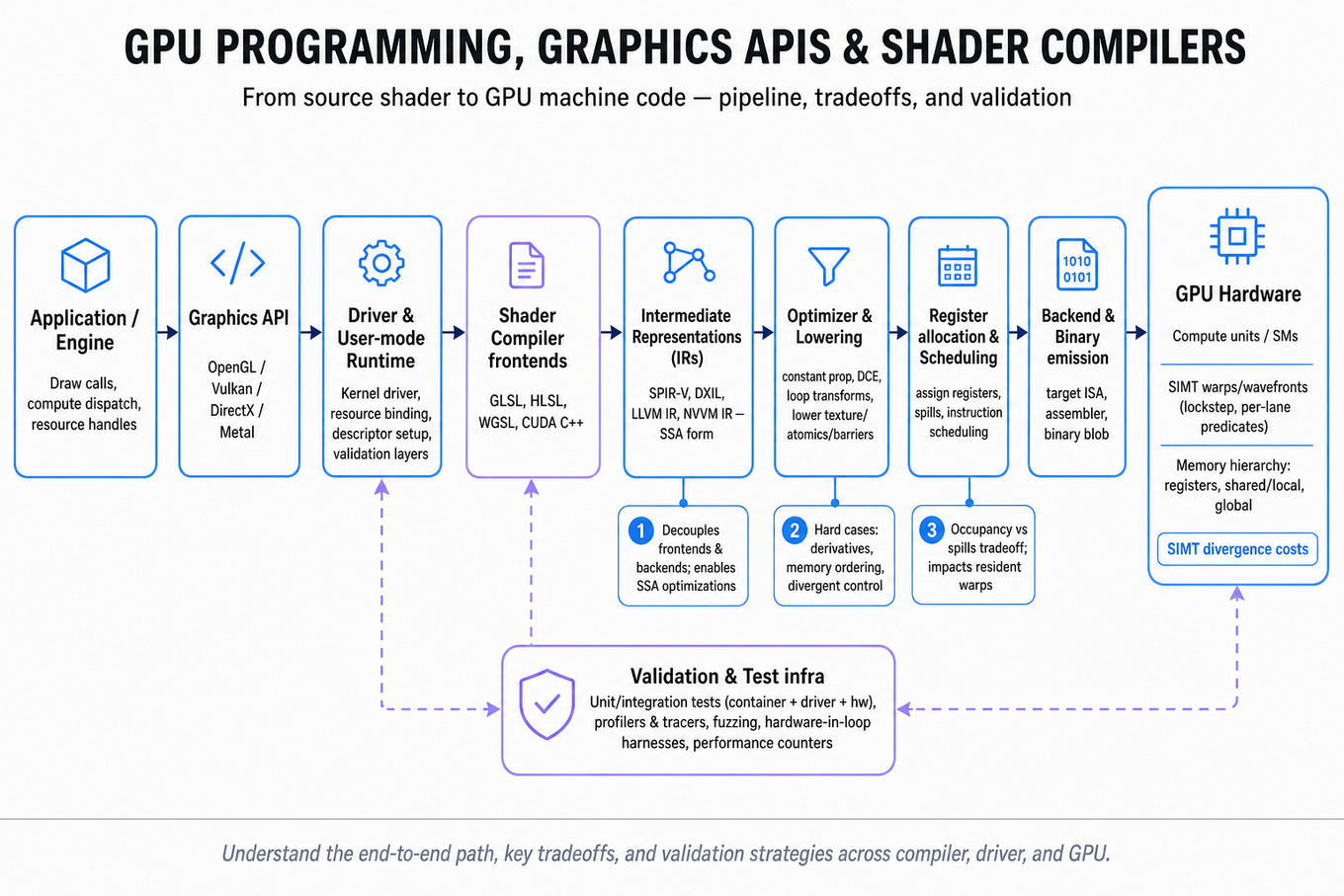
Interviewers are probing whether you can reason across the boundary between compiler architecture, GPU execution, graphics APIs, and test infrastructure without hand-waving. For NVIDIA, this matters because software engineers often work where application code, drivers, runtimes, shader compilers, and hardware behavior meet; correctness and performance bugs frequently appear at those seams. A strong answer shows you understand the end-to-end path from source shader or model representation to GPU machine code, plus how to validate it under real driver, container, and hardware constraints. The interviewer is not looking for memorized API trivia; they want structured thinking, tradeoff awareness, and the ability to debug complex GPU software systems.
Core knowledge
-
Shader compiler pipeline usually starts with source languages such as
GLSL,HLSL,WGSL, orCUDA C++, then performs lexing/parsing, semantic checks, AST construction, IR generation, optimization, lowering, register allocation, instruction scheduling, binary emission, and diagnostics. Mentioning each stage is less important than explaining why each exists. -
Intermediate representations are central because they decouple frontends from backends. Common examples include
SPIR-V,DXIL,LLVM IR,NVVM IR, and compiler-specific SSA IRs. SSA form makes dataflow explicit: every variable is assigned once, enabling optimizations like constant propagation, dead-code elimination, common subexpression elimination, and loop-invariant code motion. -
Lowering translates high-level operations into progressively more hardware-specific forms. For example, texture sampling, derivatives, barriers, atomics, and subgroup operations may start as abstract IR nodes and later become target-specific instructions or runtime calls. The hard cases are usually memory ordering, precision rules, resource binding, and divergent control flow.
-
Register allocation is a major GPU performance lever. More registers per thread can reduce spills but lower occupancy; fewer registers can increase resident warps but increase local-memory traffic. A useful mental model is: occupancy is constrained by registers, shared memory, thread blocks, and architectural limits, not just by thread count.
-
SIMT execution means a warp or wavefront executes many lanes in lockstep while tracking per-lane predicates. Divergent branches are not “parallel branches for free”; they can serialize paths and reduce utilization. Good compiler and shader design minimizes expensive divergence, uncoalesced memory access, and unnecessary synchronization.
-
Graphics API pipeline state differs across
OpenGL,Vulkan,Direct3D 11, andDirect3D 12. Older APIs hide more driver work behind mutable state; explicit APIs likeVulkanandD3D12push responsibility to the application via pipeline state objects, descriptor sets/root signatures, command buffers, synchronization primitives, and explicit memory management. -
Resource binding models are a common interview pivot.
OpenGLuses global binding points;Vulkanuses descriptor sets and pipeline layouts;D3D12uses root signatures, descriptor heaps, and resource barriers. A correct answer distinguishes shader-visible resource declarations from runtime binding, lifetime, synchronization, and layout transitions. -
Model-to-GPU execution typically flows from a frontend representation such as
PyTorch,TensorFlow,ONNX, orMLIRinto graph optimization, operator fusion, layout selection, kernel selection or code generation, device memory planning, command submission, and runtime scheduling. For SWE interviews, focus on systems mechanics: IR, lowering, runtime APIs, memory, streams, and debugging. -
Kernel launch overhead and memory movement often dominate before arithmetic does. Host-to-device copies over
PCIe, synchronization points, and small kernels can bottleneck execution. The rough roofline intuition is performance is bounded by . -
GPU correctness testing needs more than “does it render.” Strong strategies include golden-image comparison with tolerances, shader compiler differential testing, API conformance tests, replay traces, randomized shader generation, stress tests for synchronization, and cross-driver or cross-GPU comparisons. Floating-point tolerances must account for precision, format, ordering, and nondeterminism.
-
Dockerized GPU CI requires coordinating user-space libraries with host kernel drivers. With
NVIDIAhardware, containers typically usenvidia-container-toolkit,libnvidia-container,CUDAruntime libraries, and device nodes exposed by the host. The kernel driver is not meaningfully containerized, so reproducibility requires pinning image versions, driver compatibility ranges, test assets, and runtime flags. -
Headless graphics testing can use
EGL,Vulkansurfaceless extensions, virtual displays, or software fallbacks likeSwiftShaderfor some cases. For real GPU validation, avoid accidentally testing a CPU renderer. Capture logs, shader binaries, driver versions, GPU UUIDs, command streams, screenshots, and timing counters for debuggability.
Worked example
For “Explain a shader compiler pipeline”, a strong candidate would first frame the answer: “I’ll describe a typical graphics shader compiler from source to GPU binary, then call out optimizations, target-specific lowering, and testing.” Good clarifying questions include which source language is assumed, whether the compiler targets an offline format like SPIR-V or a vendor backend, and whether the focus is correctness, performance, or debugging.
The answer skeleton should have four pillars: frontend parsing and semantic analysis; IR construction, usually SSA-based; optimization and lowering; and backend code generation plus validation. In the frontend, discuss tokenization, parsing into an AST, type checking, scope/name resolution, and API-specific rules such as interpolation qualifiers or resource declarations. In the middle end, explain why SSA enables dataflow optimizations and how passes must preserve shader semantics around precision, derivatives, barriers, and memory ordering.
In the backend, cover instruction selection, register allocation, scheduling, binary encoding, and metadata needed by the driver/runtime. A specific tradeoff to flag is optimization time versus runtime performance: game shaders may compile at pipeline creation or first use, so aggressive optimization can cause stutter, while offline or cached compilation can afford heavier passes. Close by saying that if you had more time, you would discuss shader cache invalidation, pipeline libraries, differential testing, and collecting minimized repro cases for compiler bugs.
A second angle
For “Design a Dockerized GPU test pipeline”, the same core concept appears through validation and reproducibility rather than compiler internals. The framing shifts from “how do we compile and execute GPU code?” to “how do we reliably prove it works across real drivers, GPUs, APIs, and container boundaries?” A strong design names the constraints: host driver dependency, GPU scheduling isolation, test flakiness, headless rendering, artifact capture, and security of privileged device access.
The pillars would be container image pinning, hardware-aware scheduling, deterministic test execution, observability, and failure triage. The key tradeoff is between hermetic builds and the reality that the GPU kernel driver lives on the host; you can pin user-space libraries and test inputs, but you must explicitly record and matrix against driver and GPU versions. This is the same systems skill applied to the test loop: understand the compilation/execution boundary, then make it observable and repeatable.
Common pitfalls
Pitfall: Treating the shader compiler as a generic CPU compiler with different syntax.
A tempting answer says “parse, optimize, generate assembly” and stops there. That misses GPU-specific issues: SIMT divergence, resource bindings, texture/sampler semantics, barriers, precision qualifiers, occupancy, and register pressure. A better answer anchors each compiler stage to a GPU-specific concern.
Pitfall: Confusing graphics API abstractions with hardware behavior.
Candidates often say Vulkan is “faster” than OpenGL without explaining why. The stronger version is that explicit APIs reduce hidden driver work and expose synchronization, memory allocation, and pipeline state management to the application, which can improve performance when used correctly but also creates more ways to be wrong.
Pitfall: Designing GPU tests as ordinary unit tests only.
Unit tests are useful for compiler passes and utility code, but GPU systems also need conformance, image comparison, trace replay, performance regression tests, and cross-hardware validation. A good answer distinguishes deterministic compiler tests from inherently noisier runtime and rendering tests, then explains how to capture artifacts for debugging.
Connections
Interviewers may pivot from here into CUDA programming, driver/runtime architecture, compiler optimization, distributed CI infrastructure, or performance debugging with tools such as Nsight Systems, Nsight Graphics, Nsight Compute, RenderDoc, and PIX. They may also ask about memory hierarchy, synchronization, or API design tradeoffs between Vulkan, Direct3D 12, OpenGL, and CUDA.
Further reading
-
Vulkan Specification — authoritative reference for explicit graphics API concepts, synchronization, descriptors, and pipeline state.
-
LLVM Language Reference Manual — useful background on SSA-style IR, optimization passes, and compiler terminology.
-
NVIDIA CUDA C++ Programming Guide — practical grounding in GPU execution, memory hierarchy, occupancy, synchronization, and kernel behavior.
Featured in interview prep guides
Practice questions
- Design a Dockerized GPU test pipelineNVIDIA · Software Engineer · Online Assessment · hard
- Explain linear algebra for graphics transformsNVIDIA · Software Engineer · Online Assessment · medium
- Explain a shader compiler pipelineNVIDIA · Software Engineer · Online Assessment · medium
- Explain a graphics testing project in depthNVIDIA · Software Engineer · Online Assessment · medium
- Build a Jenkins CI for graphics testsNVIDIA · Software Engineer · Online Assessment · hard
- Explain shader compilers and graphics APIsNVIDIA · Software Engineer · Onsite · hard
- Describe model-to-GPU execution pipelineNVIDIA · Software Engineer · Technical Screen · medium