Concurrency, Deadlocks, And Synchronization
Asked of: Software Engineer
Last updated
What's being tested
Interviewers are probing whether you can reason about shared mutable state under real execution interleavings, not just define locks. Microsoft cares because backend services, client runtimes, storage systems, and developer tools all depend on correct behavior under concurrency, where bugs are often rare, nondeterministic, and high-impact. Expect to explain deadlock conditions, choose synchronization primitives, debug producer-consumer code, and design data structures whose invariants survive concurrent reads and writes. Strong answers balance correctness, performance, and maintainability: “this is safe because…” matters more than “I used a mutex.”
Core knowledge
-
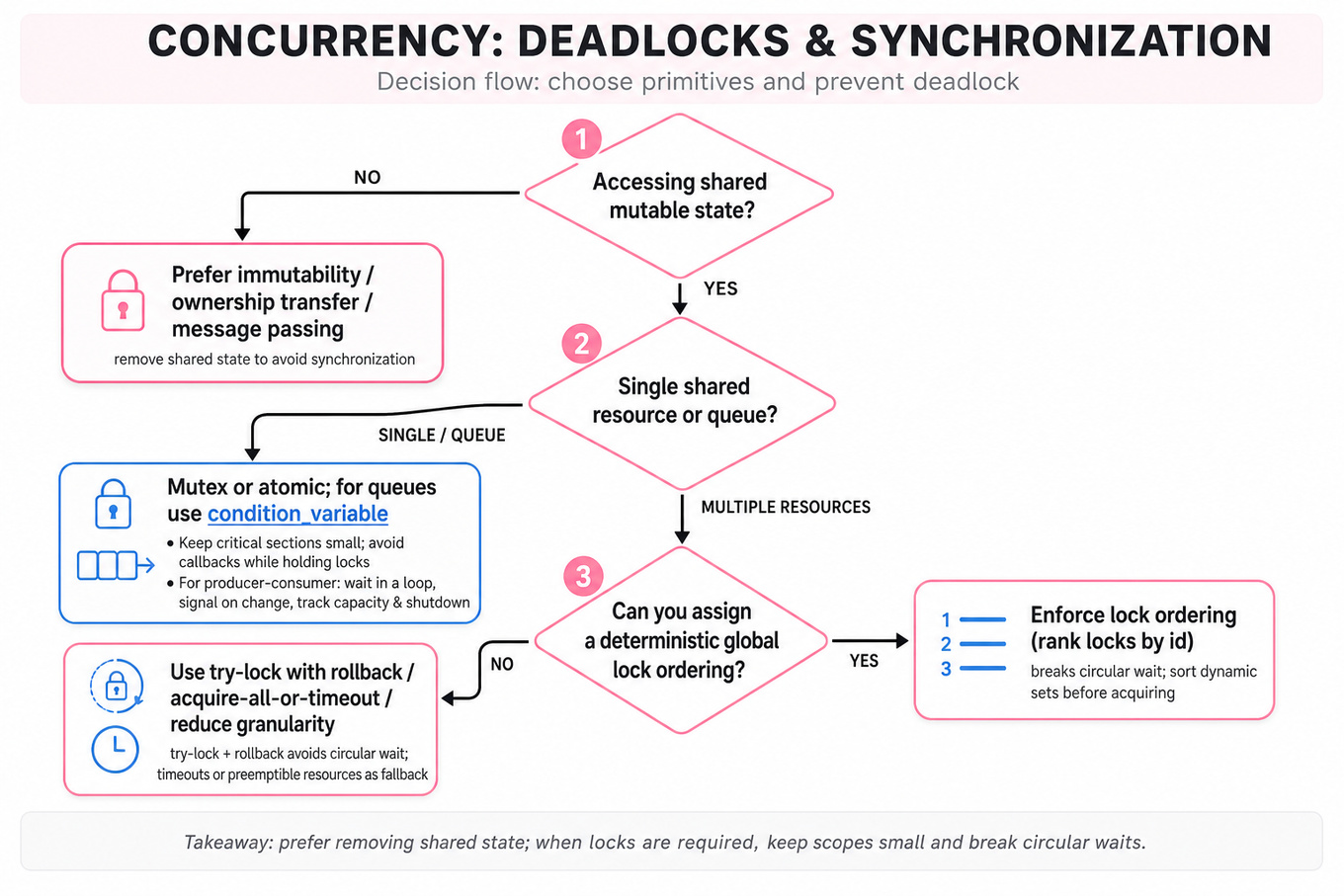
Race conditions happen when correctness depends on timing between threads accessing shared state, with at least one write. The fix is not always “add a lock”; it may be immutability, ownership transfer, message passing, atomic operations, or reducing shared state entirely.
-
Critical sections protect invariants, not individual lines of code. For an
`LRUCache`, the map and doubly linked list must be updated under the same synchronization boundary; locking onlyget()map lookup but not list movement can corrupt recency order. -
Mutexes provide mutual exclusion and usually acquire/release memory ordering. Keep lock scope small but complete: acquire before reading shared invariant, update all related fields, release after the invariant is restored. Avoid calling external callbacks or blocking I/O while holding a mutex.
-
Deadlock requires four Coffman conditions: mutual exclusion, hold-and-wait, no preemption, and circular wait. Prevention usually breaks one condition: enforce global lock ordering, acquire all-or-none with timeout, make resources preemptible, or reduce lock granularity.
-
Lock ordering is the most common practical deadlock prevention technique. Assign every lock a rank, e.g.,
`Account.lock`ordered byaccountId, and always acquire lower rank first. This works well until dynamic resource sets require sorting or try-lock rollback. -
Condition variables such as
`std::condition_variable`or Java’sConditionare for waiting until a predicate becomes true. Always wait in a loop:while queue.empty(): wait(). Spurious wakeups and missed notifications are real interview traps. -
Producer-consumer queues require coordinating capacity, emptiness, and shutdown state. A correct bounded queue typically has one mutex,
not_empty,not_full, and aclosedflag so consumers do not block forever after producers exit. -
Atomic operations are appropriate for simple independent state like counters, flags, or reference counts. They are not a magic substitute for locks when multiple variables must change together;
sizeandheadin a queue still need one coherent invariant. -
Reader-writer locks help read-heavy workloads only when read sections are long enough and writes are infrequent. In
`std::shared_mutex`, excessive readers can starve writers depending on implementation policy; for hot paths, consider copy-on-write or snapshotting. -
Consistency models matter in read-heavy designs. For subordinate counts in an org chart, you can provide strong consistency by updating ancestor counts transactionally, or eventual consistency using async recomputation; the right answer depends on read latency, update rate, and correctness requirements.
-
Idempotency is a concurrency-adjacent correctness tool for retries and duplicate requests. A token manager or update API can use an idempotency key and state machine so repeated
renew(token)ordelete(token)calls do not double-apply side effects. -
Performance tradeoffs include contention, lock convoying, cache-line bouncing, and false sharing. A single global lock is often acceptable for small
Nor low`QPS`; for high contention, shard by key, use striped locks, or move to lock-free structures only with strong justification.
Worked example
For “Explain deadlock cases and how to prevent them,” a strong candidate first frames the problem by asking whether the scenario involves threads, processes, database transactions, or distributed services, because prevention mechanisms differ. They would state assumptions: “I’ll discuss in-process locks first, then mention how the same idea maps to transactions and RPCs.” The answer should be organized around three pillars: the four necessary deadlock conditions, a concrete example such as thread A holding `Lock1` while waiting for `Lock2` and thread B doing the reverse, and prevention/detection strategies.
A good skeleton is: define deadlock precisely, identify the resource graph cycle, explain why each Coffman condition holds, then show how to break the cycle. The candidate should call out global lock ordering as the most practical fix for codebases: if every path acquires `UserLock` before `OrgLock`, circular wait is impossible. They should also mention alternatives like try_lock with backoff, timeouts, reducing shared state, or using a single coarser lock if simplicity beats throughput.
One explicit tradeoff: a single coarse-grained lock may eliminate deadlocks and simplify reasoning, but can increase contention and hurt `p99` latency under parallel load. A strong close would be: “If I had more time, I’d add runtime diagnostics: lock-order assertions in debug builds, thread dumps when waits exceed a threshold, and stress tests with randomized scheduling.”
A second angle
For “Implement concurrent structures and debug queue code,” the same principles become code-level invariants rather than verbal definitions. A producer-consumer queue is not correct just because it uses a mutex; the candidate must show the relationship among queue, capacity, not_empty, not_full, and shutdown behavior. The framing is more operational: identify the shared state, decide which lock protects it, and prove each method restores the invariant before releasing the lock. The interviewer may pull on edge cases such as two consumers waking for one item, a producer blocking forever after shutdown, or notifying before updating state. Compared with the deadlock explanation, this tests whether you can translate concurrency theory into safe implementation patterns.
Common pitfalls
Pitfall: Treating
volatileas a synchronization primitive.
In languages like Java, volatile gives visibility and ordering for a variable, but it does not make compound operations atomic, such as count++ or “check then insert.” In C/C++, volatile is generally for memory-mapped I/O and does not provide thread synchronization; use `std::atomic`, mutexes, or language-level concurrency primitives.
Pitfall: Explaining deadlock prevention only as “use fewer locks.”
That answer is directionally reasonable but too shallow. Interviewers want a precise mechanism: global ordering, timeout and rollback, lock hierarchy assertions, or redesigning ownership so only one thread mutates a resource.
Pitfall: Forgetting to communicate invariants.
For concurrent data structures, naming operations is not enough. Say, “The invariant is that every key in `map` has exactly one node in `list`, and both are modified under mu,” then discuss how get, put, eviction, and destruction preserve it.
Connections
Interviewers may pivot from synchronization into memory models, thread-safe data structure design, distributed locking, database isolation levels, or idempotent API design. They may also connect concurrency bugs to debugging skills: reproducing flaky failures, using logs with thread IDs, examining dumps, and stress-testing with randomized interleavings.
Further reading
-
Java Concurrency in Practice — practical coverage of locks, safe publication, thread confinement, and concurrent collections.
-
The Art of Multiprocessor Programming — deeper treatment of lock-free algorithms, consensus, and correctness under concurrency.
-
C++ reference:
`std::condition_variable`— concise reference for correct wait-loop usage and notification semantics.
Featured in interview prep guides
Practice questions
- Implement concurrent structures and debug queue codeMicrosoft · Software Engineer · Technical Screen · hard
- Implement interval room counter and token managerMicrosoft · Software Engineer · Onsite · easy
- Explain deadlock cases and how to prevent themMicrosoft · Software Engineer · Technical Screen · medium
- Design read-heavy org chart subordinate countsMicrosoft · Software Engineer · Onsite · medium
- Discuss mutexes, memory alignment, polymorphism, idempotencyMicrosoft · Software Engineer · Onsite · medium
Related concepts
- Concurrency And SynchronizationSoftware Engineering Fundamentals
- Concurrency And Thread SafetyCoding & Algorithms
- Concurrency Control And Thread SafetySystem Design
- Thread-Safe Queues And Concurrency PrimitivesCoding & Algorithms
- Concurrency, OS Threads, And MemorySoftware Engineering Fundamentals
- Concurrency And Multithreading FundamentalsCoding & Algorithms