Java, Concurrency, And Framework Internals
Asked of: Software Engineer
Last updated
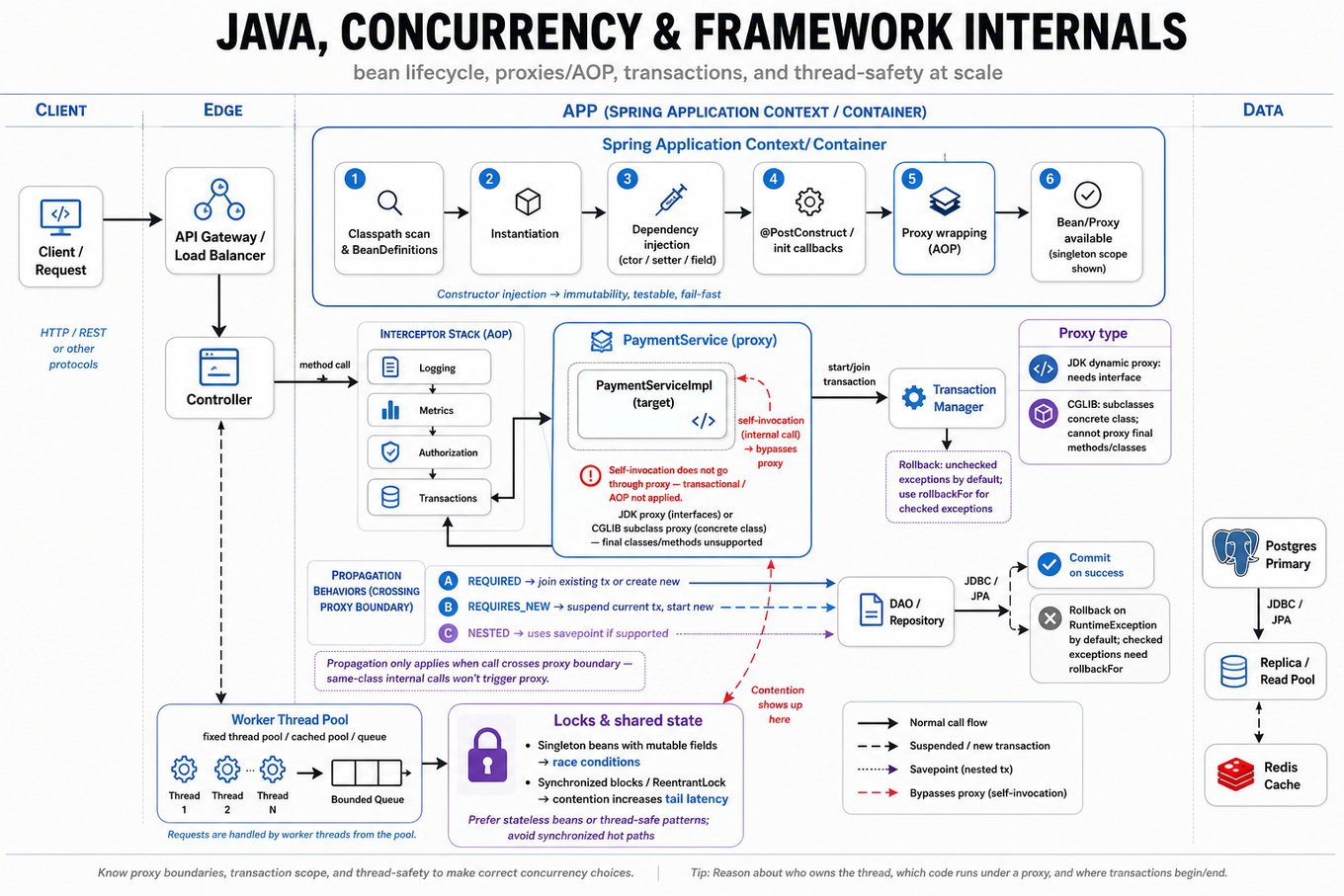
What's being tested
Interviewers are probing whether you understand Java framework internals, concurrency correctness, and design tradeoffs beyond surface-level API usage. For TikTok-scale services, a Software Engineer must reason about how Spring creates objects, how proxies intercept calls, how transactions behave under failure, and how thread pools or locks affect latency and correctness. The expected signal is not memorization; it is the ability to explain mechanisms, identify edge cases, and make safe implementation choices under high concurrency.
Core knowledge
-
Dependency injection separates object construction from business logic: classes declare dependencies through constructors, setters, or fields, and a container such as
Springwires concrete implementations. Constructor injection is usually preferred because it supports immutability, easier testing, and fail-fast detection of missing dependencies. -
Bean lifecycle in
Springtypically flows through classpath scanning or explicit configuration, bean definition creation, instantiation, dependency injection, initialization callbacks such as@PostConstruct, proxy wrapping, and destruction callbacks. A common edge case: the object you call may be a proxy, not the raw class instance. -
Aspect-oriented programming applies cross-cutting behavior such as logging, authorization, metrics, retries, or transactions around method calls.
Spring AOPcommonly uses JDK dynamic proxies for interfaces andCGLIBsubclass proxies for concrete classes; limitations include final classes, final methods, and internal self-invocation bypassing the proxy. -
Transaction management in
Springusually works by intercepting a method annotated with@Transactional, opening or joining a transaction, committing on success, and rolling back on configured exceptions. By default, rollback happens for unchecked exceptions, while checked exceptions require explicitrollbackFor. -
Transaction propagation controls how nested calls behave:
REQUIREDjoins an existing transaction or creates one,REQUIRES_NEWsuspends the current transaction, andNESTEDuses savepoints if supported. Interviewers often test whether you know that propagation only matters when calls pass through the transaction proxy. -
Isolation levels define what anomalies are allowed:
READ_COMMITTEDprevents dirty reads,REPEATABLE_READprevents non-repeatable reads in many databases, andSERIALIZABLEgives strongest correctness with lower concurrency. You should connect this to real bugs like double-spending, duplicate order creation, or stale inventory reads. -
Java Memory Model defines visibility and ordering guarantees between threads.
volatileprovides visibility and ordering for a single variable,synchronizedprovides mutual exclusion plus happens-before guarantees, andAtomicInteger/Compare-And-Swapsupport lock-free updates for simple state transitions. -
Thread pools avoid creating one thread per task and provide bounded concurrency. For CPU-bound work, start near number of cores; for I/O-bound work, more threads may be useful. Little’s Law, , helps reason about concurrency: in-flight work equals arrival rate times average latency.
-
Locking primitives solve different problems:
synchronizedandReentrantLockprovide mutual exclusion,Semaphorelimits concurrent access,ReadWriteLockallows multiple readers but exclusive writers, andConditionsupports wait/notify-style coordination. Always pair condition checks withwhile, notif, because of spurious wakeups. -
Deadlock requires four conditions: mutual exclusion, hold-and-wait, no preemption, and circular wait. Practical prevention includes global lock ordering, timeouts via
tryLock, minimizing lock scope, and avoiding blocking I/O while holding a lock. -
Design patterns are communication tools, not decorations. Singleton needs thread-safe initialization, often via enum or static holder; Factory Method hides object creation; Strategy replaces condition-heavy branching with interchangeable behavior. Overusing patterns can increase indirection and reduce readability.
-
Python GIL is relevant as a comparison point:
CPythonallows only one thread to execute Python bytecode at a time, so threads help I/O-bound tasks more than CPU-bound tasks. Java has true parallel threads, so data races and memory visibility issues become more central.
Worked example
For “Explain Java DI, AOP, and transactions”, start by framing the answer as “how Spring turns plain classes into managed runtime behavior.” In the first 30 seconds, clarify whether the interviewer wants conceptual explanation, implementation internals, or production pitfalls; then state assumptions such as “I’ll describe typical Spring Boot behavior using annotations and proxy-based AOP.” Organize the answer into four pillars: dependency injection, bean lifecycle, proxy/AOP mechanism, and transaction boundaries.
For dependency injection, explain that the container builds a graph of beans and injects dependencies, preferably through constructors. For AOP, explain that annotations such as @Transactional do not magically alter bytecode in normal Spring AOP; a proxy intercepts external method calls and wraps behavior around them. For transactions, describe how the proxy opens or joins a transaction, delegates to the target method, then commits or rolls back depending on the outcome. A strong tradeoff to flag is proxy-based simplicity versus limitations: self-invocation like this.updateUser() bypasses the proxy, so the transactional advice may not run. Close by saying that, with more time, you would cover propagation, isolation levels, rollback rules, and how to test transactional behavior using integration tests against a real database.
A second angle
For “Explain multithreading and locks”, the same depth standard applies, but the framing shifts from framework behavior to correctness under interleavings. Instead of explaining how a container intercepts method calls, focus on shared state, visibility, atomicity, and progress. A good answer names primitives such as synchronized, ReentrantLock, Semaphore, ReadWriteLock, and Condition, then explains when each is appropriate. The candidate should also show implementation instincts: a bounded blocking queue needs a lock, two conditions such as notFull and notEmpty, and while loops around condition waits. The transfer is that both topics require reasoning about hidden runtime behavior: proxies in framework code, scheduler interleavings in concurrent code.
Common pitfalls
Pitfall: Saying “
@Transactionalstarts a transaction whenever the method is called.”
That is only true when the call goes through the managed proxy. A better answer mentions proxy interception, self-invocation failure, method visibility constraints, propagation behavior, and rollback defaults.
Pitfall: Treating
volatileas a general replacement for locks.
volatile gives visibility and ordering for reads/writes of that variable, but it does not make compound actions like count++ atomic. For increments, use AtomicInteger, LongAdder under high contention, or a lock if multiple fields must change consistently.
Pitfall: Listing design patterns without explaining tradeoffs.
“Use Singleton, Factory, and Strategy” sounds memorized if you do not discuss coupling, testability, lifecycle, and thread safety. A stronger answer says when a pattern helps, when dependency injection is cleaner, and what concurrency bugs a naive implementation could introduce.
Connections
Interviewers may pivot from this area into JVM internals, including garbage collection, class loading, and JIT compilation; distributed systems, including idempotency, retries, and consistency; or database correctness, including isolation levels, indexes, and locking. They may also ask you to implement a small concurrent class or refactor code to use Strategy, Factory, or dependency injection cleanly.
Further reading
-
Java Concurrency in Practice — the classic practical reference for Java thread safety, memory visibility, locks, and executor design.
-
Spring Framework Reference Documentation — authoritative source for
Springbean lifecycle, AOP proxying, and transaction semantics. -
Design Patterns: Elements of Reusable Object-Oriented Software by Gamma, Helm, Johnson, and Vlissides — canonical treatment of Singleton, Factory Method, Strategy, and their tradeoffs.
Featured in interview prep guides
Practice questions
- Explain Java ConcurrentHashMap and queuesTikTok · Software Engineer · Technical Screen · medium
- Discuss Python mutability, copying, and GILTikTok · Software Engineer · Technical Screen · medium
- Explain multithreading and locksTikTok · Software Engineer · Technical Screen · hard
- Explain Java DI, AOP, and transactionsTikTok · Software Engineer · Technical Screen · medium
- Implement and compare key design patternsTikTok · Software Engineer · Technical Screen · medium
- Answer core CS fundamentals conciselyTikTok · Software Engineer · Technical Screen · medium
Related concepts
- Concurrency, Deadlocks, And SynchronizationSoftware Engineering Fundamentals
- Concurrency And SynchronizationSoftware Engineering Fundamentals
- Concurrency And Thread SafetyCoding & Algorithms
- Concurrency, OS Threads, And MemorySoftware Engineering Fundamentals
- Thread-Safe Queues And Concurrency PrimitivesCoding & Algorithms
- C++ Concurrency And Memory Model