Linked Lists, Pointers, Caches, And In-Memory Stores
Asked of: Software Engineer
Last updated
What's being tested
These problems test pointer manipulation, hash map + linked list composition, and stateful in-memory data modeling under strict complexity guarantees. Interviewers are probing whether you can preserve invariants, reason about edge cases, and explain tradeoffs like O(1) average access versus extra memory.
Patterns & templates
-
Hash map deep copy for
copyRandomList— map original nodes to clones inO(n)time/space; handlenullrandom pointers cleanly. -
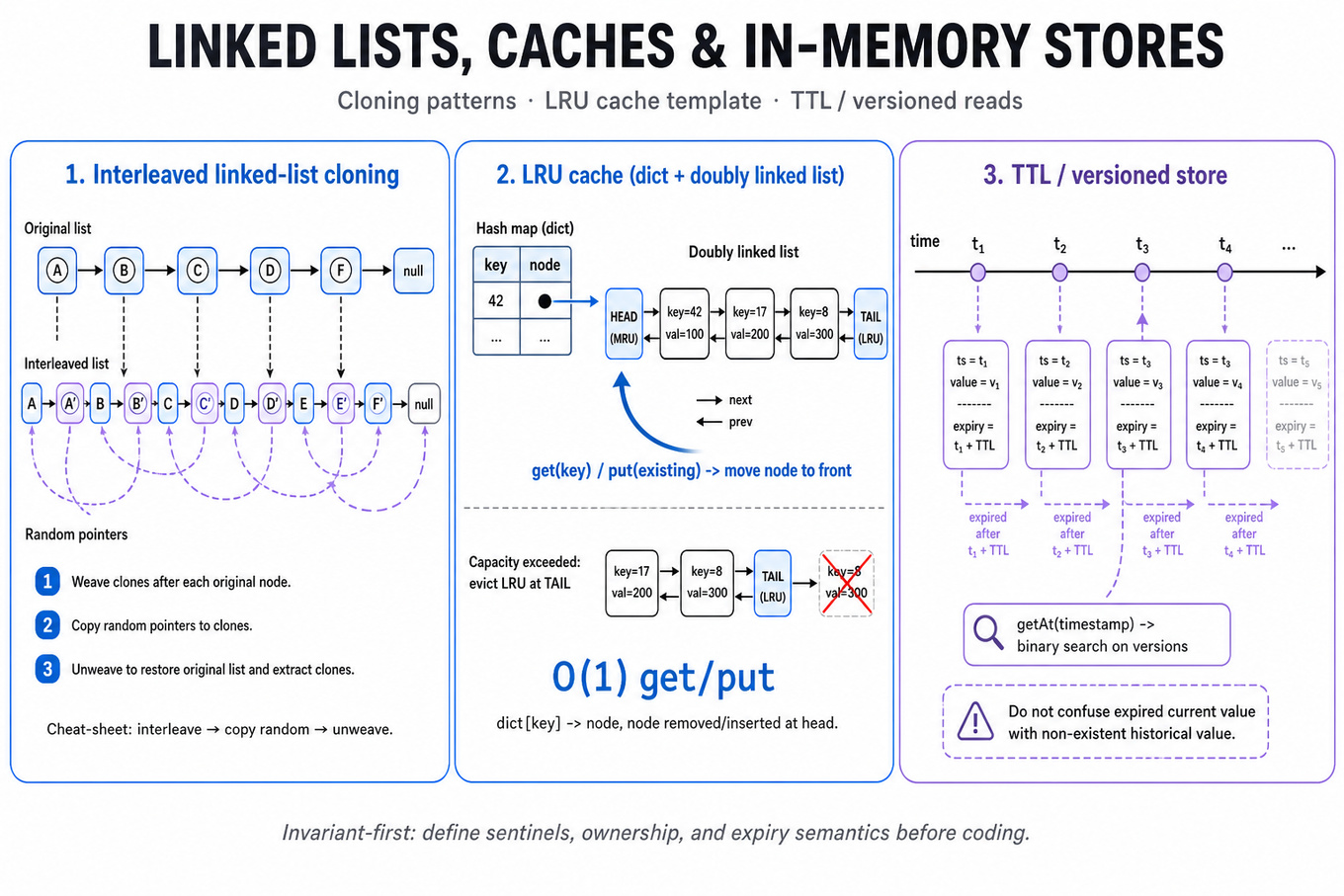
Interleaved linked-list cloning — weave clone nodes into the original list for
O(n)time andO(1)auxiliary space; restore original links. -
Character stream comparison across linked string chunks — implement
nextChar()iterators; compare lazily inO(total chars)time. -
LRU cache template — combine
dict[key] -> nodewith a doubly linked list;getandputmust both move nodes to front. -
TTL/versioned store design — store per key-field a sorted history of
(timestamp, value, expiry); use binary search for historical reads. -
Top-k selection for closest points — use max-heap size
kforO(n log k)or Quickselect averageO(n); avoid square roots. -
Invariant-first coding — define sentinel
head/tail, node ownership, expiration semantics, and tie-breaking before writing update logic.
Common pitfalls
Pitfall: Updating cache values without refreshing recency breaks LRU semantics; every successful
getand existing-keyputshould move the node.
Pitfall: Deep-copying only
nextpointers creates sharedrandomreferences; verify cloned nodes never point back into the original structure.
Pitfall: For TTL history, confusing “current value expired” with “historical value never existed” leads to incorrect
getAt(timestamp)behavior.
Practice these
The practice cards below cover the canonical variants — solve all of them and time yourself.
Featured in interview prep guides
Practice questions
- Implement an in-memory database with record lockingMeta · Software Engineer · Online Assessment · easy
- Implement an in-memory key-field-value DB with TTLMeta · Software Engineer · Online Assessment · medium
- Implement list cloning and k-frequency finderMeta · Software Engineer · Technical Screen · easy
- Design an O(1) recency-evicting cacheMeta · Software Engineer · Technical Screen · medium
- Design an in-memory database with TTL and historyMeta · Software Engineer · Online Assessment · medium
- Reverse between equal-value nodes in listMeta · Software Engineer · Technical Screen · medium
- Clone list with random pointersMeta · Software Engineer · Technical Screen · medium
- Reverse sublist between equal-value nodesMeta · Software Engineer · Technical Screen · medium
- Design prefix-sum function and max stackMeta · Software Engineer · Technical Screen · medium
- Compare two string linked listsMeta · Software Engineer · Technical Screen · medium
- Design LRU cache and pick k closest pointsMeta · Software Engineer · Technical Screen · medium
Related concepts
- Linked Lists, Stacks, Caches, And Pointer TechniquesCoding & Algorithms
- Trees, Linked Lists, And Pointer AlgorithmsCoding & Algorithms
- LRU Cache And O(1) Data StructuresCoding & Algorithms
- Mutable Data Structures And O(1) DesignCoding & Algorithms
- Core Data Structures, Caches, And Clean ImplementationCoding & Algorithms
- Tree And Linked Structure AlgorithmsCoding & Algorithms