In-Place Arrays And Linked List Manipulation
Asked of: Software Engineer
Last updated
What's being tested
These problems test in-place manipulation: preserving useful structure while modifying arrays or linked lists with O(1) auxiliary space. You must demonstrate two-pointer traversal, careful boundary handling, and accurate time-complexity analysis without allocating a replacement collection.
Patterns & templates
-
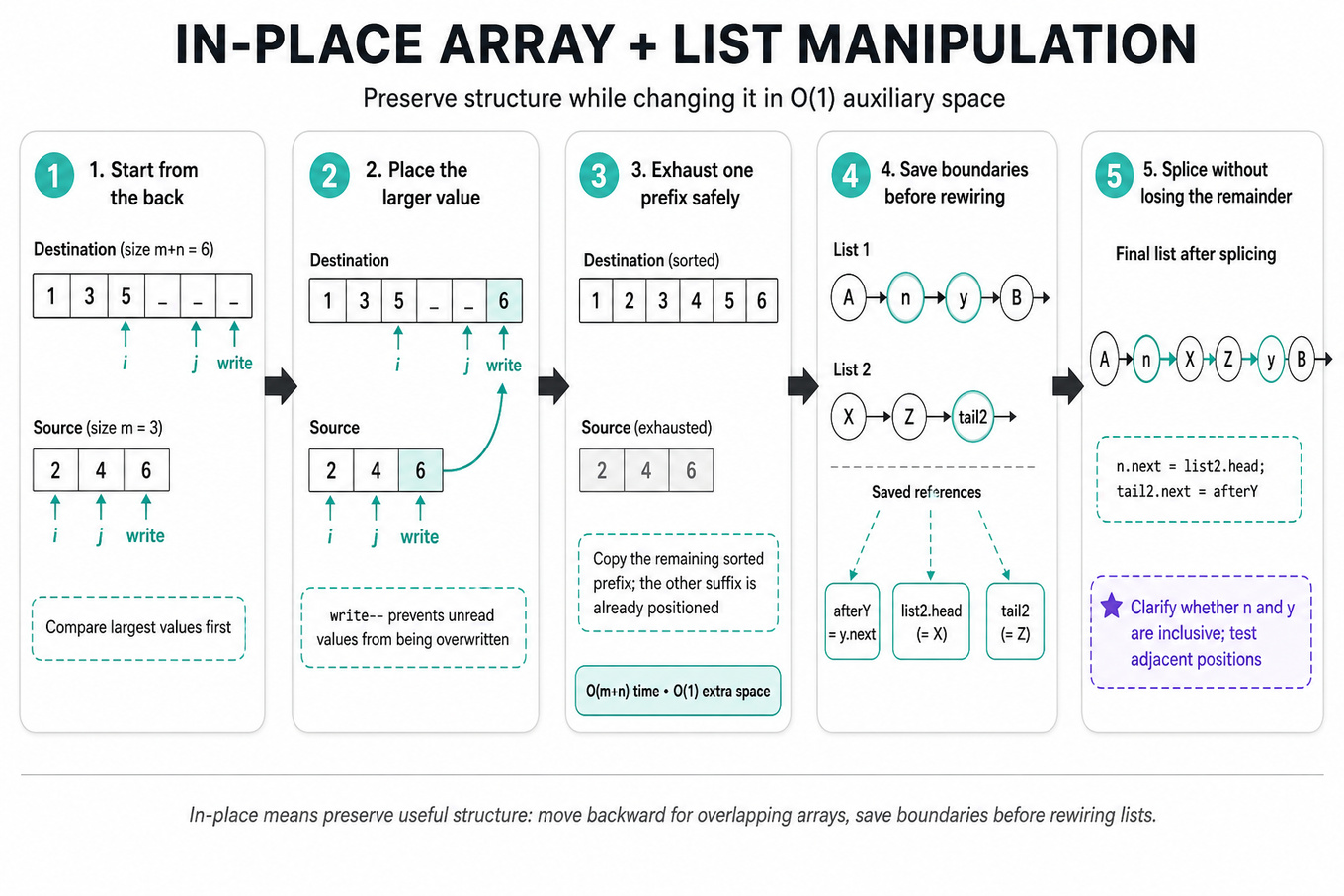
Backward two-pointer merge — when the destination array has trailing capacity, compare from the ends; runs in
O(m+n)time andO(1)space. -
Maintain
i,j, andwrite; place the larger value atwrite--, preventing unread destination values from being overwritten. -
Handle exhausted inputs explicitly: once one sorted prefix remains, copy it; the other suffix is already correctly positioned.
-
For linked-list splicing, locate predecessor node
n, successor nodey, and the second list’s tail before changing links. -
Save boundary references before rewiring:
afterY = y.next, then connectn.nextto list two and its tail toafterY. -
Clarify whether positions are zero- or one-based, whether
nandyare inclusive, and whether either list may be empty. -
State complexity precisely: traversal is
O(N+M)time; pointer rewiring usesO(1)extra space, excluding input nodes.
Common pitfalls
Pitfall: Merging forward into the first array overwrites values that have not been compared; merge from the back when storage overlaps.
Pitfall: Losing
list2’s head or tail during splicing makes the remainder unreachable; store both boundary pointers before assignment.
Pitfall: Off-by-one errors around
nandycan retain or discard the wrong node; draw a small pointer diagram and test adjacent positions.
Practice these
The practice cards below cover the canonical variants—solve all of them and time yourself.
Practice questions
Related concepts
- Linked Lists, Pointers, Caches, And In-Memory StoresCoding & Algorithms
- Linked Lists, Stacks, Caches, And Pointer TechniquesCoding & Algorithms
- Trees, Linked Lists, And Pointer AlgorithmsCoding & Algorithms
- Linear Array, Hashing, Prefix/Suffix, And Cycle TechniquesCoding & Algorithms
- Arrays, Strings, Hashing, And Two PointersCoding & Algorithms
- Mutable Data Structures And O(1) DesignCoding & Algorithms