Cross-Functional Product Leadership
Asked of: Machine Learning Engineer
Last updated
What's being tested
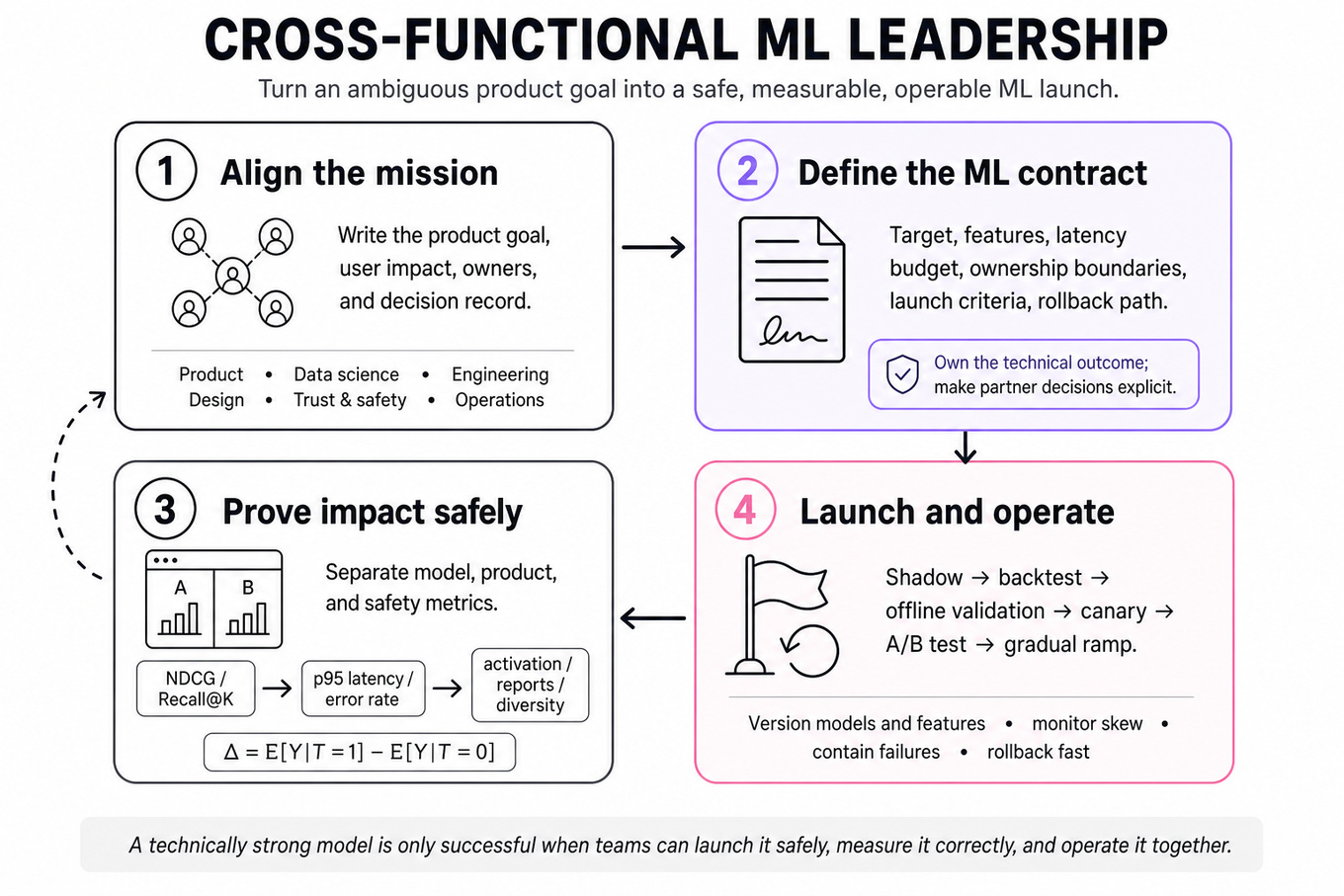
This evaluates whether you can lead an ML initiative across product, data science, software engineering, design, trust and safety, and operations while retaining ownership of the technical outcome. The interviewer is probing for structured communication, honest accountability, stakeholder alignment, and judgment about model quality, reliability, launch risk, and user impact. Reddit cares because recommendation and ranking systems affect community health at scale: a technically strong model is still a failure if it cannot be deployed safely, measured correctly, or operated by partner teams.
Core knowledge
-
Cross-functional technical leadership means converting an ambiguous product goal into an ML contract: objective, prediction target, features, latency budget, ownership boundaries, launch criteria, and rollback path. You should distinguish decisions you own from product, policy, and infrastructure decisions owned by partners.
-
Use a written decision record to align teams asynchronously: problem statement, alternatives, assumptions, evaluation results, risks, owner, and deadline. For contentious choices, document the disagreement and the evidence that would change your mind rather than forcing premature consensus.
-
Define offline/online parity explicitly. Training features, feature-store values, transformations, model versions, and serving-time defaults must match; otherwise a strong offline AUC can coexist with poor production behavior from training-serving skew.
-
Separate model metrics from product and safety metrics. Ranking quality might use
NDCGorRecall@K, while production health needsp95/p99latency, error rate, freshness, and CPU cost; user impact may include activation, retention, reports, hides, or community diversity. -
Establish a launch ladder: shadow mode, backtest, offline validation, canary, small randomized experiment, and gradual ramp. A canary detects operational regressions; an A/B test estimates user impact. Neither alone proves the model is safe or beneficial.
-
A useful experiment target is an intention-to-treat effect, such as Guard against interference, novelty effects, treatment contamination, and Simpson’s paradox across new users, logged-out users, and established communities.
-
Treat rollback and failure containment as part of the design, not incident paperwork. Version models and feature definitions, preserve the last-known-good artifact, define automated thresholds, and ensure a fallback ranker or heuristic can serve within the latency budget.
-
For model incidents, use a blameless postmortem with timeline, customer impact, detection gap, contributing conditions, and corrective actions. “The model was bad” is incomplete; identify whether review, data validation, deployment, monitoring, or ownership failed.
-
Drift monitoring should cover input distributions, prediction distributions, calibration, missingness, feature freshness, and delayed-label performance. Population Stability Index or distributional tests can flag change, but alerts require an owner, severity, and response runbook.
-
In onboarding, expect cold-start constraints: a new user has little behavioral history, while a new community may have sparse engagement. Use robust defaults, content and community metadata, exploration, and explicit uncertainty rather than overfitting to the first few clicks.
-
Make tradeoffs explicit with a decision matrix: expected user value, model quality, latency, operational complexity, privacy or safety risk, and reversibility. A simpler model that reliably meets
p99and has interpretable failure modes may beat a marginally better but fragile architecture.
Worked example: Improve Reddit onboarding
In the first 30 seconds, I would clarify which onboarding outcome matters—successful account activation, first meaningful community interaction, week-one retention, or reduced early abandonment—and which surfaces and user cohorts are in scope. I would state that, as the MLE, I would own the recommendation or ranking implementation, offline and online evaluation, deployment safety, and monitoring, while partnering with product on the user journey and with trust and safety on policy constraints. I would organize the answer around four pillars: cold-start feature and model design, training-serving consistency, an experiment and guardrail plan, and staged rollout with operational ownership. For cold start, I might combine selected interests, locale or language where appropriate, community metadata, and popularity or quality priors, while preserving exploration so the system does not immediately lock users into narrow recommendations. I would propose a primary activation or meaningful-engagement metric, with guardrails for hides, reports, diversity, latency, and short-term versus longer-term retention. A key tradeoff is personalization depth versus privacy, latency, and sparse-signal risk; I would prefer a simpler, resilient fallback for users without enough history. I would close by saying that, with more time, I would inspect cohort-level effects, validate community-health impacts, and run a post-launch review of drift and false-positive recommendations.
A second angle
For “Describe a failure and a success,” the same concept is framed around ownership under imperfect execution rather than designing a future launch. A strong response should explain the technical context, the observable impact, how you communicated uncertainty, and the concrete remediation that prevented recurrence. For example, a model launch that improved offline ranking but degraded p99 latency should include detection, rollback, partner coordination, and what evaluation or capacity test was added afterward. The success story should still credit collaborators while making your individual technical decisions and measurable contribution clear.
Common pitfalls
Pitfall: Treating onboarding as a pure product-strategy exercise. Saying “add a better interest picker” without explaining the model contract, cold-start behavior, evaluation, and rollout leaves the MLE contribution unclear; connect every proposal to implementability and measurable system behavior.
Pitfall: Reporting only aggregate improvement. A global activation lift can conceal harm to new communities, language cohorts, or users exposed to low-quality recommendations; propose cohort analysis and guardrails for safety, diversity, retention, and latency.
Pitfall: Describing failure as someone else’s fault or claiming a flawless launch. “Data scientists gave me a bad model” signals weak ownership; explain your validation gap, escalation, rollback, and the durable engineering or process change that followed.
Connections
The interviewer may pivot to model monitoring, A/B experimentation, feature-store design, recommender cold start, or incident response. Be ready to connect leadership behavior to concrete artifacts: evaluation dashboards, launch checklists, model cards, runbooks, and postmortems.
Further reading
-
Google, “The ML Test Score” — A practical rubric for production readiness and ML-specific technical debt.
-
Google, “Hidden Technical Debt in Machine Learning Systems” — Explains why integration, monitoring, and dependency management often dominate model code.
-
Google SRE Book: “Postmortem Culture” — Concrete guidance for blameless incident learning and corrective action.
Practice questions
Related concepts
- Ambiguous Project Leadership And Product ImpactBehavioral & Leadership
- Technical Leadership, Project Impact And TradeoffsBehavioral & Leadership
- Technical Leadership, Project Ownership, And Stakeholder CommunicationBehavioral & Leadership
- Technical Leadership, Impact, And Trade-OffsBehavioral & Leadership
- Cross-Functional Leadership And Analytical CommunicationBehavioral & Leadership
- Behavioral Leadership And Stakeholder ManagementBehavioral & Leadership