DAG Algorithms, Topological Sort, And Cycle Detection
Asked of: Software Engineer
Last updated
What's being tested
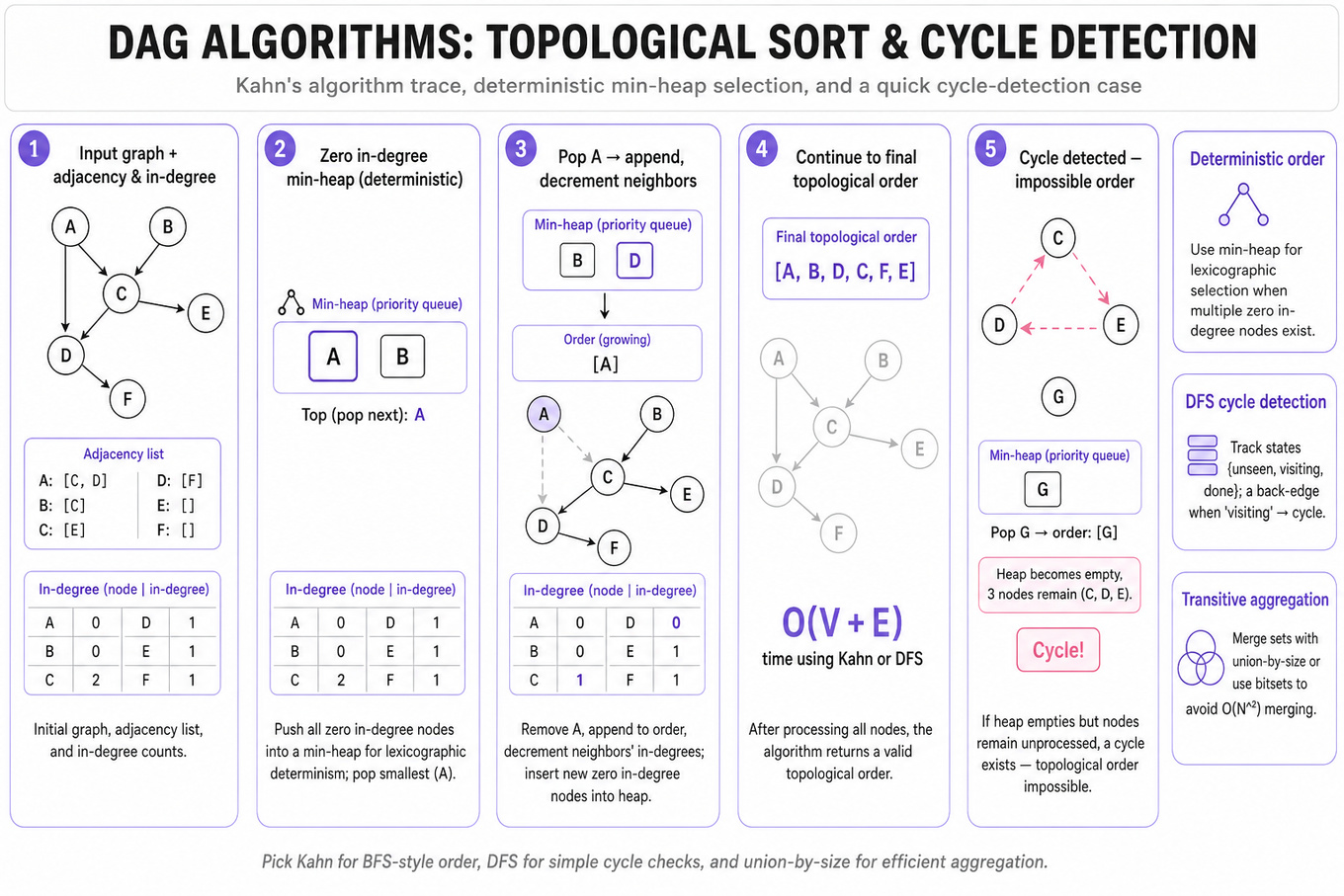
Candidates must demonstrate correct application of topological sort over a directed acyclic graph (DAG), including deterministic ordering and reachable-node aggregation. Interviewers probe both cycle detection (detecting and reporting impossible orders) and efficient transitive aggregation (e.g., inherited permissions/roles) under time/space constraints.
Patterns & templates
-
Kahn's algorithm (BFS in-degree queue) for
O(V+E)topological orders; use a min-heap when lexicographic determinism is required. -
DFS with recursion stack for fast cycle detection and postorder topological output; track visit states {unseen, visiting, done}.
-
Represent graphs with an adjacency list (
Map<int, List<int>>) for memory-efficient traversal whenE ~ V..10V. -
For transitive aggregation, propagate sets top-down (BFS) or merge child-to-parent using union-by-size to limit copying.
-
Use a priority queue to produce deterministic alphabetical outputs when multiple nodes have zero in-degree.
-
For permission models, treat "local deny" vs "inherited allow" by storing two flags per node and resolving precedence on aggregation.
-
When scale is large (
N > 1e6edges), prefer iterative DFS/Kahn and avoid recursion to prevent stack overflow.
Common pitfalls
Pitfall: Forgetting disconnected components — run the algorithm starting from all zero in-degree nodes, not just an arbitrary root.
Pitfall: Returning any topological order when the problem requires deterministic lexicographic order — use a min-heap for zero in-degree selection.
Pitfall: Merging large sets naively per node — use union-by-size or bitsets when alphabet/domain is small to avoid
O(N^2)behavior.
Practice these: the practice cards below cover the canonical variants — solve all of them and time yourself.
Practice questions
- Propagate Permission Letters Through a DAG Using Each Node's Final StateSnowflake · Software Engineer · Technical Screen · medium
- Compute Effective Letter Permissions in a DAGSnowflake · Software Engineer · Technical Screen · medium
- Compute Inherited Role PrivilegesSnowflake · Software Engineer · Technical Screen · hard
- Implement topological sort and tree boundary traversalSnowflake · Software Engineer · Technical Screen · medium
- Implement course scheduling and rate limiter analysisSnowflake · Software Engineer · Technical Screen · hard
- Design cache for DAG-based query viewsSnowflake · Software Engineer · Onsite · hard
- Find first error and propagate failuresSnowflake · Software Engineer · Technical Screen · medium
- Solve build ordering and expression evaluationSnowflake · Software Engineer · Technical Screen · medium
- Compute task order and layered executionSnowflake · Software Engineer · Onsite · medium
- Design multi-core service startup schedulerSnowflake · Software Engineer · Onsite · hard
- Schedule dependent services with layered startupSnowflake · Software Engineer · Onsite · medium
- Design error detection and propagation algorithmsSnowflake · Software Engineer · Technical Screen · medium
Related concepts
- Topological Sort And Cycle DetectionCoding & Algorithms
- Dependency Graphs and Cycle HandlingSoftware Engineering Fundamentals
- Topological Sorting And Cycle DetectionCoding & Algorithms
- Cycle DetectionCoding & Algorithms
- Graph Algorithms, Dependency Resolution And ConnectivityCoding & Algorithms
- Graph, Grid, And Connectivity AlgorithmsCoding & Algorithms