Distributed Control Planes And Schedulers
Asked of: Software Engineer
Last updated
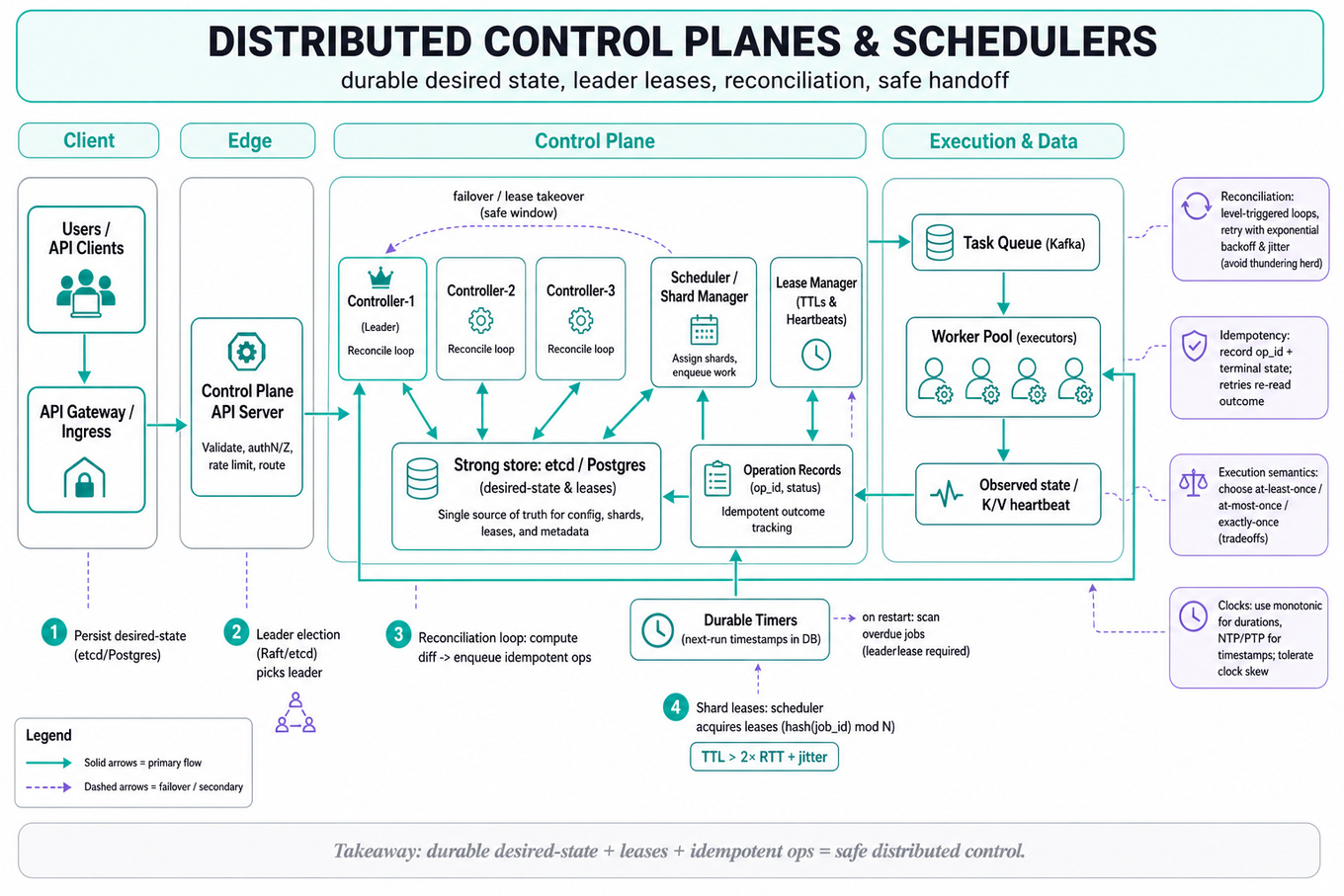
What's being tested
Candidates must demonstrate designing a durable, fault-tolerant control plane and distributed scheduler: durable desired-state storage, reconciliation loops, leader election/lease semantics, safe handoff, idempotent execution, and observability. Interviewers probe correctness under failures (partitions, restarts, clock skew) and pragmatic tradeoffs (consistency vs availability, latency vs throughput) that a backend engineer would implement and operate.
Core knowledge
-
Desired-state vs observed-state — store durable desired configuration in a strongly consistent store like
`etcd`/`Postgres`; controllers continuously reconcile observed state to desired state using level-triggered loops rather than ad-hoc RPCs. -
Consensus & leader election — use Raft/Paxos via
`etcd`/`ZooKeeper`for small-control-plane consensus/leader election; leader-only actions simplify correctness but require handling leader failover and leases. -
Lease-based ownership — implement shard/owner leases (TTL + heartbeats); pick TTL > 2× typical heartbeat RTT plus jitter. Lease renewal failures indicate takeover safety windows.
-
Reconciliation loop pattern — controller reads desired state, computes diff, enqueues idempotent operations, and retries on errors; rate-limit with exponential backoff and jitter to avoid thundering herds.
-
Idempotency & operation records — record each long-running operation with a unique operation id and terminal state in durable store; retries re-read outcome to avoid duplicate side effects.
-
Distributed scheduling & sharding — shard job space (hash(job_id) mod N) or use consistent hashing; rebalancing during scale events must move lease ownership and migrate in-flight tasks safely.
-
Time and clocks — coordinate scheduling using monotonic clocks for durations and synchronized wall clocks (
`NTP`/`PTP`) for real-world timestamps; design tolerance for clock skew and late executions. -
Execution semantics — choose and document semantics: at-least-once is easiest (duplicates possible), at-most-once requires strict locking/coordination, exactly-once needs dedup + transactional side-effects or external idempotency primitives.
-
Durable timers & missing-tick recovery — persist next-run timestamps in DB; on restart, scan overdue jobs and use leader/lease to dispatch them ensuring no silent task-drop if timer service dies.
-
Failure modes & safety windows — define safe takeover windows: if lease TTL expires, a new owner can start tasks but must detect and either reattach to running tasks (via operation records) or assume they failed.
-
Observability & SLOs — emit metrics (
`p50`,`p99`scheduling latency, success rates), traces for reconciliation loops, and health checks; target meaningful SLOs for scheduling latency and success rate. -
Storage choices tradeoffs —
`etcd`/`Postgres`for strong consistency and low cardinality control-plane state;`DynamoDB`/`Bigtable`for massive scale but eventual-consistency options require careful read-after-write logic.
Tip: model every stateful action as "write operation record" + "perform external side-effect" so restarts can reconcile from durable state.
Worked example — Design a Control Plane That Manages Cloud Clusters and Monitors Host Health
First 30 seconds: ask required APIs (create/resize/delete clusters, desired configuration fields, scale policies, health signals), expected QPS, and failure/consistency SLAs. Organize answer into three pillars: state management (durable desired-state store and operation records), reconciliation & autoscaling engine (periodic reconciler that computes diff, emits ops), and health monitoring & remediation (heartbeat, per-host probes, remediation actions like restart/replace). Use `etcd`/Raft for cluster metadata and operation journals to keep linearizability for create/delete semantics; store per-cluster lease and per-host health timestamps. Explicit tradeoff: choose strong consistency for cluster metadata (simpler correctness) at cost of higher write latency vs using eventual store for telemetry. Explain idempotency: every orchestration step has an operation id persisted, and workers are responsible for checking operation state before executing. Close by saying: if more time, detail shard assignment, slow-roll upgrades, and chaos-tests and add canary rollout logic.
A second angle — Design a Cron Job Scheduler
This is the same reconciliation + durable-state pattern but different constraints: high cardinality short-lived jobs, complex cron expressions, multi-tenant isolation, and strict timing. Shard schedule space by job_id into many partitions; each partition owner holds a lease and runs a local timer wheel reading persisted next-run timestamps. Ensure correct semantics for missed windows (backfill vs skip) and implement per-job concurrency limits and idempotency tokens for run attempts. Time skew and daylight-saving/time-zone handling are critical: parse cron into UTC next-run times and persist them. For reliable delivery, record run attempts in DB; use leader/lease handoff plus operation-resume logic to avoid duplicate runs across failovers.
Common pitfalls
Pitfall: Ignoring clock skew — designing timers only with wall-clock timestamps can easily lead to duplicated or missed runs when nodes disagree; use monotonic timers for intervals and synchronize wall-clock for scheduling.
Pitfall: Assuming single leader solves everything — leaders simplify coordination but you must design safe takeover: persist operation state and detect in-flight actions to avoid conflicting repairs.
Pitfall: Overselling "exactly-once" — candidates often promise exactly-once without specifying transactional side-effect guarantees; better to state achievable semantics (at-least-once with dedup keys, or idempotent actions) and how you'd implement them.
Connections
Interviewers may pivot to distributed consensus (Raft/Paxos), Kubernetes controller/operator internals, or workflow engines like `Temporal`/`Cadence` to discuss durable workflows and activity replay. They might also steer toward rate limiting and backpressure in schedulers.
Further reading
-
In Search of an Understandable Consensus Algorithm (Raft) — core consensus algorithm to justify
`etcd`/leader design. -
Kubernetes Controller Pattern (official docs) — practical reconciliation loop and controller best-practices.
Practice questions
- Design a Control Plane That Manages Cloud Clusters and Monitors Host HealthSnowflake · Software Engineer · Technical Screen · medium
- Design a Cron Job SchedulerSnowflake · Software Engineer · Technical Screen · medium
- Design multi-core service startup schedulerSnowflake · Software Engineer · Onsite · hard
- Design a distributed tree node counterSnowflake · Software Engineer · Technical Screen · medium
Related concepts
- Distributed Job Scheduler SystemsSystem Design
- Distributed Query, Storage, And Metadata SystemsSystem Design
- Scalable Distributed System ArchitectureSystem Design
- Distributed Systems Reliability And StorageSystem Design
- SQL Query Planning And Optimization
- Distributed Systems Consistency And Low-Latency DesignSystem Design