Distributed Systems Reliability For Rippling Services
Asked of: Software Engineer
Last updated
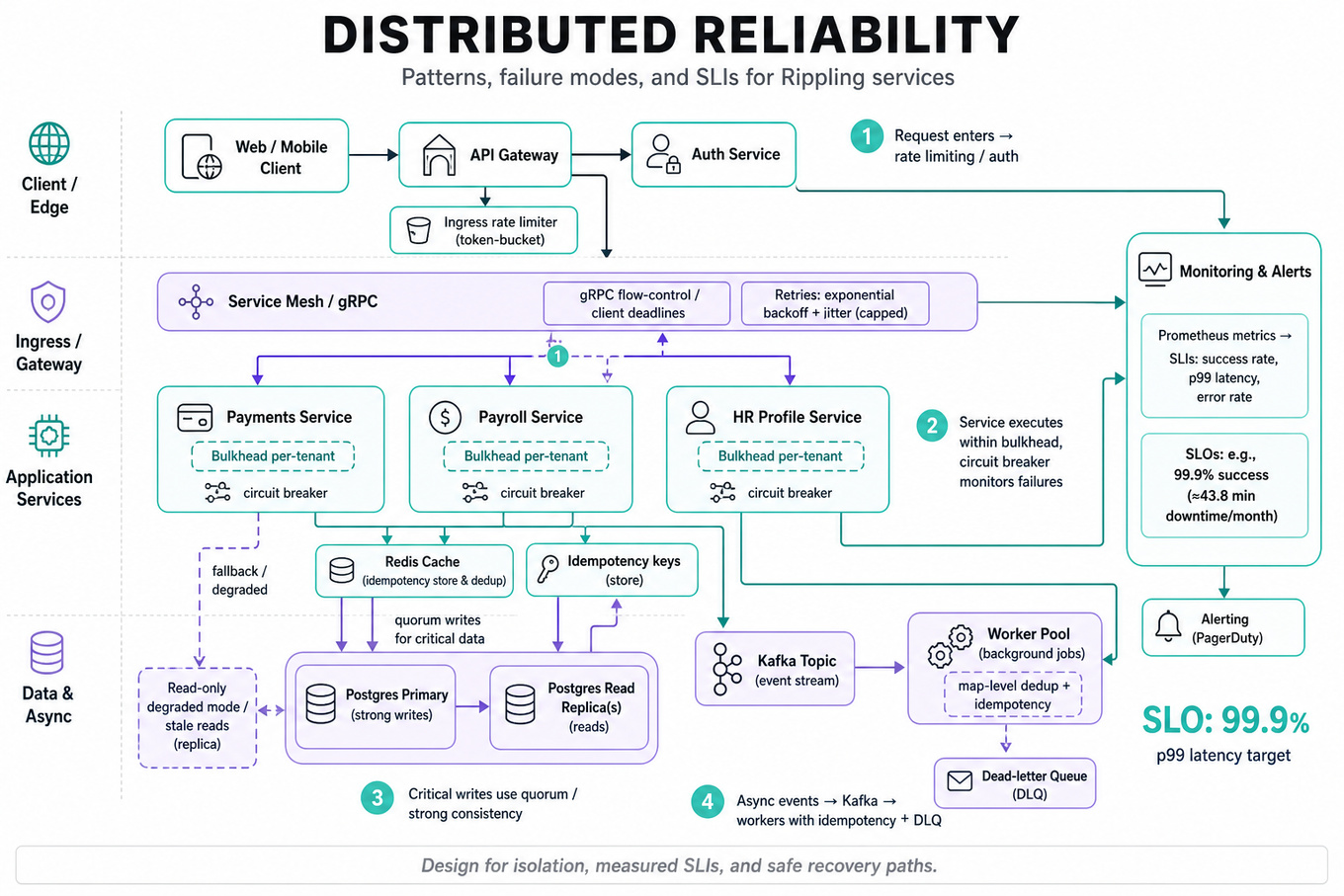
What's being tested
Interviewers are probing your ability to design and implement reliable distributed services that meet availability and correctness targets under realistic failure modes: partial network failure, instance crashes, traffic spikes, and data inconsistencies. Expect to demonstrate tradeoff reasoning between consistency and availability, practical patterns for fault isolation, retries, and idempotency, plus how you measure and validate reliability (SLIs/SLOs). Rippling cares because payroll/HR workflows require high correctness and predictable availability; you should show you can build features that fail safely and recover cleanly.
Core knowledge
-
Service-level indicator (SLI), service-level objective (SLO) and service-level agreement (SLA) basics: SLI is the metric (e.g., success rate, latency
p99), SLO is the target (e.g., 99.9% success), SLA is contractual with penalties; compute availability: 1 - allowable_downtime/total_time (e.g., 99.9% ≈ 43.8 min/month). -
p99 / percentile latency interpretation: optimize tail latencies (p95/p99) separately from mean; measuring percentiles requires windowed histograms (e.g.,
HDR histogram) not simple averages. -
Timeouts and retries: choose conservative timeouts, use exponential backoff with jitter to avoid retry storms. Cap retries and prefer client-side deadlines to prevent cascading overload.
-
Idempotency: design idempotent APIs (idempotency keys, idempotent operations stored in
DB/cache) to safely re-run requests; map-level deduplication for message consumers. -
Backpressure & rate limiting: implement backpressure in RPC layers (
gRPCflow control) and token-bucket or leaky-bucket rate limits at ingress to protect downstream systems. -
Bulkhead and circuit breaker patterns: isolate resources per tenant/flow (bulkhead) and trip failing dependencies early (circuit breaker) to allow graceful degradation rather than total collapse.
-
Data consistency models: know tradeoffs between strong consistency and eventual consistency; use quorum reads/writes for critical data, and asynchronous replication for durable but cheaper availability.
-
Distributed coordination / consensus: for leader election and metadata, rely on proven algorithms like Raft (e.g.,
etcd/consul) rather than homegrown solutions; understand leader/follower failure implications. -
Message delivery semantics: differences between at-least-once, at-most-once, and exactly-once; implement compensating transactions if you cannot achieve exactly-once end-to-end.
-
Observability: instrument traces (
OpenTelemetry), structured logs, and metrics; correlate traces with logs for root cause; define SLO burn rate alerts rather than raw error counts. -
Capacity planning & throttles: model capacity as max concurrent requests = throughput * latency; provision headroom (typically 2–3x expected peak) and tune autoscaling cooldowns to avoid oscillation.
-
Deployment strategies: prefer canary and progressive rollout with
feature flaggating and health metrics; rollback fast when SLOs degrade. -
Testing for reliability: unit/integration tests plus fault-injection/chaos testing (inject network partitions, high CPU, disk I/O errors) in staging to validate assumptions.
Worked example
Problem framing: "Design a reliable distributed payroll processing service." First 30s: clarify correctness invariants (no double-payments), throughput (jobs/hour), latency expectations, and failure domains (network, DB, worker crashes). Skeleton answer pillars: data model and idempotency (unique payroll-run IDs, persistent write-ahead log), execution architecture (task queue with at-least-once delivery + idempotent workers), coordination and ordering (leader for scheduling or time-window sharding), and observability/SLOs (success-rate SLI, p99 processing latency, error budget). Concrete tradeoff: choosing synchronous strong consistency for final payment ledger (quorum write) vs asynchronous reconciliation to improve availability—explicitly state you'll use quorum writes for ledger rows and async event stream for notifications to avoid blocking payments. Close by describing rollout: canary a single customer, monitor SLO burn rate, and if more time, build automated compensating transactions and end-to-end reconciliation reports.
A second angle
Imagine the prompt: "Make an APIs layer resilient to noisy tenant traffic." Same reliability concepts apply but with focus on multi-tenant isolation. You'd frame tenant-level bulkheads (request concurrency and connection pools per-tenant), rate limiting with tenant-specific quotas, and prioritized scheduling so high-value tenants get protected when the system is overloaded. Discuss circuit breakers per downstream dependency and how to surface per-tenant SLI dashboards. A key decision: hard quota enforcement (simple, prevents blasts) vs. soft throttling with backoff hints (better UX); pick based on contractual SLAs and implement both for different tiers.
Common pitfalls
Pitfall: assuming "retries fix everything." Blind retries without idempotency and jitter produce cascading overload and duplicate side effects. Always pair retries with idempotency keys, caps, and randomized backoff.
Pitfall: optimizing average latency instead of tail latency. Focusing on mean response time can hide that
p99spikes break downstream SLIs; design to control tail using queuing limits and resource isolation.
Pitfall: not declaring failure assumptions. Candidates who don't state which guarantees they require (e.g., exactly-once vs at-least-once) risk designing incompatible systems; state SLOs, failure domains, and acceptable tradeoffs upfront.
Connections
Interviewers may pivot to performance optimization (profiling hotspots and reducing p99), data modeling for durability (schema and indexing choices for high-write workloads), or security (secure retries, authentication/authorization at ingress), so be ready to relate reliability decisions to these adjacent concerns.
Further reading
-
Designing Data-Intensive Applications — Martin Kleppmann — deep coverage of consistency models, replication, and fault tolerance.
-
Raft: In Search of an Understandable Consensus Algorithm (Ongaro & Ousterhout) — practical consensus algorithm and tradeoffs.
-
Fault Injection and Chaos Engineering (principles) — guides practical testing of failure modes.
Related concepts
- Distributed Systems Reliability And StorageSystem Design
- Distributed Systems Correctness And IdempotencySystem Design
- Distributed Systems Consistency And Low-Latency DesignSystem Design
- Distributed Systems Consistency, Reliability, And ObservabilitySystem Design
- Reliable API Integration And Distributed DesignSystem Design
- Distributed Storage, Replication, and ConsistencySystem Design