Dynamic Programming and State-Space Optimization
Asked of: Software Engineer
Last updated
What's being tested
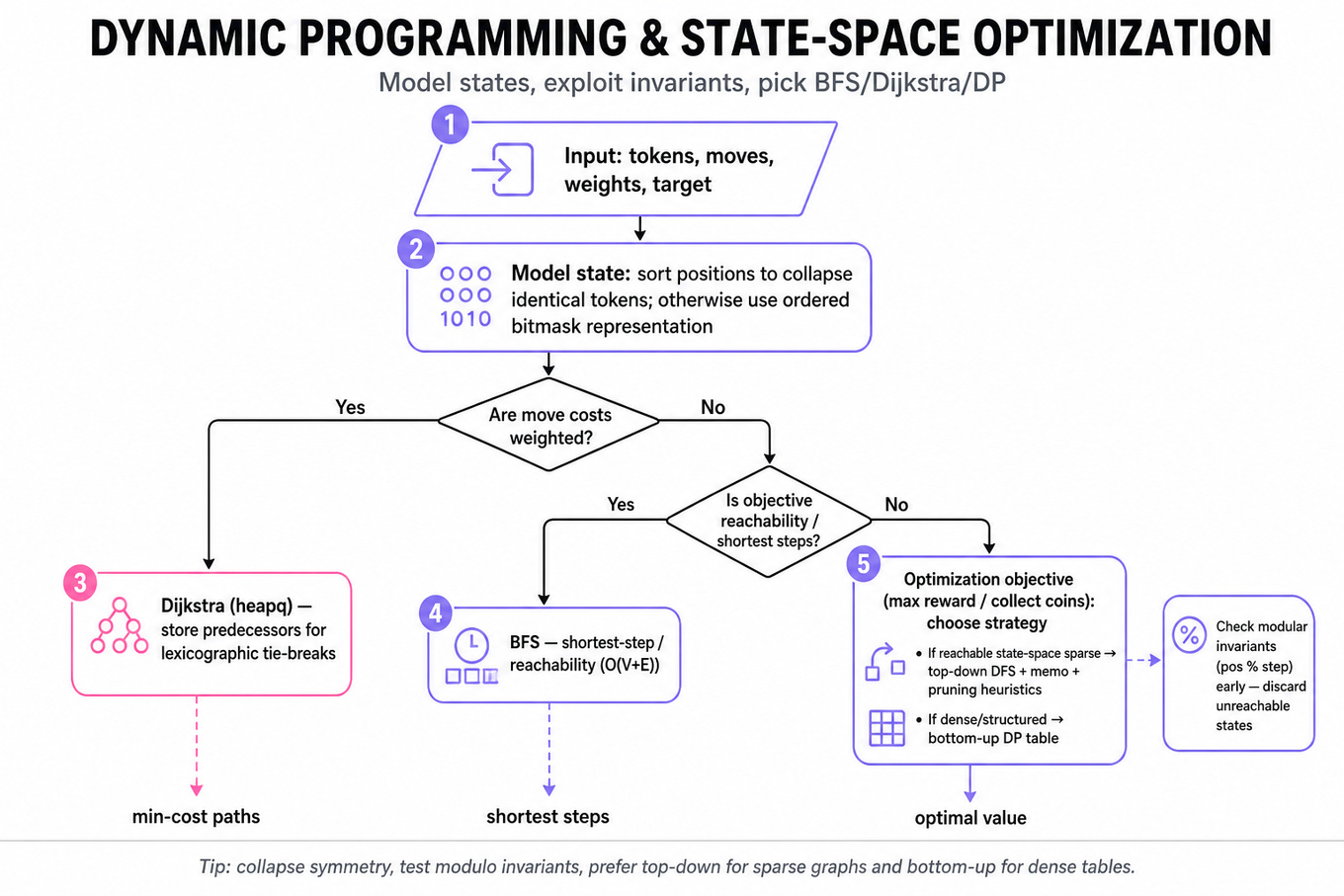
These problems test state-space modeling and dynamic programming (DP): defining compact states, transitions, and value propagation under movement and collision constraints. Interviewers probe whether you can exploit invariants (e.g., modulo classes, symmetry) to reduce exponential state blowup and choose the right search/optimization primitive (memoized dfs, bottom-up dp, bfs, or dijkstra).
Patterns & templates
-
Bitmask DP for small numbers of tokens — represent occupied cells as bits; typical complexity
O(states * transitions)and memoryO(2^k * n). -
Canonical ordering: sort token positions (or canonicalize symmetric states) to avoid counting permutations; reduces state-space by
k!when tokens indistinguishable. -
Modular invariants: reduce positions using modulo classes (e.g., moves of +3 preserve
pos % 3), immediately discarding unreachable targets. -
Use top-down memoization (
dfs+ cache) for sparse reachable state graphs; bottom-updpwhen transition ordering is clear and states dense. -
For weighted single-path problems, use Dijkstra with
heapqfor min-cost; store predecessor to reconstruct lexicographically tiebroken paths. -
Use BFS for reachability or shortest-step counts on unweighted graphs; complexity
O(V+E). -
Tip: prune states with an upper-bound heuristic (e.g., remaining coins max) to speed search when exact optimum needed.
Common pitfalls
Pitfall: Treating identical tokens as distinct causes factorial state explosion; canonicalize positions to collapse equivalent permutations.
Pitfall: Ignoring movement invariants like
pos % step == constantleads to wasted work on unreachable states and wrong feasibility answers.
Pitfall: Assuming greedy local coin collection is optimal; without proof, fallback to DP/search and justify complexity tradeoffs.
Practice these
the practice cards below cover the canonical variants — solve all of them and time yourself
Practice questions
- Find Paths Across a Weighted Binary GridGoogle · Software Engineer · Onsite · medium
- Solve Two Array Optimization ProblemsGoogle · Software Engineer · Onsite · medium
- Maximize coins with tokens moving by +3Google · Software Engineer · Online Assessment · easy
- Solve chat, grid paths, and car rentalsGoogle · Software Engineer · Technical Screen · medium
- Compute max coins with 3-step token movesGoogle · Software Engineer · Online Assessment · easy
- Find fair split of a two-color necklaceGoogle · Software Engineer · Onsite · medium
- Optimize 0/1 to bounded knapsack DPGoogle · Software Engineer · Onsite · medium
- Maximize coins collected by 3-step piecesGoogle · Software Engineer · Onsite · medium
Related concepts
- Dynamic Programming, Backtracking, and State-Space SearchCoding & Algorithms
- Dynamic Programming, Backtracking, And Combinatorial SearchCoding & Algorithms
- Dynamic Programming And MemoizationCoding & Algorithms
- Dynamic Programming, Scheduling, And Set CoverCoding & Algorithms
- Dynamic Programming And Mutable Range QueriesCoding & Algorithms
- Dynamic Programming And Combinatorial CountingCoding & Algorithms