Dynamic Programming Patterns Refresher
Asked of: Software Engineer
Last updated
What's being tested
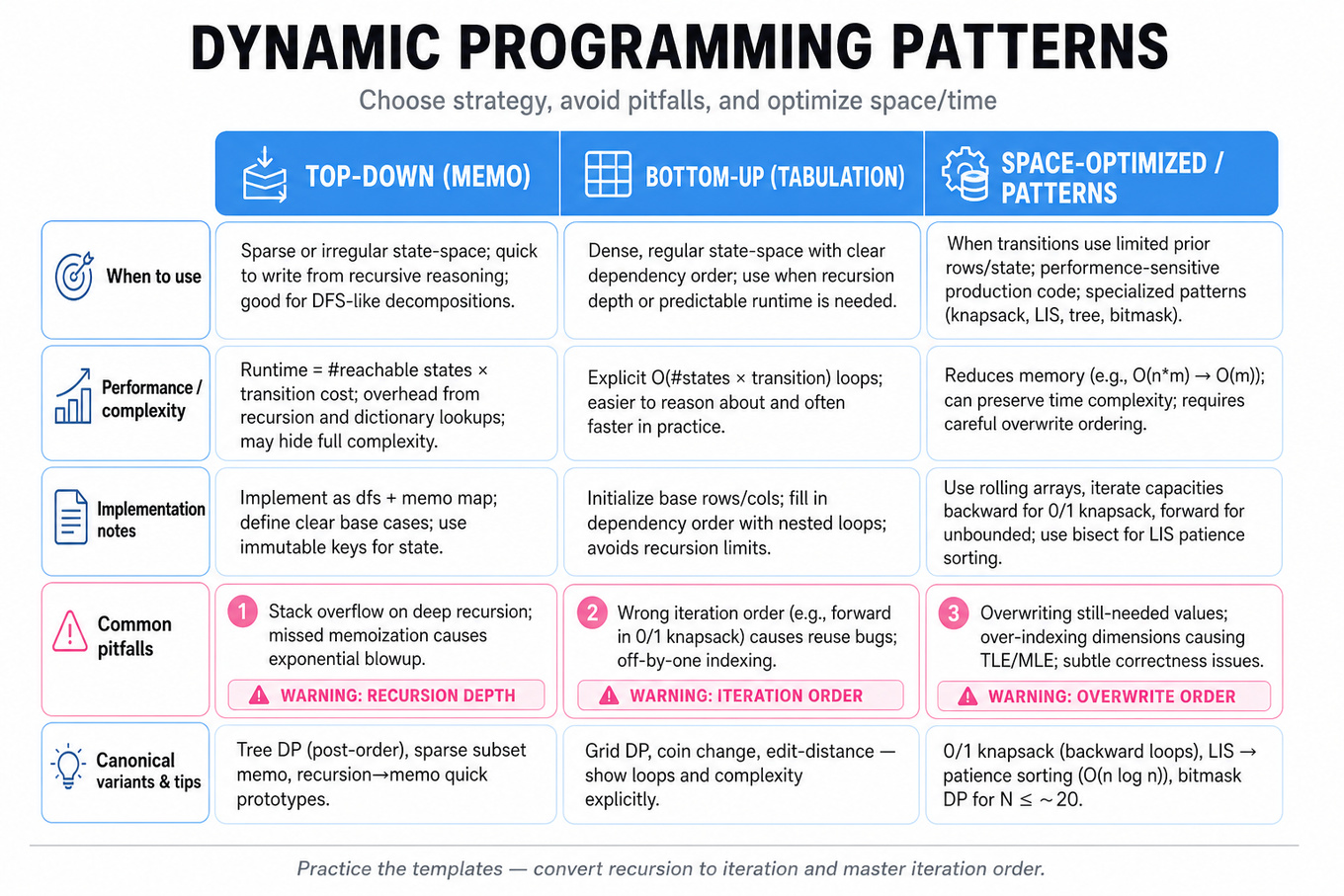
This topic tests your ability to identify a problem's state and transition, pick an appropriate Dynamic Programming strategy (top-down vs bottom-up), and implement it with correct time/space bounds. Interviewers probe whether you can reduce recursion to iterative tables, apply memoization safely, and use space optimization or specialized DP patterns for performance-sensitive production code.
Patterns & templates
-
Top-down memoization with recursion (
`dfs`+`memo`) — map state→result; clear base cases; good for sparse/irregular state-spaces. -
Bottom-up DP table filling — iterate states in dependency order; explicit loops often avoid recursion limits and show complexity easily.
-
Space optimization / rolling array — compress
O(n*m)table toO(m)when transitions only use previous row; verify overwrite order. -
Knapsack / subset DP — iterate capacities backward for 0/1 knapsack to avoid reuse; forward iteration for unbounded knapsack.
-
LIS via patience sorting — transform
O(n^2)DP to O(n log n) with binary search (`bisect`) on tails array. -
Tree DP (post-order) — compute child results, merge into parent; watch for combining multiple child states and commutativity.
-
Bitmask DP for small N (N ≤ ~20) — represent subsets as bits, iterate submasks efficiently, complexity ~
O(N * 2^N).
Common pitfalls
Pitfall: Choosing recursive memoization without handling recursion depth causes stack overflows on large inputs; convert to iterative if necessary.
Pitfall: Incorrect iteration order (e.g., forward in 0/1 knapsack) yields reuse bugs that change problem semantics.
Pitfall: Over-indexing state (too many dimensions) leads to TLE/MLE—always question whether a dimension can be compressed or eliminated.
Practice these
The practice cards below cover the canonical variants — solve all of them and time yourself.
Related concepts
- Dynamic Programming Refresher For Product Coding
- Dynamic Programming Patterns For Coding Interviews
- Dynamic Programming And MemoizationCoding & Algorithms
- Dynamic Programming And Mutable Range QueriesCoding & Algorithms
- Dynamic Programming, Greedy, And Combinatorial OptimizationCoding & Algorithms
- Dynamic Programming and State-Space OptimizationCoding & Algorithms