Dynamic Programming Refresher For Product Coding
Asked of: Software Engineer
Last updated
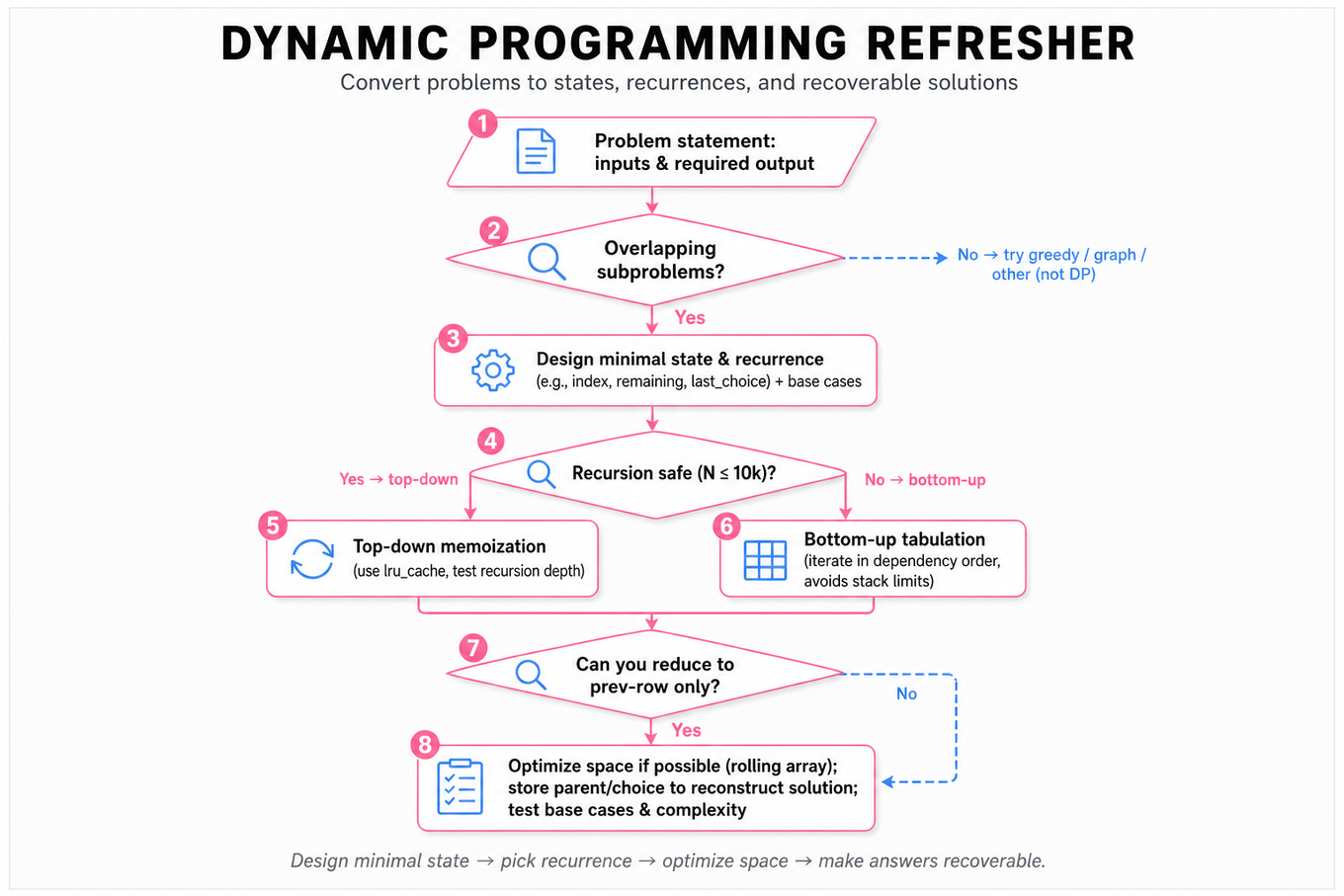
What's being tested
Candidates must demonstrate the ability to convert a problem into a Dynamic Programming formulation: identify overlapping subproblems, define a compact state, and derive a correct transition. Interviewers at Rippling care because product features often require reliable, efficient algorithmic solutions under memory/time constraints, and they expect clear tradeoffs and recoverable answers.
Patterns & templates
-
Top-down memoization with Python
`lru_cache`— natural recursion, time = O(states * avg_transitions), watch recursion depth beyond ~10^4. -
Bottom-up tabulation — iterate in dependency order, fill
`dp`table iteratively, avoids recursion overhead and stack limits. -
State design: include only necessary parameters (index, remaining capacity, last choice); aim for minimal state to avoid exponential blowup.
-
Transition recurrence: write recurrence first, then implement; test base cases like empty input, zero capacity, or single element.
-
Space optimization using a rolling array — reduce O(N*M) to O(M) when DP depends only on previous row.
-
Reconstruction: store
parentorchoicearrays to rebuild solution instead of recomputing decisions. -
Recognize families: linear subsequence, knapsack/partition, interval DP, and tree DP — map problem to a family for fast template reuse.
Common pitfalls
Pitfall: Missing or incorrect base cases (e.g., not handling empty array or negative indices) leads to wrong answers or infinite recursion.
Pitfall: Overengineering state (adding unnecessary dimensions) causes memory blowup and TLE; prefer pruning or greedy if provable.
Pitfall: Using recursion without guarding depth — convert to iterative tabulation when N > ~10^4 to avoid stack overflow.
Practice these
The practice cards below cover the canonical variants — solve all of them and time yourself.
Related concepts
- Dynamic Programming Patterns Refresher
- Dynamic Programming Patterns For Coding Interviews
- Dynamic Programming And MemoizationCoding & Algorithms
- Dynamic Programming And Mutable Range QueriesCoding & Algorithms
- Dynamic Programming, Greedy, And Combinatorial OptimizationCoding & Algorithms
- Dynamic Programming and State-Space OptimizationCoding & Algorithms