Engineering Leadership And Service Ownership
Asked of: Software Engineer
Last updated
What's being tested
Interviewers are probing technical leadership and day-to-day service ownership: your ability to design, operate, and improve a production service end-to-end while influencing cross-functional partners. They want clear evidence you can set and measure reliability (tradeoffs between availability, latency, and cost), run effective incident response, drive pragmatic technical decisions, and communicate impact with metrics. Expect emphasis on concrete examples: architecture choices, incidents you owned, measurable outcomes, and lessons translated into process or code.
Core knowledge
-
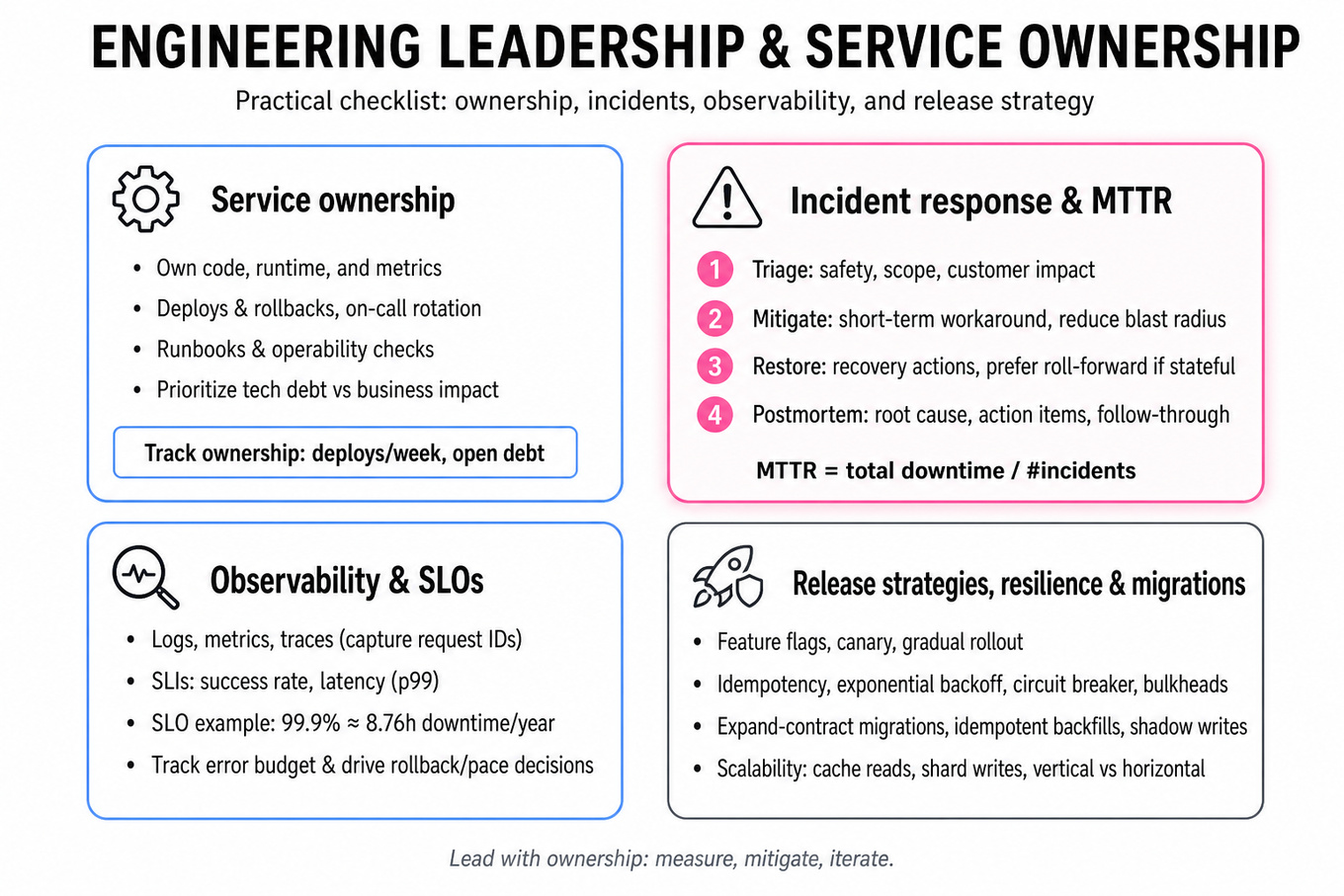
Service Ownership: owning code, runtime, and metrics for a bounded service: deploys, rollbacks, runbooks, on-call rotation, and long-term technical debt prioritization relative to business impact.
-
Incident Response: first 15–30 minutes goals (safety, mitigation, customer communication), Triage → Mitigate → Restore → Postmortem; use a runbook for repeatable incidents.
-
Observability: three pillars—logs, metrics, and traces. Instrument high-cardinality metadata sparingly; capture request ids for distributed traces (
`OpenTelemetry`,`Jaeger`). -
SLIs / SLOs / SLAs: define an SLI (e.g., success rate, latency
`p99`), set an SLO (e.g., 99.9%), and understand SLA legal/financial implications. Uptime math: uptime = 1 − downtime/total; 99.9% ≈ 8.76 hours downtime/year. -
MTTR and error budget: MTTR = total downtime / number of incidents; track to show reliability trend. Use an error budget to balance shipping velocity and stability.
-
Release strategies: feature flags, canary releases, and gradual rollout to limit blast radius; prefer roll-forward over rollback when stateful changes are involved.
-
Resilience patterns: idempotency for retries, exponential backoff for client retries, circuit breaker to avoid cascading failures, bulkhead to isolate resources, and rate limiting at ingress.
-
Data/schema migrations: use expand-contract pattern for online schema changes, backfills with idempotent workers, and blue/green or shadow writes to avoid breaking consumers.
-
Scalability tradeoffs: vertical vs horizontal scaling, caching (in-memory, CDN) when read-heavy, sharding/partitioning strategies when writes exceed single-node limits (shard at ~10M rows per shard depending on workload).
-
Measurement & impact: tie technical work to business/technical metrics (reduce
`p99`latency by X ms, increase throughput by Y RPS, reduce MTTR from A to B). Show baseline, change, and confidence intervals if using A/B style experiments. -
Cross-functional influence: how to align product, SRE, QA, and legal for rollouts; document decisions, own tradeoffs, and escalate when boundaries cross teams.
-
Postmortem discipline: blameless postmortem, clear RCA depth (what, why, fix, action owner, timeline), and verification steps to avoid recurrence.
Worked example — "Describe services you built and lessons learned"
In the first 30 seconds clarify scope: "Do you want a single end-to-end service I owned or multiple? Target scale (RPS, data size) and the critical SLOs?" Frame the answer around four pillars: context (purpose, scale, stack), architecture (key components and tradeoffs), reliability/operational practices (SLOs, monitoring, incident examples), and impact + lessons (metrics and what changed). Skeleton: 1) one-line service summary and constraints (e.g., synchronous checkout service, ~2k RPS), 2) architecture choices (sync vs async, DB choice, caching), 3) a concrete incident and how the team responded (MTTR, mitigation), 4) measurable outcomes and one or two lessons (e.g., added canaries and reduced `p99` by X). Call out one tradeoff explicitly — for example, choosing synchronous consistency for simpler ordering at the cost of higher latency, and why that matched business needs. Close with "if more time" items: deeper architecture diagram, sample runbook excerpts, or demo of monitoring dashboards and the rollout plan for a major migration.
A second angle — "Answer senior behavioral questions"
When answering senior behavioral prompts, focus less on low-level code and more on how you influenced outcomes: describe the problem, stakeholders, constraints, decision process, and measurable results. Emphasize leadership moves (mentoring engineers, negotiating with PMs, changing team priorities) and show technical judgment by documenting alternatives considered and why you rejected them. Use the STAR structure but make the Situation and Task succinct; spend most time on the Action (your architectural/operational choices) and Result (quantified improvement, follow-up changes). Highlight tradeoffs you balanced — for example, accelerating delivery vs maintaining an error budget — and show how you institutionalized learning (runbooks, tooling, postmortems).
Common pitfalls
Pitfall: Telling a success story without measurable outcomes. Interviewers need numbers — cite baselines, deltas, and time windows (e.g., reduced MTTR from 3 hours to 30 minutes within two sprints).
Pitfall: Over-emphasizing product or business rationale while skipping technical ownership. As an engineer, focus on the architecture, reliability practices, and how you implemented or enforced them.
Pitfall: Blaming people or vague "we fixed it" statements in incident narratives. Be specific about actions, tradeoffs, and follow-up fixes; demonstrate a blameless postmortem mindset and concrete prevention steps.
Connections
Interviewers may pivot to deeper system design (scaling a service to 10k RPS), Site Reliability Engineering practices (`SLO`/`error budget` enforcement), or CI/CD and test strategy for safe rollouts (`feature flags`, automated canaries). Be ready to show code-level ownership (deploy scripts, health checks) or to walk an architecture diagram end-to-end.
Further reading
-
Site Reliability Engineering (Google) — canonical practices on SLOs, incident response, and postmortems.
-
[Release It! by Michael T. Nygard] — practical resilience patterns (circuit breakers, bulkheads) and real-world failure stories.
Practice questions
Related concepts
- Technical Leadership, Project Impact And TradeoffsBehavioral & Leadership
- Technical Leadership, Impact, And Trade-OffsBehavioral & Leadership
- Technical Leadership, Project Ownership, And Stakeholder CommunicationBehavioral & Leadership
- Behavioral Ownership, Communication, And LeadershipBehavioral & Leadership
- Behavioral Leadership And Stakeholder ManagementBehavioral & Leadership
- Engineering Ownership, Communication, And AI SafetyBehavioral & Leadership