Project Ownership And Operational Follow-Through
Asked of: Software Engineer
Last updated
What's being tested
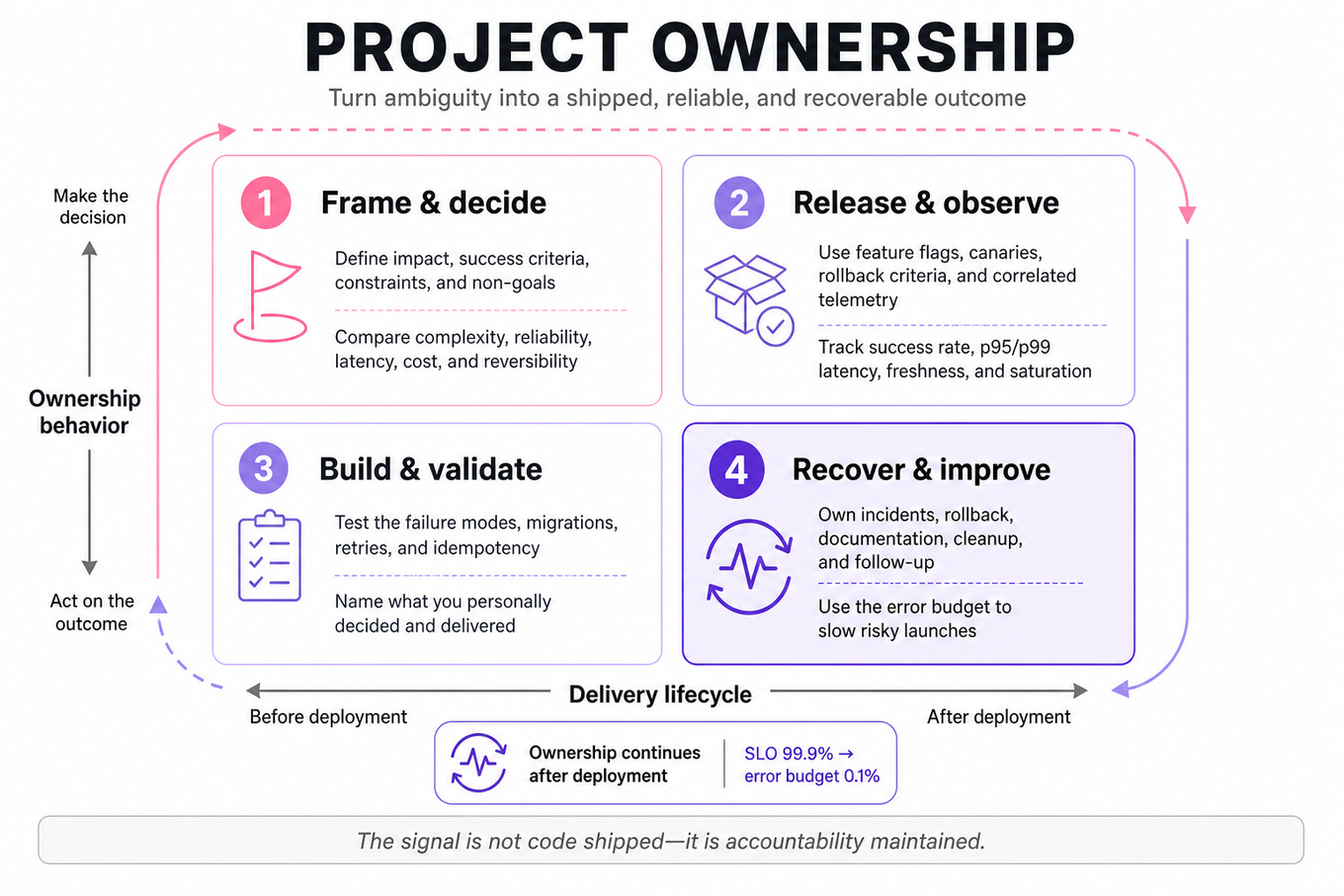
These prompts test end-to-end ownership: turning an ambiguous engineering problem into a shipped solution, making explicit trade-offs, and remaining accountable after deployment. The interviewer is looking for evidence of operational follow-through, not merely that you wrote code or participated on a team. Upstart cares because software engineers work on systems where correctness, reliability, auditability, and recovery directly affect customers and business operations.
Core knowledge
-
Problem framing means defining the user or system impact, success criteria, constraints, and non-goals before proposing implementation. Clarify scale, latency, consistency, availability, migration risk, and who owns adjacent dependencies.
-
Ownership includes discovery, design, implementation, testing, rollout, monitoring, documentation, and cleanup. A strong example names what you personally decided and delivered rather than hiding behind “we built” or taking credit for the entire team.
-
Trade-off analysis should compare alternatives using explicit dimensions: complexity, reliability, latency, cost, operational burden, and reversibility. For example, a synchronous
Postgreswrite may simplify correctness, while an asynchronousKafkaworkflow improves decoupling but introduces retries and eventual consistency. -
Reliability goals should be measurable with SLIs such as success rate, latency, and freshness, and SLOs such as 99.9% successful requests. An error budget is approximately over the measurement window; exceeding it should slow risky launches.
-
Observability requires correlated logs, useful metrics, and distributed traces. Instrument request rate, error rate, latency, saturation, and business-relevant failure states; inspect
p50,p95, andp99rather than relying on averages that hide tail behavior. -
Safe delivery uses small increments, automated tests, feature flags, canary releases, and explicit rollback criteria. A database migration should be backward-compatible first—expand schema, deploy readers/writers, migrate data, then contract—rather than requiring an all-at-once cutover.
-
Idempotency makes retries safe. For a mutating API, accept an idempotency key, persist the result associated with that key, and return the original outcome on duplicate requests; otherwise, timeout recovery can create duplicate charges, records, or actions.
-
Failure handling should distinguish transient failures from permanent ones. Use bounded retries with exponential backoff and jitter, timeouts, circuit breakers, dead-letter handling, and clear ownership; never retry non-idempotent work blindly or allow unbounded queues to exhaust resources.
-
Testing strategy should match risk: unit tests for local logic, integration tests for contracts with
Postgresor external APIs, end-to-end tests for critical paths, and load or failure tests for operational assumptions. Test timeouts, duplicate delivery, partial failure, malformed input, and rollback. -
Incident response is an engineering responsibility, not merely an operations handoff. Mitigate first through rollback, disablement, traffic reduction, or a safe fallback; then identify the trigger, communicate impact and status, preserve evidence, and create concrete follow-up actions.
-
Technical debt prioritization should connect debt to measurable risk: recurring incidents, deployment slowdown, security exposure, or growing change failure rate. A credible plan may ship a narrow fix now while scheduling structural work with an owner, deadline, and acceptance criteria.
-
Communication artifacts make ownership durable: a short design note, decision log, runbook, dashboard link, rollout plan, and post-incident review. State assumptions and unresolved risks explicitly so another engineer can operate or extend the system without depending on you.
Worked example: Demonstrate Project Ownership
In “Demonstrate Project Ownership,” I would first clarify the project’s user impact, my individual scope, scale, success metric, deadline, and whether the interviewer wants a successful delivery or a recovery story. I would state assumptions, such as whether the service was synchronous, what reliability target mattered, and which decisions were mine versus shared with the team. I would organize the answer around five pillars: problem framing, design and trade-offs, implementation and collaboration, rollout and observability, and post-launch results or recovery. I would describe a concrete engineering decision, such as choosing an idempotent asynchronous workflow over a simpler synchronous path because an external dependency had unpredictable latency. I would explicitly acknowledge the cost: eventual consistency and more operational state required stronger status tracking, retries, dashboards, and runbook procedures. I would explain how tests, feature flags, a canary, and rollback criteria reduced deployment risk rather than merely saying “we tested it.” I would quantify the outcome with reliability, latency, incident count, or deployment time, while separating my contribution from the team’s contribution. I would close by saying, “If I had more time, I’d also explain the remaining operational risk, the follow-up owner, and how we validated the system under dependency failure.”
A second angle
For “Professional Introduction for a Recruiter Screen,” the same concept is compressed into a clear narrative rather than a detailed project retrospective. Lead with your engineering identity, then select one ownership example that demonstrates design, delivery, and production responsibility in roughly 60–90 seconds. Emphasize the kinds of systems and problems you want to own next—reliable backend services, safe migrations, or distributed workflows—without drifting into product strategy or unsupported claims. End by connecting that experience to why an engineering role at Upstart is a credible next step.
Common pitfalls
Pitfall: Giving an impressive project summary without proving ownership. “We migrated the service and improved reliability” is analytically weak unless you identify your decisions, the baseline, the measured result, and how you handled setbacks.
Pitfall: Treating launch as the finish line. Saying “QA approved it” or “we monitored it” is too vague; name the dashboard signals, alert thresholds, rollout stages, rollback mechanism, and follow-up work you personally drove.
Pitfall: Overclaiming or giving implementation trivia without a coherent story. A strong answer does not require every class name; it requires clear scope, relevant technical depth, a trade-off, collaboration boundaries, and evidence that you learned from the outcome.
Connections
The interviewer may pivot into incident management, API and distributed-system design, backward-compatible database migrations, observability, or testing and release strategy. They may also ask how you prioritize follow-up work when reliability improvements compete with feature delivery.
Practice questions
Related concepts
- Engineering Leadership And Service OwnershipBehavioral & Leadership
- Program Execution, Launch, And Stakeholder ManagementProduct / Decision Making
- Project Ownership, Impact, And Team FitBehavioral & Leadership
- Ownership, Accountability, And Impact CommunicationBehavioral & Leadership
- Project Ownership, Conflict, And Tradeoff CommunicationBehavioral & Leadership
- Technical Leadership, Project Impact And TradeoffsBehavioral & Leadership