Equivalence Class And Boundary Test Design
Asked of: Software Engineer
Last updated
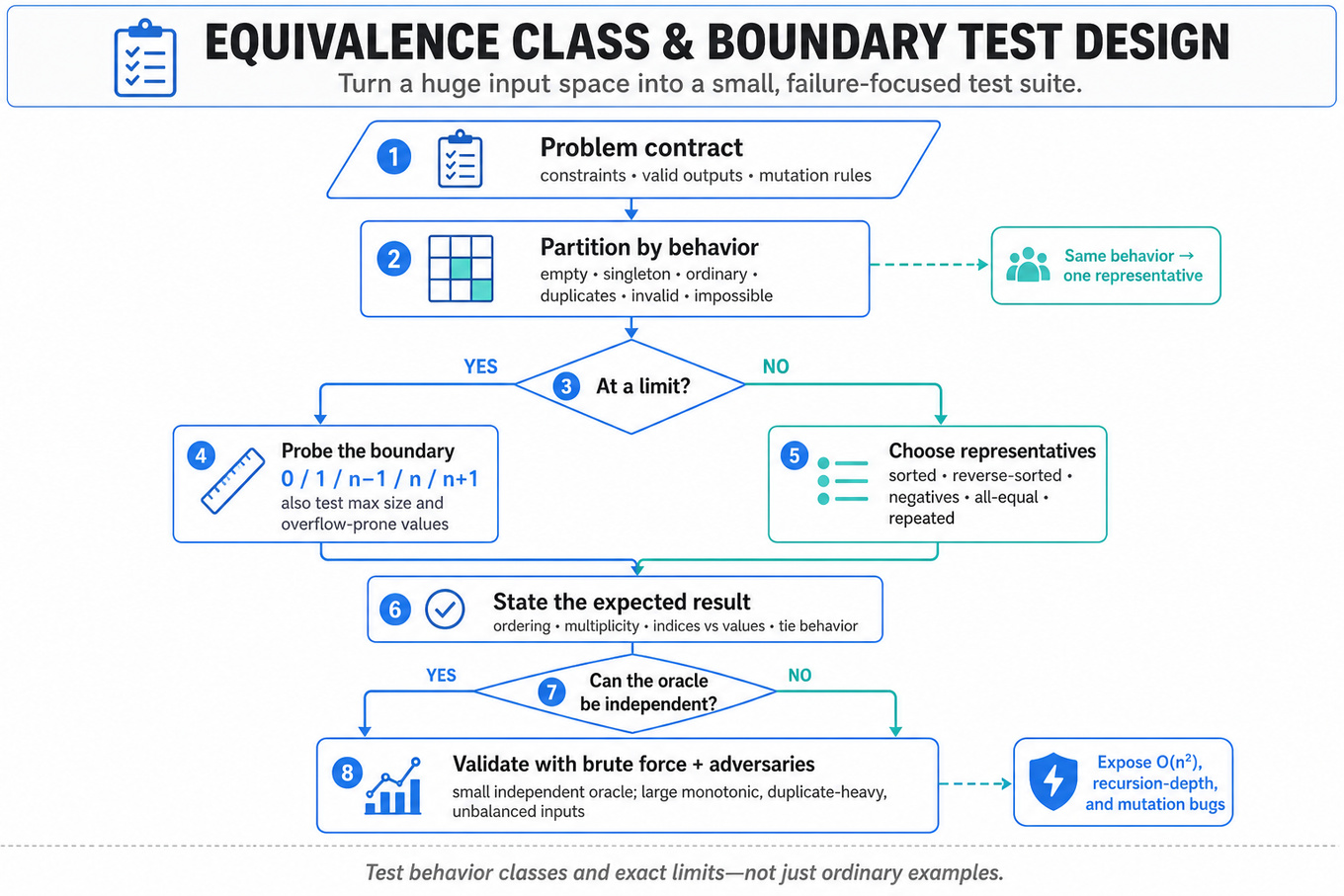
What's being tested
These questions test equivalence-class partitioning and boundary-value analysis for algorithm and data-structure problems. You must reduce a huge input space into representative valid, invalid, empty, minimal, maximal, duplicate, and adversarial cases, then state precise expected outputs. Strong answers connect each case to a likely implementation failure rather than listing random examples.
Patterns & templates
-
Equivalence classes — partition inputs by behavior: empty, singleton, ordinary, duplicate-heavy, invalid, already processed, and impossible-result cases.
-
Boundary testing — check values at, just below, and just above limits:
0,1,n,n-1, maximum size, and overflow-prone magnitudes. -
Array templates — include empty arrays, one element, sorted and reverse-sorted inputs, all-equal values, negatives, repeated values, and answers at both endpoints.
-
String templates — test empty strings, one character, whitespace, mixed case, punctuation, repeated characters, Unicode assumptions, and prefixes that almost match.
-
Expected outputs — verify ordering, multiplicity, indices versus values, stable tie behavior, and whether the function mutates its input.
-
Complexity-aware adversaries — use large monotonic, duplicate-heavy, or highly unbalanced inputs to expose accidental
O(n²)behavior or recursion-depth failures. -
Oracle design — derive expected results independently, preferably with a simple brute-force implementation for small inputs; avoid duplicating the candidate algorithm.
Common pitfalls
Pitfall: Testing only ordinary examples misses empty inputs, singleton behavior, duplicate handling, and “no solution” semantics.
Pitfall: Saying “test large inputs” without specifying the exact constraint boundary fails to distinguish
n = limitfromn = limit + 1.
Pitfall: Confusing invalid-input behavior with a valid empty result; explicitly state whether the API returns an error, sentinel, exception, or empty collection.
Practice these
The practice cards below cover the canonical variants — solve all of them and time yourself.
Practice questions
Related concepts
- A/B Testing And Experiment DesignAnalytics & Experimentation
- A/B Testing And Experiment DesignAnalytics & Experimentation
- A/B Test Design And Sample SizeAnalytics & Experimentation
- A/B Testing, Power, And Experiment DesignAnalytics & Experimentation
- A/B Testing And Experiment DesignAnalytics & Experimentation
- A/B Test Design And Analysis