Group Calls And Messaging Analytics
Asked of: Data Scientist
Last updated
What's being tested
These interviews test whether you can build a measurement and experimentation framework for a social, networked communication product like `Messenger`, `WhatsApp`, or `Facebook Groups`. The interviewer is probing whether you can translate “group call success” into defensible metrics, causal designs, and launch decisions under constraints like network effects, participant caps, call quality, and substitution from existing messaging behavior. Meta cares because group communication features can create durable social value, but naive metrics can overstate impact by double-counting participants, ignoring degraded experience, or cannibalizing healthier interactions.
Core knowledge
-
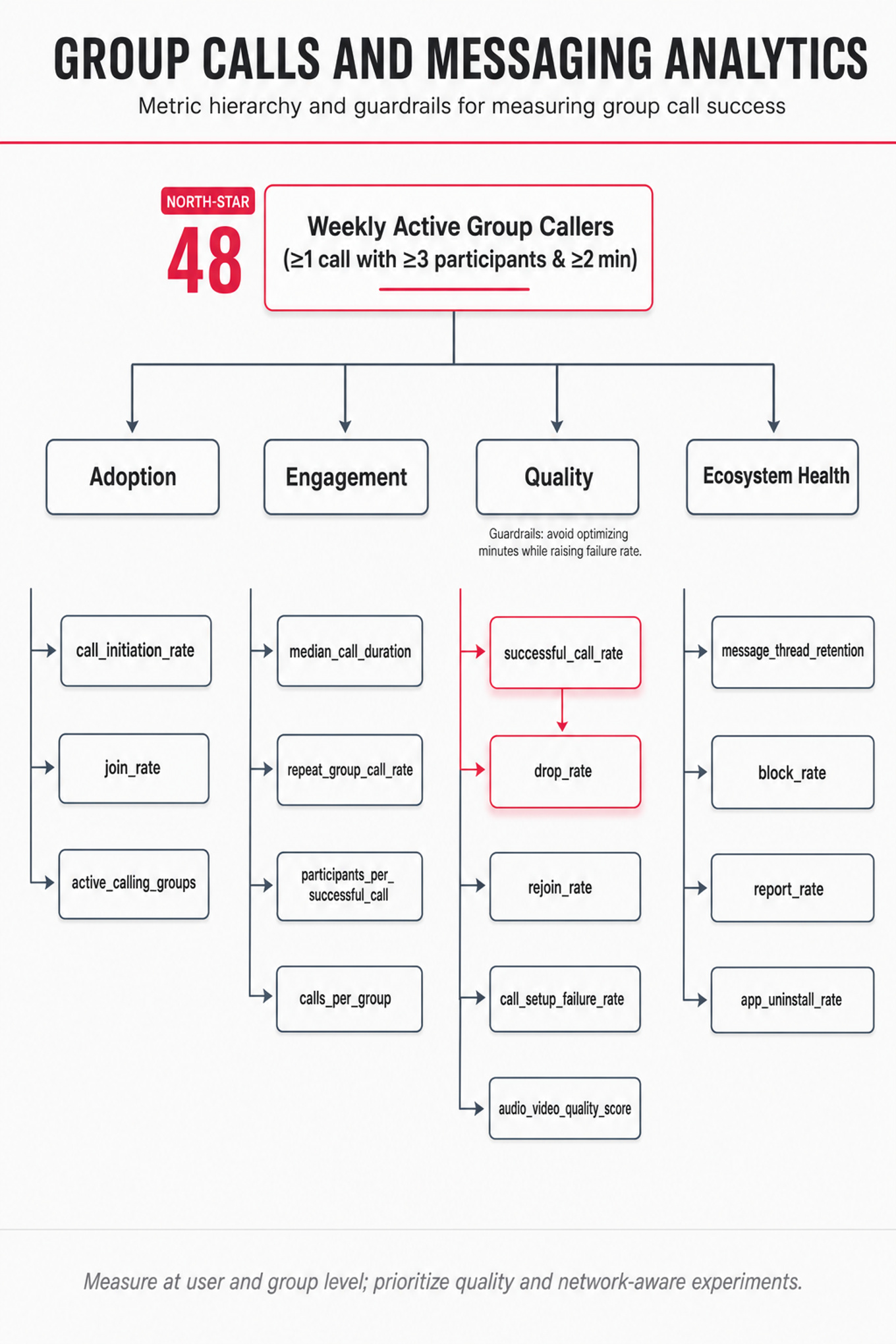
North-star metric should reflect user value, not just volume. For group calling, strong candidates might propose
`Weekly Active Group Callers`with a quality threshold, e.g. users who joined at least one call with participants and duration minutes. -
Metric hierarchy should separate adoption, engagement, quality, and ecosystem health. Examples:
`call_initiation_rate`,`join_rate`,`successful_call_rate`,`median_call_duration`,`repeat_group_call_rate`,`message_thread_retention`,`block_rate`,`report_rate`, and`app_uninstall_rate`. -
Success definition needs participant-level and group-level views. A call with 8 participants is not simply “8 successes”; analyze
`calls_per_group`,`active_calling_groups`, and`participants_per_successful_call`to avoid overweighting large groups or viral edge cases. -
Retention metrics should be precise. Define
`D7 group-call retention`as: among users who completed a qualifying group call on day 0, the share who complete another qualifying group call on days 1–7. Distinguish app retention from feature retention. -
Call quality guardrails matter because engagement can rise despite bad experiences. Track
`drop_rate`,`rejoin_rate`,`call_setup_failure_rate`,`audio_video_quality_score`,`participant_abandonment_rate`, and post-call negative feedback. A launch should not optimize minutes while increasing failed sessions. -
Network interference is central. If one treated user starts a group call, untreated friends may receive invitations and experience the product. User-level randomization violates SUTVA; consider cluster randomization by conversation thread, social graph community, family group, or geographic market.
-
Cluster experiments trade bias for variance. Randomizing at group/thread level reduces contamination but lowers effective sample size. Effective sample size is roughly where is average cluster size and is intra-cluster correlation.
-
Tie strength and group affinity are useful segmentation features. Proxies include historical message volume, reciprocity, co-participation in group chats, friend age, prior 1:1 calls, reaction/comment history, and group size. Strong ties may show higher conversion but lower incremental lift.
-
Substitution analysis prevents false wins. Group calls may replace 1:1 calls, voice notes, or text messages. Evaluate net communication value: group-call minutes, total call minutes, messages, and downstream
`D7`/`D28`retention. -
Experiment unit choice should match treatment mechanics. If the feature appears inside a group thread, randomize at
`thread_id`; if discovery is user-level, randomize at user or ego-network. If participant caps differ, randomize eligible groups to avoid mixed experiences. -
Launch decisioning should combine primary lift, guardrails, and heterogeneous effects. A plausible rule: launch if
`successful_group_calls_per_1K_users`rises by , no statistically or practically significant harm to`app_retention`,`report_rate`, or`call_failure_rate`, and lift generalizes beyond power users. -
Forecasting adoption can use proxy products. Estimate reachable audience from existing group messaging: eligible groups with active members, recent synchronous activity, prior media sharing, or overlapping online windows. Then apply funnel assumptions: exposed initiates joins repeats.
Worked example
For “Design analytics and experiment for group video calls”, a strong first 30 seconds would clarify the product surface: “Is this inside existing group chats, does everyone get video capability, and is success about incremental communication or replacing external tools?” Then state an assumption: the feature lets users start a video call from a group message thread with at least three members. I would organize the answer around four pillars: instrumentation, metric framework, experiment design, and launch analysis. For instrumentation, I would need event-level signals like call start, invite sent, participant joined, participant left, failure reason, duration, and post-call feedback, while treating these as analysis inputs rather than designing the pipelines. For metrics, I would define a primary metric such as `successful_group_video_calls_per_eligible_thread` and guardrails like `drop_rate`, `report_rate`, and `D7 app retention`.
The key design decision is randomization unit: user-level randomization is tempting, but group calls create spillovers because one enabled user can invite untreated users. I would prefer thread-level or cluster-level randomization, accepting lower power to improve causal validity. I would also segment by group size, historical activity, and tie strength because a family group and a large school group have different expected behavior. I would close by saying: “If I had more time, I’d add a power analysis accounting for cluster correlation and a substitution analysis versus existing messages and 1:1 calls.”
A second angle
For “Should We Launch Group Calling?”, the framing shifts from design to decision quality. Instead of listing all possible metrics, lead with a launch rubric: primary lift, quality guardrails, ecosystem effects, and segment consistency. You would discuss whether the observed increase in `group_call_minutes` is incremental or merely cannibalizing healthier communication, and whether harms are concentrated in vulnerable segments such as low-connectivity markets or very large groups. The causal challenge remains network interference, but the answer should emphasize interpreting evidence under uncertainty: confidence intervals, practical significance, novelty effects, and whether to launch globally, ramp gradually, or target high-affinity groups first.
Common pitfalls
Pitfall: Optimizing for raw
`call_minutes`as the success metric.
This is analytically weak because long calls can reflect stuck sessions, poor call termination, or a small number of heavy users. A better answer defines a quality-adjusted metric, such as completed group calls above a minimum duration with acceptable drop rate, paired with retention and satisfaction guardrails.
Pitfall: Ignoring spillovers and saying “just run a 50/50 user A/B test.”
For social communication products, treated and control users interact directly. A stronger answer explicitly identifies interference, proposes thread-level or cluster randomization, and explains the tradeoff: less contamination but lower statistical power due to correlated outcomes.
Pitfall: Giving a metric laundry list without a decision framework.
Interviewers want to know how you would decide, not whether you can name twenty metrics. Lead with one primary metric, a few diagnostic metrics, and hard guardrails; then explain how those metrics map to launch, iteration, or rollback.
Connections
Interviewers may pivot to network experiments, causal inference with interference, retention metric design, or marketplace/social graph segmentation. If they push on measurement validity, expect follow-ups on cluster randomized trials, difference-in-differences, heterogeneous treatment effects, or novelty-effect monitoring after launch.
Further reading
-
Trustworthy Online Controlled Experiments — Kohavi, Tang, and Xu’s practical guide to experimentation, guardrails, power, and launch decisioning.
-
Causal Inference for Statistics, Social, and Biomedical Sciences — Imbens and Rubin’s foundational treatment of potential outcomes and causal validity.
-
Aronow and Samii, “Estimating Average Causal Effects Under General Interference” — useful for understanding why social product experiments violate standard independent-treatment assumptions.
Practice questions
- How would you measure Group Call success?Meta · Data Scientist · Technical Screen · medium
- Design and analyze a group-calls experimentMeta · Data Scientist · Technical Screen · medium
- Compute video-call SQL metrics with edge casesMeta · Data Scientist · Technical Screen · medium
- Design and evaluate P2P payments in messagingMeta · Data Scientist · Onsite · hard
- Design an A/B test for WhatsApp call reliabilityMeta · Data Scientist · Onsite · hard
- Design experiment for Group Calls with interferenceMeta · Data Scientist · Technical Screen · hard
- Design analytics and experiment for group video callsMeta · Data Scientist · Technical Screen · hard
Related concepts
- Group Calls And Messaging ExperimentsAnalytics & Experimentation
- Messenger, Group Calling, And Networked AdoptionAnalytics & Experimentation
- Video Calling And Group Calls Product AnalyticsAnalytics & Experimentation
- Notifications And Push Notification AnalyticsAnalytics & Experimentation
- Adobe Real-Time Collaboration Messaging
- Google Meet Reliability And Renewal AnalyticsAnalytics & Experimentation