Group Calls And Messaging Experiments
Asked of: Data Scientist
Last updated
What's being tested
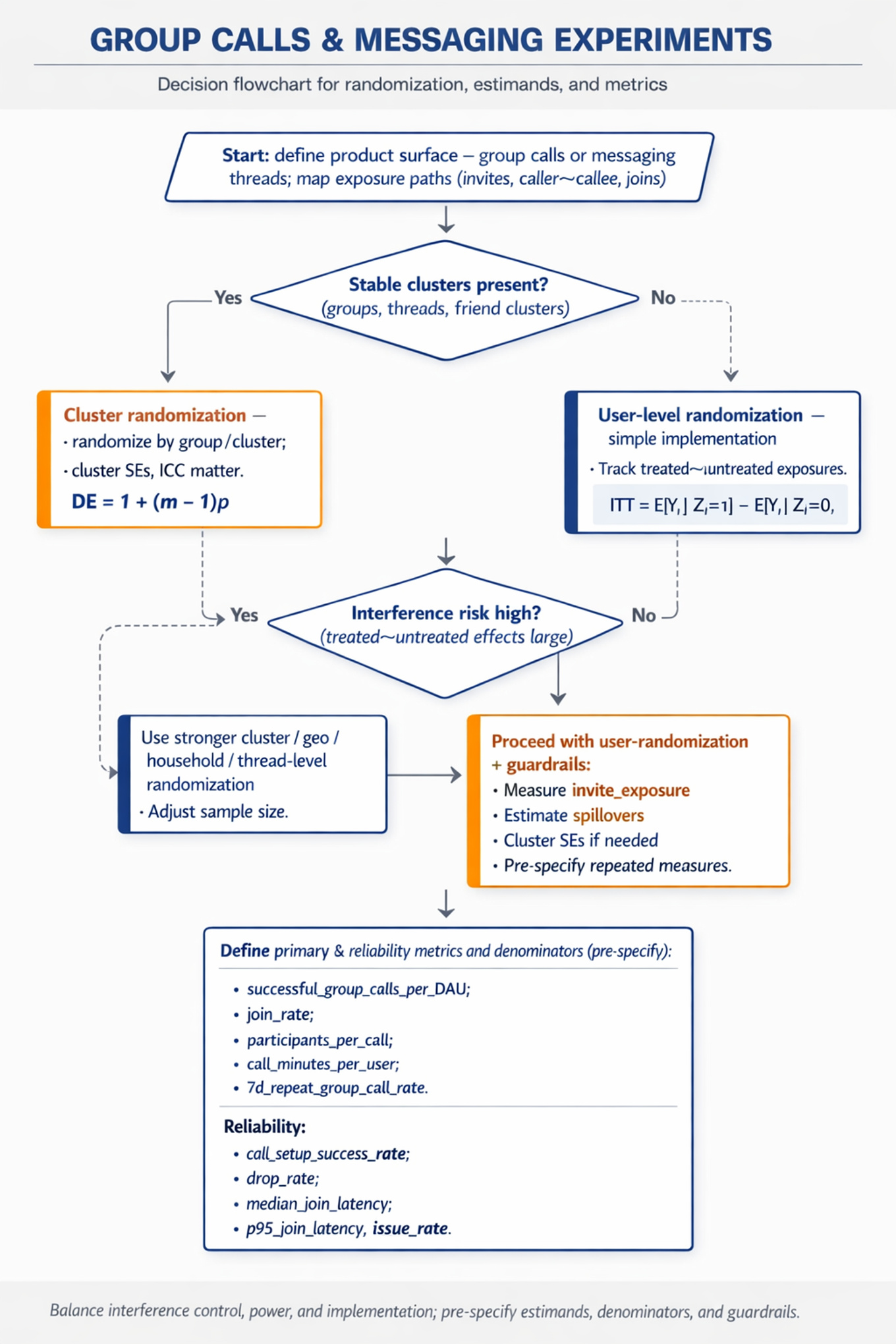
Meta is probing whether a Data Scientist can design credible analytics and experiments for products where usage is social, repeated, and two-sided: group calls, messaging threads, `WhatsApp` calls, `Messenger` rooms, and similar communication surfaces. The hard part is not choosing “conversion rate”; it is defining the right unit of analysis, handling network interference, separating adoption from quality, and interpreting metrics when one user’s treatment can affect untreated friends. Interviewers want to see whether you can move from product ambiguity to measurable hypotheses, experiment design, causal estimands, guardrails, and launch reasoning.
Core knowledge
-
Group communication metrics should separate funnel stages:
call_initiated,invite_sent,participant_joined,call_connected,call_ended, andcall_failed. Good primary metrics includesuccessful_group_calls_per_DAU,join_rate,participants_per_call,call_minutes_per_user, and7d_repeat_group_call_rate. -
Reliability metrics need denominator discipline. Use
call_setup_success_rate = connected_calls / attempted_calls,drop_rate = abnormal_ends / connected_calls,median_join_latency,p95_join_latency, andaudio_video_quality_issue_rate. Distinguish caller-side failure, callee-side failure, and multi-party partial failure. -
Experiment unit choice is central. User-level randomization is simple but can violate SUTVA when treated users call untreated users. Alternatives include thread-level, group-level, household/social-cluster-level, or geo-level randomization, each trading off interference reduction against power and implementation complexity.
-
Interference means treatment assigned to one user changes another user’s outcome. For calls, exposure is often two-sided: a user may be control but receive treated invites. Define estimands explicitly, such as intent-to-treat: and track spillover exposure separately.
-
Cluster randomization helps when stable groups exist, such as messaging groups or high-affinity friend clusters. Analysis should cluster standard errors at the randomization unit, not the event level. Effective sample size falls with intra-cluster correlation: where is cluster size and is ICC.
-
Repeated measures are common because heavy callers generate many events. Avoid treating every call as independent if randomization is by user. Aggregate to user-day, user-week, or cluster-level metrics, or use regression with clustered standard errors / mixed effects as a sensitivity check.
-
Tie strength and group affinity can guide segmentation and pre-analysis. Useful signals include prior messages exchanged, historical 1:1 calls, common group memberships, response latency, co-participation in threads, and reciprocity. These are analytical covariates, not product goals by themselves.
-
Primary metric selection should match the feature hypothesis. For a participant-cap increase,
group_calls_with_3plus_participants_per_DAUmay be better than total calls. For reliability work,successful_call_minutes_per_attempting_usermay capture both connection success and downstream usage. -
Guardrail metrics should catch user harm and ecosystem tradeoffs:
1:1_call_minutes,message_sends,block_rate,report_rate,notification_mute_rate,battery_related_complaints,app_crash_rate, andcall_quality_issue_rate. A group-call win that cannibalizes healthy messaging may still launch, but only with clear interpretation. -
Power analysis should respect low base rates and clustering. For a binary metric, approximate sample per arm with then inflate by design effect for clusters and by variance from user heterogeneity.
-
Proxy-product forecasting matters before launch when there is no exact historical feature. Estimate potential demand from adjacent behaviors: group chats with high message velocity, repeated 1:1 calls among the same triads, missed-call retries, or events where users sequentially call multiple friends in a short window.
-
Edge cases in call data include duplicated events, reconnects, overlapping sessions, users joining late, abandoned invites, multiple devices, and calls crossing date boundaries. For DS analysis, state how you would deduplicate attempts and define a canonical call/session before computing metrics.
Worked example
For Design experiment for Group Calls with interference, a strong candidate first frames the problem: “What exactly is changing—entry point, call quality, participant cap, ranking of suggested invitees, or notification behavior? Is treatment visible only to initiators, joiners, or everyone in the call?” Then they declare that ordinary user-level A/B testing is risky because a treated initiator can invite untreated friends, contaminating outcomes. The answer can be organized into four pillars: define the product hypothesis and metrics, choose the randomization unit, measure spillovers, and analyze launch tradeoffs.
For metrics, they might propose group_call_initiation_rate or successful_group_calls_per_DAU as primary, with call_setup_success_rate, p95_join_latency, 1:1_call_minutes, and negative_feedback_rate as guardrails. For design, they would compare user randomization against group/thread/social-cluster randomization. A key tradeoff: cluster randomization reduces interference but lowers power because users inside clusters behave similarly, so the experiment may need more time or broader coverage. They should explicitly define the estimand, usually ITT at the cluster or user level, and avoid overclaiming treatment-on-treated effects unless exposure is measured cleanly. They can add segmentation by group size, prior call frequency, region/network quality, and tie strength. A strong close would be: “If I had more time, I would run sensitivity analyses for spillover, compare user-level and cluster-level estimates, and validate whether gains persist in repeat usage after novelty decays.”
A second angle
For Design an A/B test for WhatsApp call reliability, the same experimentation logic applies, but the product change is quality rather than social adoption. The exposure problem is still two-sided: a caller and callee may be on different variants, and a reliability improvement may only work if both endpoints receive it. The metric emphasis shifts from group formation to call_setup_success_rate, drop_rate, join_latency, and call_minutes_per_attempt. The randomization decision may favor conversation-pair, user-cluster, or geo/device strata depending on where interference arises. The candidate should also discuss heterogeneous effects by network type, OS, app version, country, and baseline reliability, because a global average can hide regressions in low-bandwidth markets.
Common pitfalls
Pitfall: Treating calls as independent rows.
A tempting but wrong answer is to compute millions of call-level observations and run a vanilla t-test. That ignores repeated usage and social clustering; heavy callers dominate the estimate and standard errors are too small. A better answer aggregates to the randomization unit or uses clustered standard errors.
Pitfall: Choosing a metric that rewards spammy behavior.
invites_sent_per_user may increase if the feature creates noisy notifications, but that is not necessarily product value. Prefer success- and retention-weighted metrics such as successful_group_calls_per_DAU, repeat_group_call_rate, and participants_joined_per_invite, paired with mute/block/report guardrails.
Pitfall: Hand-waving interference instead of designing around it.
Saying “randomize users 50/50 and compare treatment versus control” is shallow for social products. Interviewers expect you to name the interference mechanism, pick a feasible mitigation such as cluster randomization, and explain residual bias if cross-cluster communication remains.
Connections
Interviewers may pivot from this topic into network experiments, cluster-randomized trials, causal inference with spillovers, metric design for social products, or SQL-based event aggregation for calls and messages. They may also ask about novelty effects, heterogeneous treatment effects, or how to make a launch recommendation under conflicting primary and guardrail metrics.
Further reading
-
Trustworthy Online Controlled Experiments — Kohavi, Tang, and Xu’s practical reference for A/B testing, metrics, power, and pitfalls.
-
Aronow and Samii, “Estimating Average Causal Effects Under General Interference” — useful for formalizing spillovers beyond standard SUTVA assumptions.
-
Causal Inference for Statistics, Social, and Biomedical Sciences — Imbens and Rubin’s foundation for potential outcomes, estimands, and randomized experiments.
Practice questions
- How would you measure Group Call success?Meta · Data Scientist · Technical Screen · medium
- Design and analyze a group-calls experimentMeta · Data Scientist · Technical Screen · medium
- Compute video-call SQL metrics with edge casesMeta · Data Scientist · Technical Screen · medium
- Design and evaluate P2P payments in messagingMeta · Data Scientist · Onsite · hard
- Design an A/B test for WhatsApp call reliabilityMeta · Data Scientist · Onsite · hard
- Write SQL to analyze Group Calls adoptionMeta · Data Scientist · Technical Screen · medium
- Design experiment for Group Calls with interferenceMeta · Data Scientist · Technical Screen · hard
- Design analytics and experiment for group video callsMeta · Data Scientist · Technical Screen · hard
Related concepts
- Group Calls And Messaging Analytics
- Messenger, Group Calling, And Networked AdoptionAnalytics & Experimentation
- Video Calling And Group Calls Product AnalyticsAnalytics & Experimentation
- Chat System Design and Message DeliverySystem Design
- Metrics Monitoring And ExperimentationSystem Design
- Experimentation, A/B Testing, And Product MetricsBehavioral & Leadership