Video Calling And Group Calls Product Analytics
Asked of: Data Scientist
Last updated
What's being tested
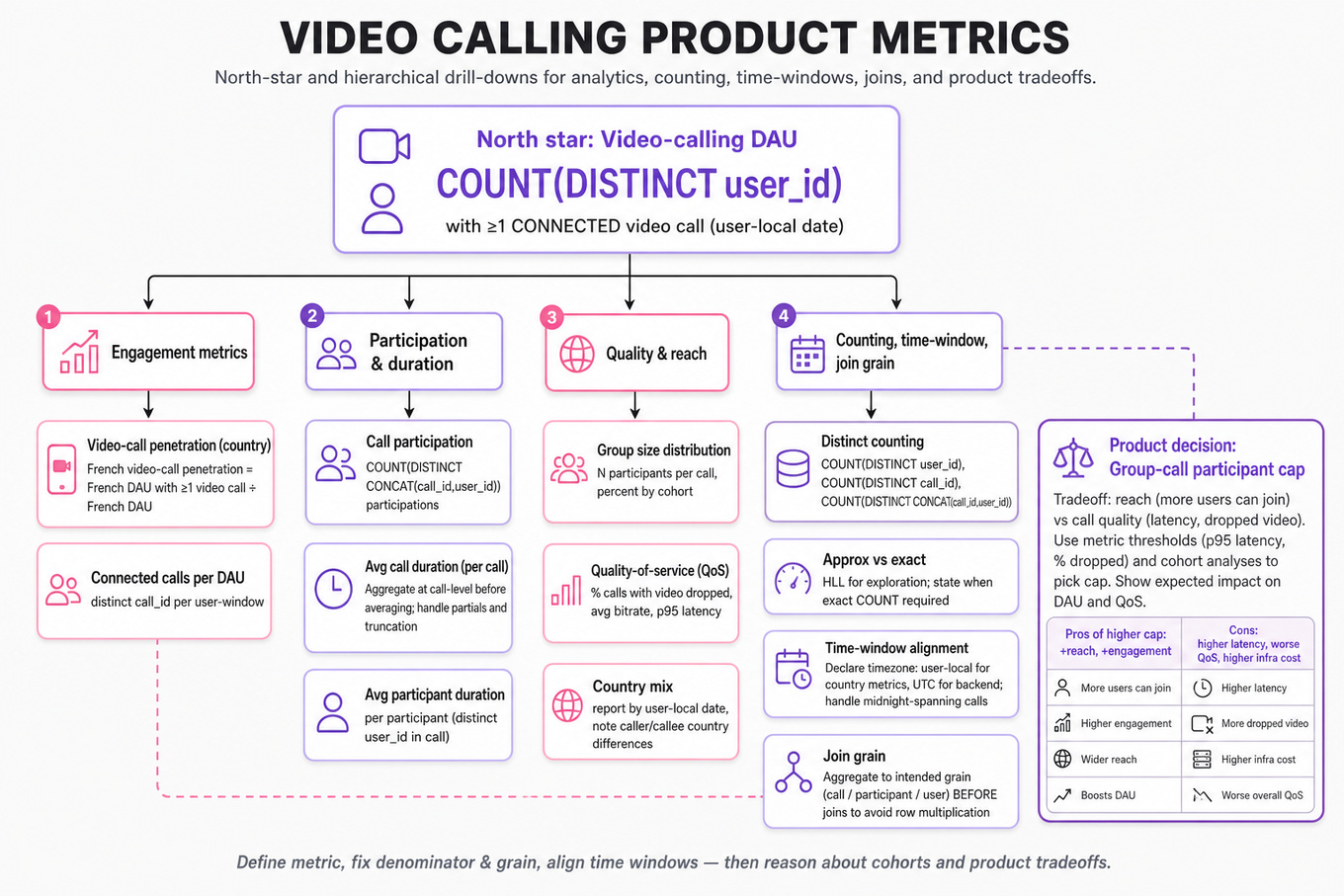
Interviewers are probing whether you can turn video-call event logs and user dimensions into reliable product metrics, then reason about trends, cohorts, and tradeoffs without overclaiming causality. For Meta, calling products are high-scale social surfaces where small metric definitions can change conclusions: `DAU`, call participation, call duration, country mix, group size, and quality-of-service all interact. A strong Data Scientist must define the denominator, join logic, time window, and segmentation before computing anything. The deeper version is deciding how a metric should guide product decisions, such as choosing a group-call participant cap that balances reach against call quality.
Core knowledge
-
Metric definition is the first step, not an afterthought. For video calling, distinguish
call_initiated,call_connected,participant_joined,participant_left, andcall_ended. “Used video calling” usually means at least one connected video-call participation, not merely seeing or tapping the call button. -
Denominator discipline matters for percentages. A metric like French video-call penetration should usually be not calls divided by users, not video-call users divided by all global users, and not participants divided by
`DAU`if the same user can appear multiple times. -
Distinct counting is central in calling analytics. Use
COUNT(DISTINCT user_id)for users,COUNT(DISTINCT call_id)for calls, and sometimesCOUNT(DISTINCT CONCAT(call_id, user_id))for participations. At Meta scale, approximate methods like HyperLogLog may be used for exploration, but interview answers should state when exactness is required. -
Time-window alignment prevents silent bias. “Yesterday” needs a declared timezone, often user-local date for country-level product analytics or
`UTC`for backend-consistent reporting. Cross-country comparisons can change if a call spans midnight or if caller and callee are in different countries. -
Join grain is the most common source of wrong answers. User tables are often one row per user, while call logs are many rows per call or participant. Joining a call-level table to a participant-level table can multiply rows; aggregate at the intended grain before computing
avg_duration,`DAU`, or call counts. -
Duration metrics require clear semantics. Call duration may mean end-to-end
call_end_ts - call_start_ts, connected duration only, or per-user watch/listen time. For group calls, total participant-minutes is \sum_i (\text{leave_ts}_i - \text{join_ts}_i) while call duration is max end minus min start; these answer different product questions. -
Country segmentation has edge cases. Country can come from profile, SIM, IP geolocation, or user-local locale; each has different noise. For cross-country calls, decide whether to attribute by caller country, callee country, all participant countries, or country-pair tuples like
FR→US. -
Trend analysis should separate volume, rate, and composition. If video-call minutes rise in India, ask whether
`DAU`rose, video-call penetration rose, calls per caller rose, or average duration rose. A useful decomposition is:
-
Distribution analysis is often better than averages. For group-call participant caps, inspect percentiles such as
p50,p90,p95, andp99of max concurrent participants per call. Averages hide rare but important large calls; caps are naturally percentile-driven decisions. -
Quality tradeoffs should be quantified with an explicit objective. If
`MOS`decreases with participant count, define an expected utility such as or compare incremental reach from increasing capkagainst incremental quality degradation. -
Causal claims need experimental or quasi-experimental support. Observing that longer calls increased after a launch is not enough; seasonality, country mix, holidays, or network conditions may explain it. For product changes, propose an
`A/B`test with guardrails like crash rate, call setup failure,`p95`join latency, and negative social feedback. -
Small segments require uncertainty estimates. A country-date metric with few
`DAU`can be noisy. For a proportion, use an approximate standard error and avoid overinterpreting day-over-day swings where confidence intervals overlap.
Worked example
For Choose group-call participant cap via distribution, a strong candidate would start by clarifying the decision: “Are we choosing a hard maximum participant count for all users, or evaluating a default cap with exceptions for certain countries, devices, or network conditions?” They would also ask what the objective is: maximize successful group-call participation, preserve perceived quality measured by `MOS`, reduce call failures, or protect server/client performance as reflected in user-facing metrics.
The answer should be organized around four pillars. First, define the unit of analysis: one group call, with features like max concurrent participants, country mix, device class, network type, duration, and quality outcomes. Second, inspect the participant-count distribution: p50, p90, p95, p99, share of calls above candidate caps, and share of users affected. Third, model the quality relationship, for example estimating average `MOS` or call-failure probability by participant count while controlling for country, device, network, and call duration. Fourth, compare policies: cap at 8, 16, 32, or adaptive thresholds based on predicted quality.
The key tradeoff is that a cap may affect a tiny fraction of calls but a highly engaged or strategically important user segment. For example, a cap of 16 may cover 98% of calls, but if the remaining 2% are long, recurring community calls, the lost participant-minutes could be meaningful. A good candidate would avoid saying “choose p95” mechanically; instead, they would weigh marginal coverage against marginal quality degradation and propose guardrail metrics.
They should also flag that the observed historical distribution may be censored by the existing cap. If today’s product already limits calls to 16 participants, the data cannot reveal true demand above 16 without an experiment, waitlist, failed-invite data, or a temporary cap increase. A strong close would be: “If I had more time, I’d validate the recommendation with an `A/B` test that randomizes eligible calls or users to different caps, monitors `MOS`, join success, participant-minutes, retention, and complaint rates, and checks heterogeneity by market and network quality.”
A second angle
For Calculate Video Call Usage Metrics by Country and Date, the same skill set becomes more operational and metric-definition heavy. Instead of choosing a policy, the task is to produce a trustworthy country-date panel: date, country, `DAU`, video-call users, video-call user percentage, total video-call duration, and duration per `DAU`. The main constraint is grain: user activity is user-day level, while call logs may be call-level or participant-level. The candidate should explicitly avoid double-counting a user who joins multiple calls on the same date. The stronger answer also mentions that duration per `DAU` and duration per video-call user tell different stories: one captures overall product penetration, while the other captures intensity among adopters.
Common pitfalls
Pitfall: Using the wrong denominator.
A tempting answer is “French video-call percentage equals French video-call events divided by French `DAU`.” That is wrong if one user can generate many events. The better answer counts distinct French active users with at least one qualifying video-call participation and divides by distinct French active users.
Pitfall: Treating event timestamps as self-explanatory.
Candidates often compute “yesterday” with a raw event_timestamp filter and never discuss timezone, call-spanning behavior, or user-local dates. A stronger response says which date convention they are using and why, then notes how they would handle calls crossing midnight.
Pitfall: Jumping to causal product conclusions from descriptive cuts.
If cross-country calls are down 10%, it is not enough to say users dislike the product. A better answer decomposes the drop by `DAU`, penetration, calls per caller, duration, country-pair mix, app version, and quality metrics, then proposes an experiment or causal design only after ruling out obvious compositional and logging explanations.
Connections
Interviewers may pivot from this topic into experimentation design, especially how to test a new calling feature or participant cap with network effects and guardrail metrics. They may also ask about causal inference, metric design, retention analysis, or ranking/recommendation quality if calling entry points are surfaced by a recommendation system.
Further reading
-
Trustworthy Online Controlled Experiments — Kohavi, Tang, and Xu — practical reference for
`A/B`testing, guardrails, variance, and decision-making. -
Experimentation Works — Stefan Thomke — useful framing for product experimentation culture and interpreting evidence.
-
The Signal and the Noise — Nate Silver — accessible treatment of uncertainty, forecasting, and overinterpreting noisy trends.
Featured in interview prep guides
Practice questions
- Compute High-Call Usage RatesMeta · Data Scientist · Technical Screen · hard
- Compute video-call SQL metrics with edge casesMeta · Data Scientist · Technical Screen · medium
- Write SQL to analyze group-call concurrencyMeta · Data Scientist · Technical Screen · medium
- Compute French DAU video-call percentage yesterdayMeta · Data Scientist · Onsite · medium
- Write SQL for 7-day WhatsApp call metricsMeta · Data Scientist · Onsite · medium
- Write SQL to analyze Group Calls adoptionMeta · Data Scientist · Technical Screen · medium
- Choose group-call participant cap via distributionMeta · Data Scientist · Technical Screen · medium
- Write SQL to infer group-call demandMeta · Data Scientist · Technical Screen · medium
- Analyze Cross-Country Call Data for Recent TrendsMeta · Data Scientist · Technical Screen · medium
- Analyze Recent User Activity from Video Call LogsMeta · Data Scientist · Technical Screen · medium
- Identify User Interest in Group Video Calls Using DataMeta · Data Scientist · Technical Screen · hard
- Determine Metrics for Group-Video Calling Experiment SuccessMeta · Data Scientist · Technical Screen · medium
Related concepts
- Group Calls And Messaging Analytics
- Group Calls And Messaging ExperimentsAnalytics & Experimentation
- Messenger, Group Calling, And Networked AdoptionAnalytics & Experimentation
- Facebook Product AnalyticsAnalytics & Experimentation
- Cohort, Retention, Funnel And Product MetricsAnalytics & Experimentation
- Google Meet Reliability And Renewal AnalyticsAnalytics & Experimentation