Heavy-Tailed and Zero-Inflated Distribution Analysis
Asked of: Data Scientist
Last updated
-
What it is Heavy-tailed data have a non-negligible chance of producing very large values (e.g., Pareto/lognormal tails), so means/variances can be unstable. Zero-inflated data are counts with more zeros than standard Poisson/NB models expect; models explicitly add a “zero-generating” process alongside the count process.
-
Why interviewers ask about it Product metrics at scale often look like this: ad clicks per impression are mostly zero; creator revenue and session lengths have rare but huge values. Choosing appropriate models and estimators affects A/B test sensitivity, anomaly detection, and business decisions in systems like News Feed ranking or Ads delivery.
-
Core ideas to know
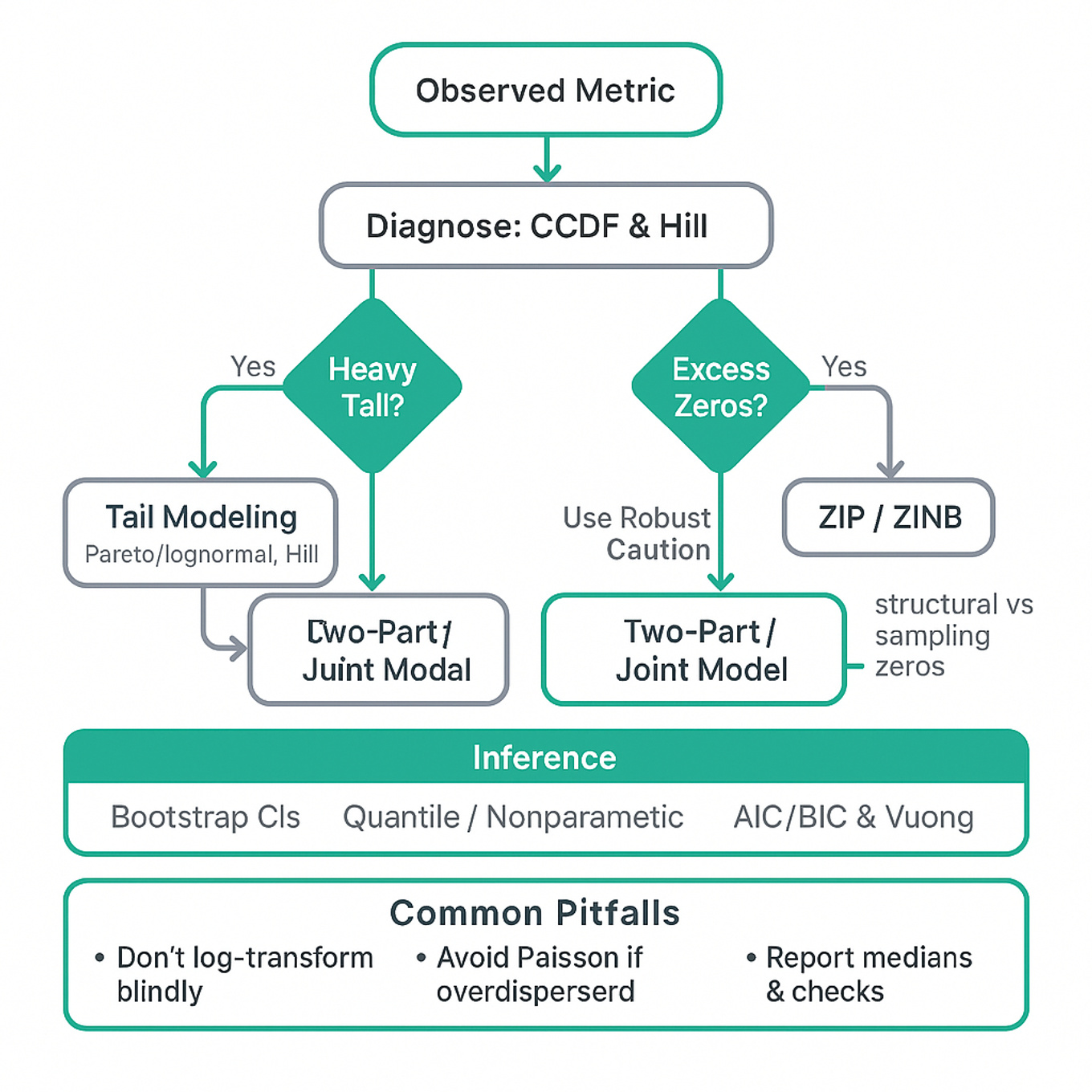
- Diagnose tails with CCDF on log–log scales; estimate tail index (e.g., Hill) to quantify decay rate.
- Use robust summaries for skewed metrics: medians, trimmed means, winsorization; prefer bootstrap CIs.
- Overdispersion indicates negative binomial over Poisson; excess zeros suggest ZIP/ZINB or hurdle models.
- Structural vs sampling zeros: hurdle assumes all zeros from a separate process; ZI allows zeros in both.
- Compare models via AIC/BIC and Vuong tests; inspect fitted zero probability and residuals.
- For experiments on heavy-tailed outcomes, consider quantile effects, nonparametric tests, or model-based inference.
- Handle log transforms carefully: use log1p, or model zero mass separately to avoid bias.
-
A common pitfall Candidates often jump to Poisson or log-transform everything, ignoring overdispersion and zero inflation. That leads to underfit, anticonservative p-values, and misleading average effects dominated by a few “whales.” Another miss is reporting only mean differences on heavy-tailed metrics without robust intervals or sensitivity checks. Strong answers name diagnostics (Hill/rank plots, zero-probability fit), justify ZIP/ZINB versus hurdle, and outline bootstrap-based inference.
-
Further reading
- The Fundamentals of Heavy Tails: Properties, Emergence, and Estimation — Wierman et al. (free book). Practical guidance on tail estimation, Hill plots, and pitfalls. https://adamwierman.com/wp-content/uploads/2021/05/book-05-11.pdf
- A comparison of zero-inflated and hurdle models for modeling zero-inflated count data (Journal of Statistical Distributions and Applications, 2021). Clear when-to-use-which, with examples. https://jsdajournal.springeropen.com/articles/10.1186/s40488-021-00121-4
- statsmodels: ZeroInflatedNegativeBinomialP. Python API reference and examples for fitting ZINB/ZIP in practice. https://www.statsmodels.org/stable/generated/statsmodels.discrete.count_model.ZeroInflatedNegativeBinomialP.html
Related concepts
- Skewed And Heavy-Tailed Distributions
- Distributional Analysis And Robust Statistics
- Central Limit Theorem, Sampling, And Heavy-Tailed Metrics
- Skewed Distributions And Count DataStatistics & Math
- Skewed Distributions, Count Data, And Ratio Metrics
- Distribution Interpretation And Data DiagnosticsMachine Learning