Hierarchical Path Stores
Asked of: Software Engineer
Last updated
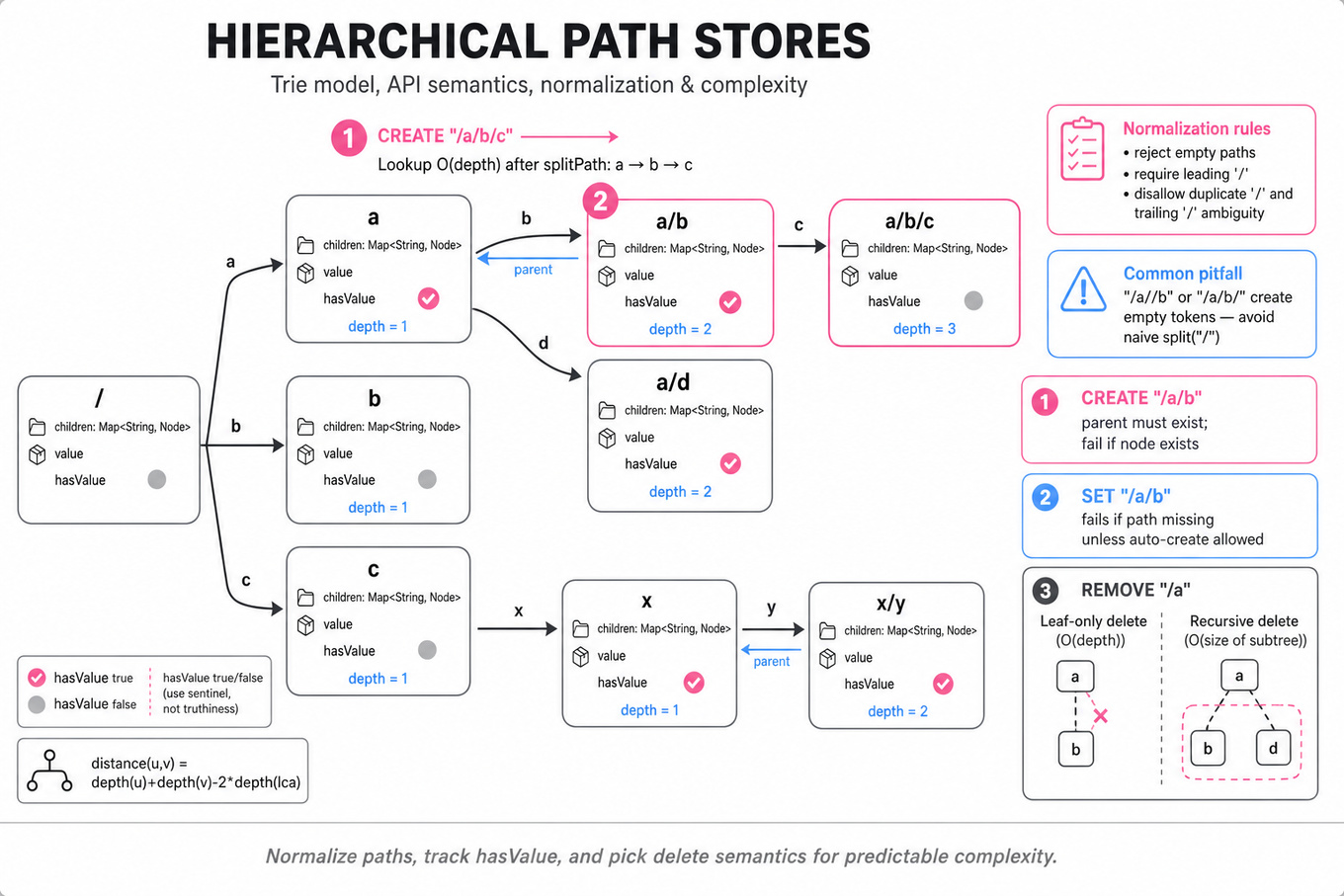
What's being tested
This tests trie/tree modeling for path-addressed state, plus clean API semantics for `create`, `set`, `get`, `remove`, and path validation. Interviewers probe whether you can turn UNIX-style strings into reliable data-structure operations with predictable complexity and well-defined error behavior.
Patterns & templates
-
Trie node model —
Node { children: Map<String, Node>, value, hasValue }; lookup isO(depth)nodes after parsing. -
Path normalization — implement
`splitPath(path)`once; reject empty paths, missing leading/, duplicate slashes, trailing slash ambiguity, and./..if unsupported. -
Create semantics —
`create("/a/b", v)`usually requires parent`/a`to exist and`/a/b`not to exist; return boolean or throw consistently. -
Set vs create —
`set(path, v)`should fail if path missing unless requirements say auto-create; clarify this before coding. -
Remove semantics — decide whether deleting non-leaf paths is allowed; recursive delete is
O(size of subtree), leaf-only delete isO(depth). -
Tree distance template — store
parentpointers anddepth; distance isdepth(u)+depth(v)-2*depth(lca(u,v)). -
Complexity accounting — include string parsing cost: operations are
O(L)whereLis path length, orO(k)components after splitting.
Common pitfalls
Pitfall: Treating
`"/a//b"`or`"/a/b/"`as valid accidentally because`split("/")`produces empty tokens.
Pitfall: Conflating missing node with node storing
null; use`hasValue`or a sentinel instead of checking value truthiness.
Pitfall: Forgetting subtree deletion and stale parent references when implementing
`remove`on an internal node.
Practice these
The practice cards below cover the canonical variants — solve all of them and time yourself.
Featured in interview prep guides
Practice questions
- Design hierarchical path store with create/set/get/removeDoorDash · Software Engineer · Technical Screen · medium
- Solve tree distance and design file systemDoorDash · Software Engineer · Onsite · medium
- Implement string-path file system operationsDoorDash · Software Engineer · Technical Screen · medium
- Design a hierarchical path registryDoorDash · Software Engineer · Onsite · medium
- Implement a hierarchical key-value storeDoorDash · Software Engineer · Technical Screen · medium
Related concepts
- In-Memory File SystemCoding & Algorithms
- Durable Key-Value Stores And CachesSystem Design
- Persistent Key-Value StoresCoding & Algorithms
- Trees, Tries, and Hierarchical DataCoding & Algorithms
- Hierarchical In-Memory Data StructuresCoding & Algorithms
- Key-Value Stores, Caches, And WAL DurabilitySystem Design