DoorDash Software Engineer Interview Prep Guide
Everything DoorDash actually asks Software Engineer candidates — concept walkthroughs, worked examples, and the real interview questions, drawn from candidate reports. Free to read.
Last updated
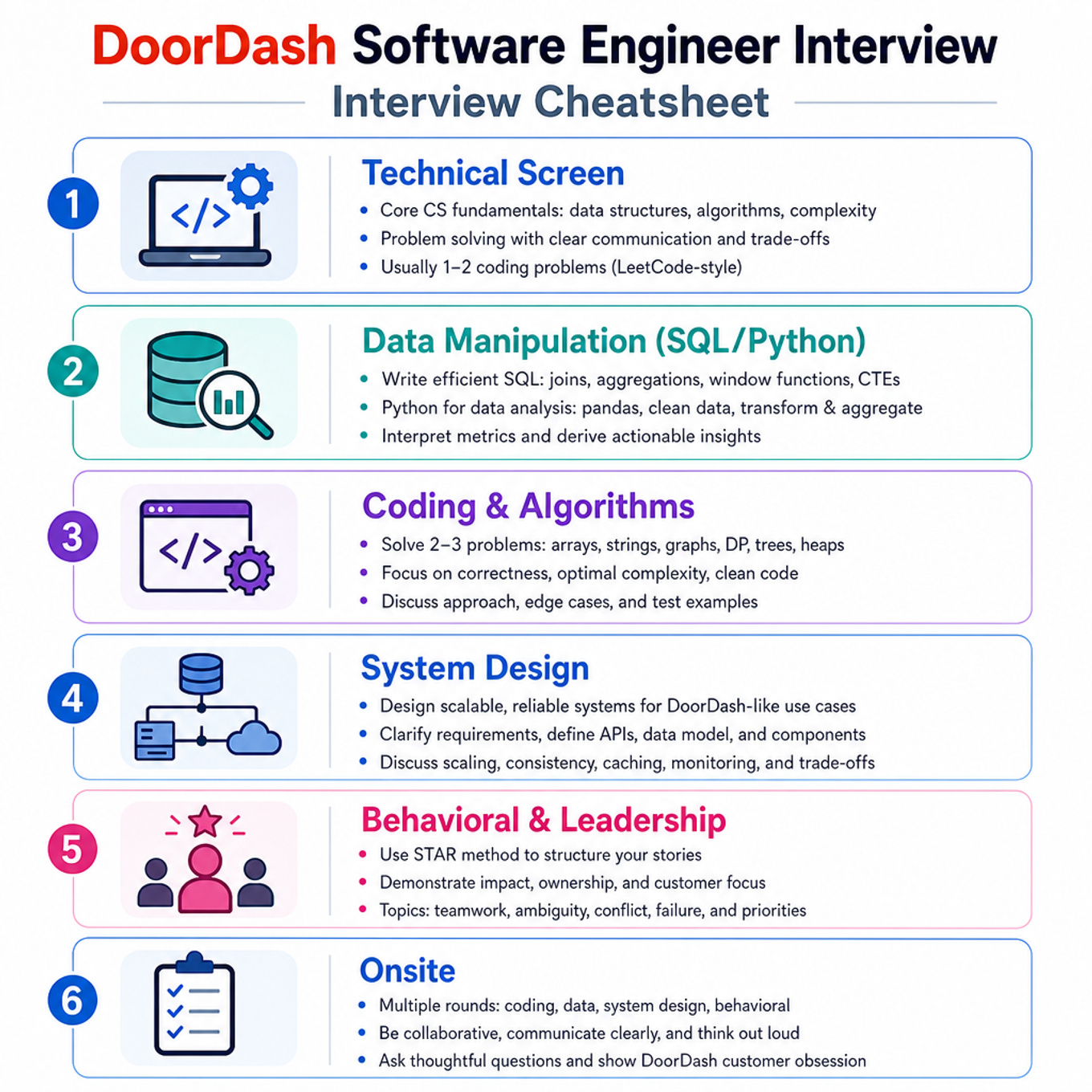
Technical Screen
Data Manipulation (SQL/Python)
- Monetary Pay Computation And Event-Time Aggregation — covered in depth under Onsite below.
Coding & Algorithms
-
DashMart Grid Routing And Spatial Matching — covered in depth under Take-home Project below.
-
Hierarchical Path Stores — covered in depth under Onsite below.
-
Tree And Dynamic Connectivity Algorithms — covered in depth under Onsite below.
-
Consistent Hashing — covered in depth under Onsite below.
-
Round-Robin Load Balancing — covered in depth under Onsite below.
System Design
-
Multi-Channel Notification Systems — covered in depth under Take-home Project below.
-
Donation And Payment Platforms — covered in depth under Take-home Project below.
Behavioral & Leadership
- Project Ownership, Conflict, And Tradeoff Communication — covered in depth under Take-home Project below.
Onsite
Data Manipulation (SQL/Python)
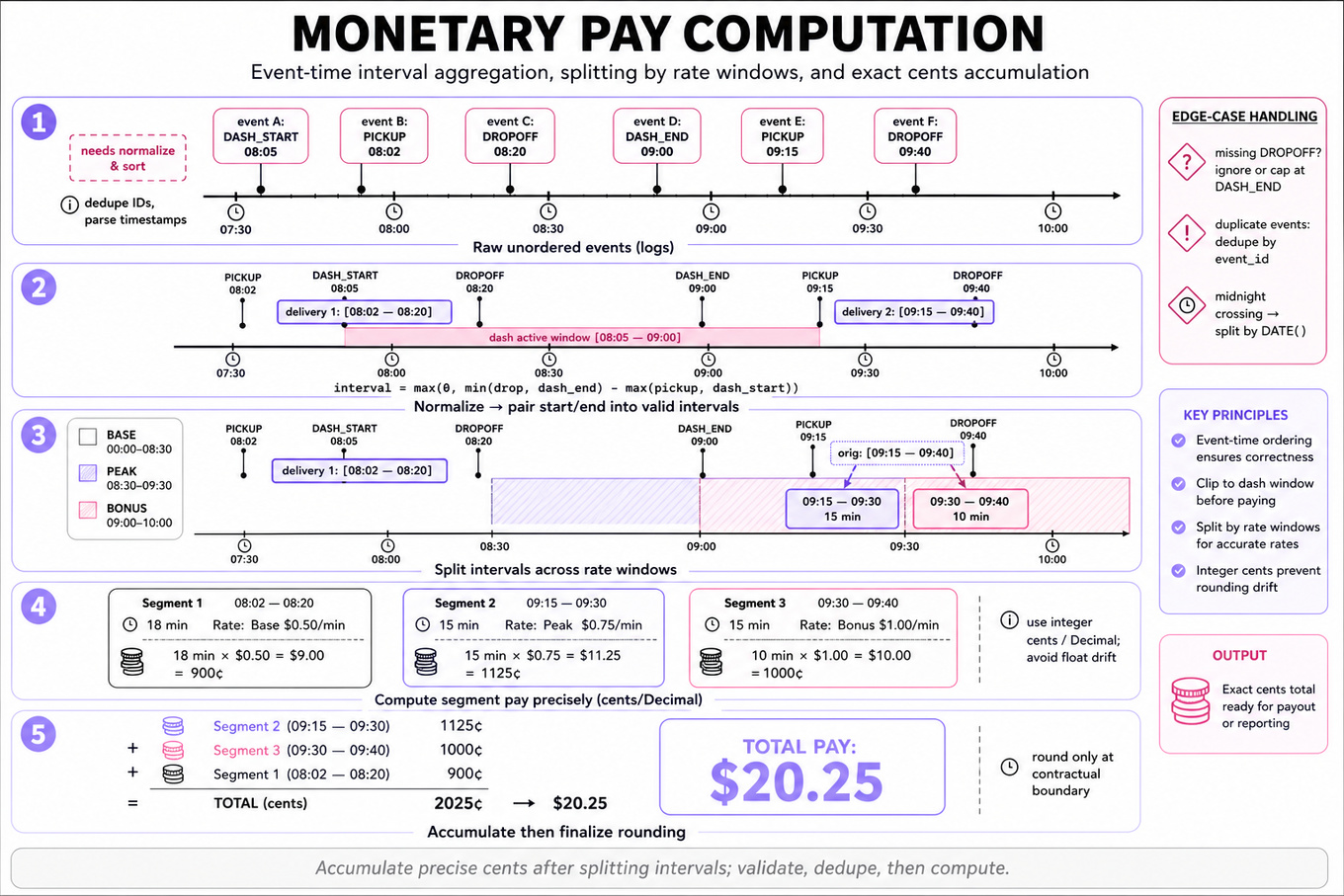
What's being tested
These problems test event-time interval aggregation: converting unordered delivery/work events into valid time ranges, splitting ranges across rate windows, and summing monetary pay exactly. Interviewers are probing for clean data manipulation in Python or SQL, robust edge-case handling, and readable business-rule implementation.
Patterns & templates
-
Sweep line over start/end events — sort by timestamp, maintain active count/state, accumulate
duration * rate;O(n log n)time. -
Interval intersection helper —
overlap = max(0, min(end1,end2) - max(start1,start2)); reuse for peak windows, shifts, and deliveries. -
Normalize then compute — parse timestamps, validate
start < end, dedupe IDs/events, sort chronologically before applying pay rules. -
Segment by rate windows — split one delivery across base, peak, bonus, or minimum-pay windows; never apply one multiplier to the whole interval blindly.
-
Per-day aggregation — group by
driver_id,DATE(ts), or local service day; watch midnight crossings and timezone assumptions. -
SQL window functions — use
LAG,LEAD,ROW_NUMBER, andSUM(...) OVER (...)to pair events and detect malformed sequences. -
Money representation — compute in integer cents or
Decimal; avoid binary floating-point drift in final pay totals.
Common pitfalls
Pitfall: Treating delivery duration as
dropoff - pickupwithout checking overlap against active dash time, peak windows, or day boundaries.
Pitfall: Assuming events are ordered and unique; production-style logs often contain duplicates, missing ends, or contradictory state transitions.
Pitfall: Rounding each segment early; accumulate precise cents/decimals first, then round only at the final contractual boundary.
Practice these
The practice cards below cover the canonical variants — solve all of them and time yourself.
Practice questions
Coding & Algorithms
- DashMart Grid Routing And Spatial Matching — covered in depth under Take-home Project below.
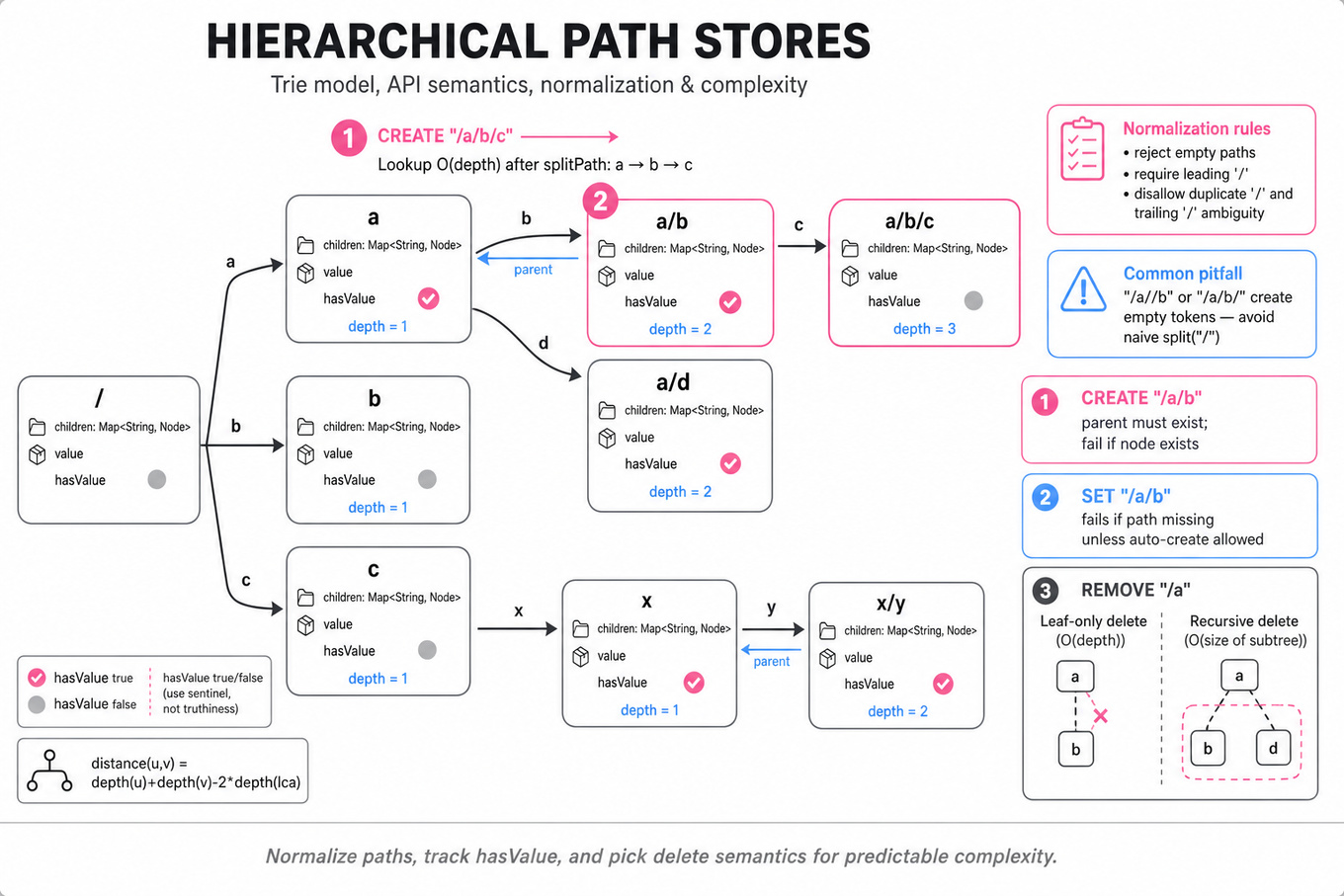
What's being tested
This tests trie/tree modeling for path-addressed state, plus clean API semantics for `create`, `set`, `get`, `remove`, and path validation. Interviewers probe whether you can turn UNIX-style strings into reliable data-structure operations with predictable complexity and well-defined error behavior.
Patterns & templates
-
Trie node model —
Node { children: Map<String, Node>, value, hasValue }; lookup isO(depth)nodes after parsing. -
Path normalization — implement
`splitPath(path)`once; reject empty paths, missing leading/, duplicate slashes, trailing slash ambiguity, and./..if unsupported. -
Create semantics —
`create("/a/b", v)`usually requires parent`/a`to exist and`/a/b`not to exist; return boolean or throw consistently. -
Set vs create —
`set(path, v)`should fail if path missing unless requirements say auto-create; clarify this before coding. -
Remove semantics — decide whether deleting non-leaf paths is allowed; recursive delete is
O(size of subtree), leaf-only delete isO(depth). -
Tree distance template — store
parentpointers anddepth; distance isdepth(u)+depth(v)-2*depth(lca(u,v)). -
Complexity accounting — include string parsing cost: operations are
O(L)whereLis path length, orO(k)components after splitting.
Common pitfalls
Pitfall: Treating
`"/a//b"`or`"/a/b/"`as valid accidentally because`split("/")`produces empty tokens.
Pitfall: Conflating missing node with node storing
null; use`hasValue`or a sentinel instead of checking value truthiness.
Pitfall: Forgetting subtree deletion and stale parent references when implementing
`remove`on an internal node.
Practice these
The practice cards below cover the canonical variants — solve all of them and time yourself.
Practice questions
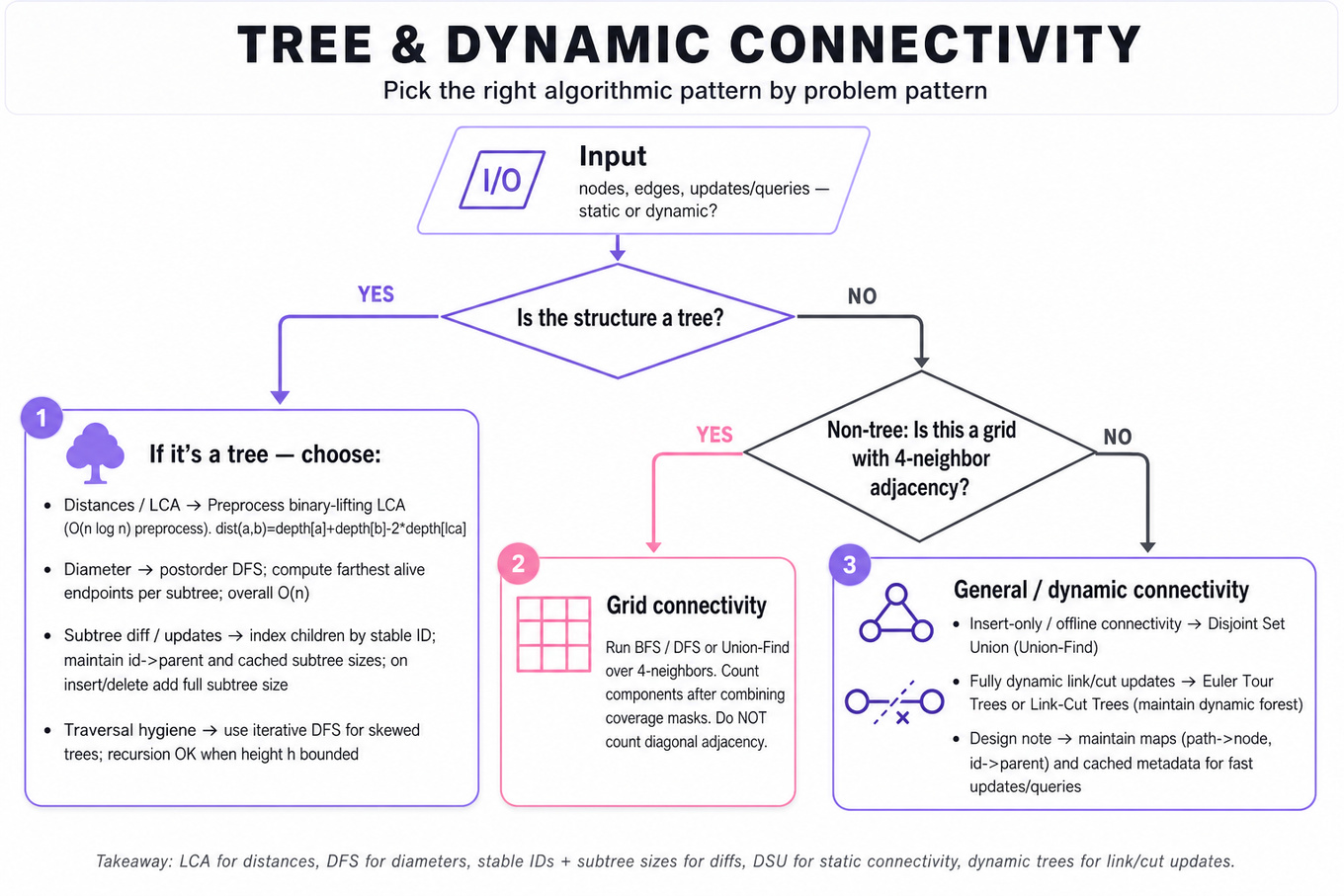
What's being tested
These problems test tree traversal, hierarchical diffing, and dynamic connectivity under clear time/space bounds. You need to recognize when to use DFS/BFS, subtree aggregation, diameter reasoning, hash maps by node identity, or connected-component labeling.
Patterns & templates
-
Tree diameter with filters — compute farthest alive endpoints via postorder DFS; target
O(n)time andO(h)recursion space. -
Distance in trees — use LCA when parent pointers or preprocessing exist:
dist(a,b)=depth[a]+depth[b]-2*depth[lca]. -
N-ary tree diff — index children by stable key or ID, compare old/new recursively, and count added, deleted, changed, or moved subtrees.
-
Subtree size shortcut — when a node is inserted/deleted, add its whole subtree size instead of traversing pairwise descendants.
-
Connected components on grids — run DFS/BFS/Union-Find over 4-neighbor cells; count components after combining dasher coverage masks.
-
Dynamic hierarchy design — maintain maps like
path -> node,id -> parent, and cached metadata; state update/query complexity explicitly. -
Traversal hygiene — iterative DFS avoids stack overflow on skewed trees; recursive DFS is acceptable when height
his bounded.
Common pitfalls
Pitfall: Treating node value as identity in tree diff problems; use stable IDs/keys, because values can change independently.
Pitfall: Recomputing distances or subtree sizes from scratch per query when preprocessing or caching is expected.
Pitfall: Counting diagonal grid cells as connected when the problem expects 4-directional adjacency.
Practice these
The practice cards below cover the canonical variants — solve all of them and time yourself.
Practice questions
What's being tested
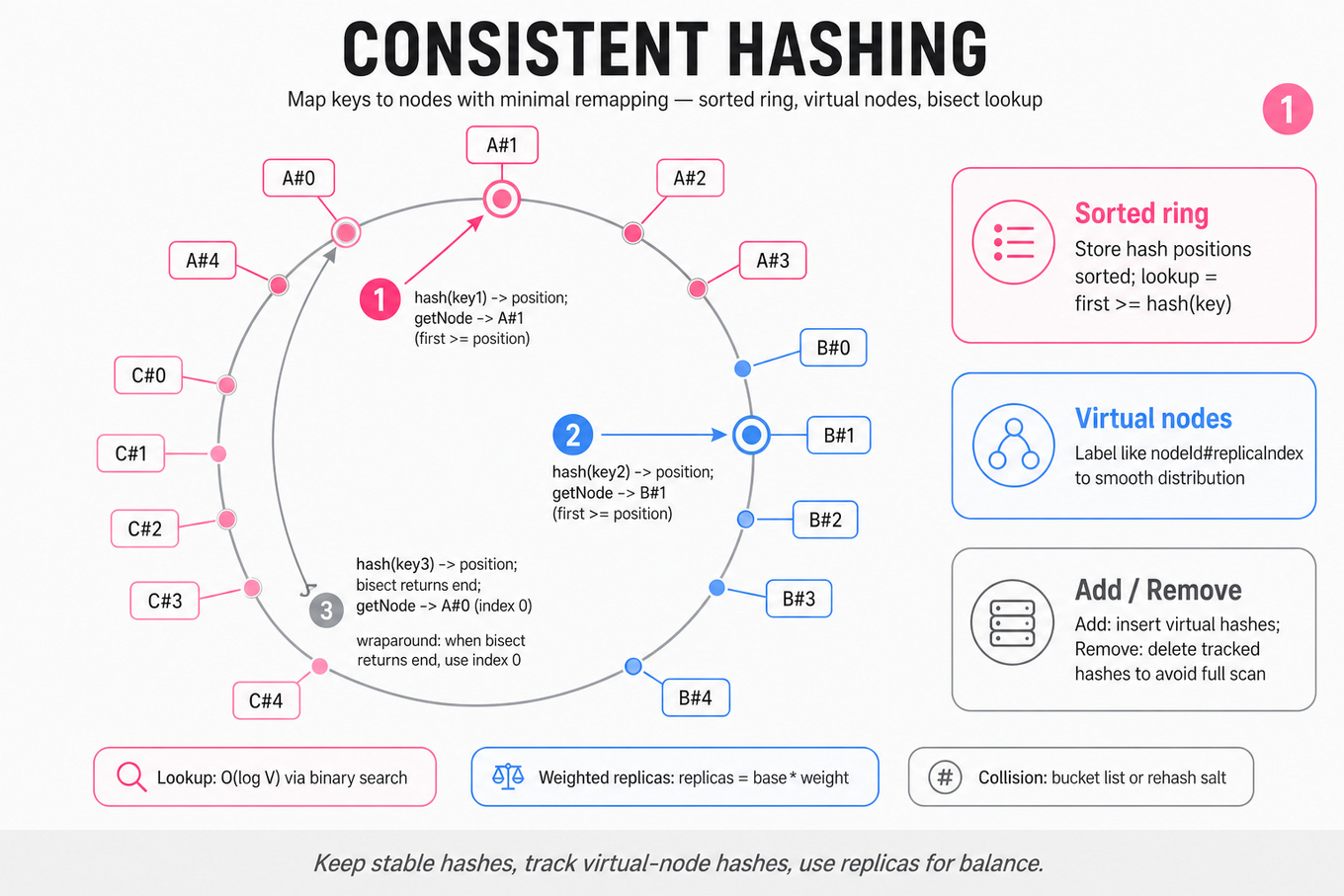
These problems test consistent hashing as a data-structure and routing algorithm: map arbitrary keys to nodes while minimizing remapping after addNode / removeNode. Interviewers expect clean APIs, deterministic hashing, sorted-ring lookup, virtual nodes, and complexity analysis.
Patterns & templates
-
Sorted ring representation — store hash positions in sorted order;
getNode(key)finds first position>= hash(key), wrapping to index0. -
Binary search lookup — use
bisect_left/TreeMap.ceilingEntry;getNodeisO(log V)whereV = nodes * virtualNodes. -
Virtual nodes — insert labels like
nodeId#replicaIndex; improves distribution versus one hash point per physical node. -
addNode(node)— hash each virtual node, insert into ring/map, track ownership metadata;O(R log V)forRreplicas. -
removeNode(node)— delete all virtual-node hashes for that node; maintainnode -> hashesto avoid scanning the whole ring. -
Collision handling — deterministic hashes can collide; resolve with bucket lists, rehashing salt, or storing
hash -> [virtualNodes]. -
Weighted distribution — allocate more virtual nodes to higher-capacity servers, e.g.
replicas = baseReplicas * weight.
Common pitfalls
Pitfall: Using Python’s built-in
hash()for routing; it is process-randomized, so use stable hashing likemd5,sha1,mmh3, orcrc32.
Pitfall: Forgetting ring wraparound when
bisect_leftreturns the end; the correct node is the first point on the ring.
Pitfall: Claiming removals are cheap without tracking each node’s virtual hashes; otherwise
removeNodecan degrade to scanning all virtual nodes.
Practice these
The practice cards below cover the canonical variants — solve all of them and time yourself.
Practice questions

What's being tested
These problems test stateful request selection: implementing a correct, health-aware round-robin router while servers are added, removed, or marked unhealthy. Interviewers probe index invariants, concurrency safety, fault handling, and whether you can compare simple rotation with consistent hashing when request affinity matters.
Patterns & templates
-
Round-robin pointer — keep
nextIndex; chooseservers[nextIndex % n], then increment;O(1)selection,O(n)storage. -
Health-aware scan — skip unhealthy nodes with at most
nprobes; return explicit error when no backend is available. -
Dynamic membership invariant — after
addServerorremoveServer, normalizenextIndex %= len(servers)to avoid out-of-bounds and skew. -
Concurrent router state — protect
nextIndexandserverswithMutex/RWMutex, or use atomic index plus immutable server snapshots. -
Retry vs reroute — retry transient failures with bounded attempts/backoff; avoid infinite loops when every backend fails.
-
Consistent hashing template — hash each request key and server virtual node; lookup via sorted ring in
O(log V), whereV = servers * replicas. -
Testing matrix — cover empty pool, one server, unhealthy servers, removal before current index, wraparound, concurrent calls, and distribution sanity.
Common pitfalls
Pitfall: Incrementing
nextIndexbefore validating availability can skip servers or produce uneven routing after failures.
Pitfall: Removing a server without adjusting the pointer causes out-of-bounds errors or repeated routing to the wrong backend.
Pitfall: Claiming round-robin preserves request affinity; use consistent hashing when the same customer/order/session should usually hit the same backend.
Practice these
The practice cards below cover the canonical variants — solve all of them and time yourself.
Practice questions
System Design
-
Multi-Channel Notification Systems — covered in depth under Take-home Project below.
-
Donation And Payment Platforms — covered in depth under Take-home Project below.
Software Engineering Fundamentals
What's being tested
DoorDash is probing whether you can build and debug resilient service-to-service aggregation under real production constraints: partial failures, latency budgets, retries, concurrency limits, caches, and routing behavior. A strong Software Engineer answer shows you can turn multiple downstream calls into one reliable API response without creating retry storms or hiding failures. Interviewers are also looking for operational maturity: how you reproduce incidents, inspect logs/traces/metrics, isolate root cause, and add tests or guardrails so the same failure does not recur. This matters because marketplace systems depend on many microservices—consumer, merchant, dasher, dispatch, pricing, promotions—and a fragile aggregator can turn one slow dependency into a user-visible outage.
Core knowledge
-
API aggregation usually means a request fan-out to several downstream services and merges results into one response. Parallel fan-out changes latency from roughly to , but increases concurrency, timeout coordination, and partial-failure complexity.
-
Concurrency primitives should fit the language:
CompletableFuturein Java,asyncio.gatherin Python,Promise.allSettledin JavaScript, goroutines pluscontext.Contextin Go. Use bounded concurrency when fan-out can grow; unbounded parallelism can exhaust threads, sockets, or connection pools. -
Timeouts need both per-call and overall budgets. If the API has a
500msSLA, you might reserve50msfor merge/serialization and split450msacross downstream calls. Always propagate cancellation so losing work stops after the client no longer needs it. -
Failure policies should be explicit.
WAIT_ALLreturns after all calls finish or timeout, useful when partial data is acceptable.FAIL_FASTcancels outstanding work after a critical dependency fails, useful when the response is invalid without that dependency. -
Retries help only for transient failures such as
HTTP 503, connection resets, or short timeouts. Use capped exponential backoff with jitter: . Do not retry non-idempotent writes unless you have an idempotency key. -
Retry amplification is a common distributed-systems bug. If one frontend request fans out to
5services and each retries3times, the backend may see up to15calls per user request. Add retry budgets, per-service limits, and circuit breakers. -
Circuit breakers prevent repeatedly calling a known-bad dependency. A simple breaker has
closed,open, andhalf-openstates, using rolling failure rate or latency thresholds. Pair it with graceful degradation, not silent data corruption. -
Load balancing affects both reliability and debuggability. Round-robin is simple and fair for similar hosts; least-connections adapts to variable request cost; consistent hashing preserves cache locality. Bad routing can overload one instance while aggregate fleet metrics look healthy.
-
Caching improves latency and protects downstream services, but adds failure modes: stale values, cache stampedes, hot keys, negative-cache poisoning, and inconsistent invalidation. Common mitigations include TTL jitter, request coalescing, stale-while-revalidate, and per-key locks in
Redisor in-process caches. -
Observability should connect a single user request across services. Use correlation IDs, structured logs, distributed tracing via
OpenTelemetry, and metrics likerequest_rate,error_rate,p50,p95,p99, timeout count, retry count, cache hit rate, and downstream saturation. -
Debugging production incidents should follow a disciplined loop: define the symptom, bound the blast radius, compare healthy versus unhealthy paths, form hypotheses, validate with data, mitigate first, then root-cause. Avoid changing multiple variables at once during mitigation.
-
Test coverage should include deterministic unit tests for merge logic, fake downstream services for timeout/retry behavior, concurrency tests for cancellation/races, and integration tests for partial failure. For legacy modules, add characterization tests before refactoring behavior.
Worked example
For Build an API aggregator with concurrency and retries, start by clarifying the contract: “Which downstream calls are required versus optional? What is the overall latency budget? Are requests read-only and safe to retry? Should partial responses include error metadata?” Then state assumptions, such as three downstream HTTP services, a 500ms overall timeout, and read-only idempotent calls.
A strong answer can be organized around four pillars: concurrent fan-out, timeout propagation, configurable failure policy, and retry control. For concurrent fan-out, describe launching one future per dependency with a bounded executor or async runtime, then merging results into a response object. For timeouts, use a parent deadline and derive per-call deadlines, ensuring cancellation propagates to outstanding futures when FAIL_FAST triggers.
For retries, propose retrying only transient errors with capped exponential backoff and jitter, while respecting the remaining request deadline. For failure policy, define WAIT_ALL as “collect successes and typed failures until the overall deadline,” and FAIL_FAST as “cancel siblings when a required dependency fails.” A concrete tradeoff to flag: aggressive retries can improve success rate but worsen tail latency and overload a degraded dependency, so retries should be limited by attempt count, deadline, and circuit-breaker state.
Close by saying you would add tests using fake services that fail once then recover, hang until timeout, return permanent 400 errors, and verify that cancellation, retry count, and partial-response semantics are correct. If you had more time, you would add metrics for per-dependency latency, retries, timeouts, and result quality so production behavior can be debugged without reading code.
A second angle
For Debug a cache incident end-to-end, the same resilience concept appears as an operational debugging problem rather than a greenfield design problem. The first move is to quantify the symptom: did p99 latency spike, did error rate increase, did downstream database load jump, or did users see stale/incorrect assignment data? Then compare cache metrics—hit rate, miss rate, evictions, hot keys, Redis CPU, connection count, and timeout rate—against the incident window.
The design instincts transfer: cache failure should degrade predictably, not cascade into a database overload or return corrupt data. Instead of discussing WAIT_ALL versus FAIL_FAST, you might discuss stale-while-revalidate versus bypassing cache, or whether negative caching caused valid entities to disappear temporarily. The best answer ends with both an immediate mitigation, such as disabling a bad key pattern or increasing TTL jitter, and a prevention step, such as adding cache-hit-rate alerts and load tests for cold-cache behavior.
Common pitfalls
Pitfall: Treating retries as a universal fix.
A tempting answer is “retry failed calls three times” without distinguishing transient failures from permanent ones. A better answer says which status codes are retryable, caps retries by deadline, adds jitter, and explains how to avoid retry amplification during downstream degradation.
Pitfall: Jumping to root cause before proving the symptom.
In debugging prompts, candidates often say “it’s probably the cache” or “the load balancer is uneven” too early. Land better by first naming the observable evidence you would gather: request IDs, traces, per-host traffic, cache hit rate, recent deploys, config changes, and healthy-versus-unhealthy comparisons.
Pitfall: Designing only the happy-path aggregator.
Some solutions show parallel calls and a merge function but skip cancellation, partial responses, timeouts, and testability. Interviewers want to see failure semantics as part of the API contract: what happens when one service is slow, wrong, unavailable, or returns after the overall deadline?
Connections
Interviewers may pivot from here into microservice system design, distributed tracing, rate limiting, idempotency, cache invalidation, or load-balancer algorithms. They may also ask you to write production-quality code for the aggregator, refactor legacy error handling, or design tests that reproduce a race, timeout, or transient downstream failure.
Further reading
-
Release It! by Michael Nygard — practical patterns for timeouts, circuit breakers, bulkheads, and production failure modes.
-
The Tail at Scale by Dean and Barroso — explains why tail latency dominates large fan-out systems and why hedging, deadlines, and isolation matter.
-
AWS Architecture Blog: Exponential Backoff and Jitter — clear treatment of why jitter prevents synchronized retry storms.
Practice questions
Behavioral & Leadership
- Project Ownership, Conflict, And Tradeoff Communication — covered in depth under Take-home Project below.
Take-home Project
Coding & Algorithms

What's being tested
These problems test grid shortest paths, multi-source BFS, time-aware graph traversal, and nearest-neighbor matching under deterministic tie-breaking. Interviewers want to see whether you can model DashMart/courier/customer locations as graphs or spatial points, pick the right data structure, and justify complexity.
Patterns & templates
-
Single-source BFS on an unweighted grid —
O(R*C)time,O(R*C)space; usedeque,visited, and 4-direction neighbors. -
Multi-source BFS for nearest
DashMartdistances — enqueue all stores at distance0; first visit gives shortest distance to any source. -
Dijkstra’s algorithm for weighted or time-dependent movement — use
heapq; complexityO((V+E) log V); BFS is wrong once edge costs vary. -
Time-grid constraints — store earliest arrival per cell; when entering cell
(r,c), compute wait time before pushing updated arrival. -
Spatial nearest neighbor — brute force is
O(C*K); for many dynamic queries, discuss k-d tree, grid bucketing, or geohash-style indexing. -
Deterministic tie-breaking — compare
(distance, id)or(distance, dashmart_id)tuples so equal-distance results are stable and testable. -
Sparse grid representation — use
setfor obstacles anddictfor distances when coordinates are large but occupied cells are few.
Common pitfalls
Pitfall: Using DFS for shortest path on an unweighted grid; DFS may find a path, but not the minimum path length.
Pitfall: Running BFS separately from every query when all queries ask distance to the nearest source; reverse it with multi-source BFS.
Pitfall: Ignoring tie rules; equal distances must usually be broken by stable
courier/storeid, not traversal order.
Practice these
The practice cards below cover the canonical variants — solve all of them and time yourself.
Practice questions
System Design
What's being tested
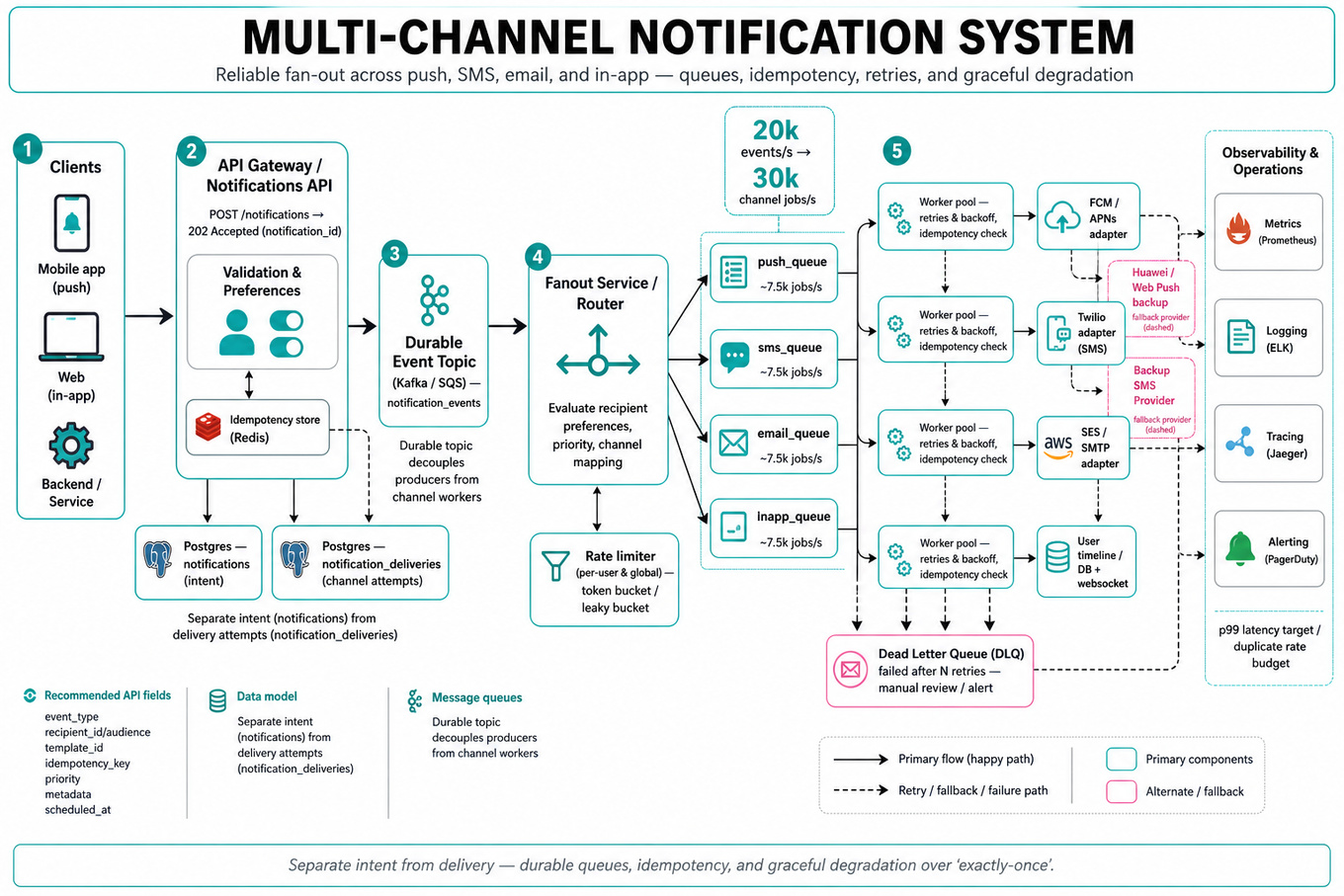
This probes whether you can design a reliable distributed notification platform that fans out messages across push, SMS, email, and in-app channels without spamming users or losing critical alerts. DoorDash cares because notifications sit on high-value workflows: order status, Dasher assignment, delivery issues, promotions, support escalations, and operational alerts. The interviewer is looking for API design, queue-based architecture, delivery guarantees, idempotency, rate limiting, user preferences, provider failures, observability, and graceful degradation. A strong answer separates the product event from channel delivery and makes tradeoffs explicit instead of promising “exactly once” delivery everywhere.
Core knowledge
-
Functional requirements should distinguish notification types: transactional order updates, time-sensitive alerts, marketing messages, and internal operational alerts. Each class has different latency, retry, opt-out, and compliance behavior; for example, “order delivered” may target sub-second push, while marketing email can tolerate minutes.
-
Non-functional requirements should be quantified early: peak events/sec, recipients per event, target
p99latency, retention period, and acceptable duplicate rate. A simple sizing sketch is: ifDoorDashemits 20k notification events/sec and each fans out to 1.5 channels on average, downstream workers process 30k channel jobs/sec before retries. -
API design usually starts with
POST /notificationsacceptingevent_type,recipient_idor audience,template_id,idempotency_key,priority,metadata, and optionalscheduled_at. Keep the API asynchronous: return202 Acceptedwithnotification_id, then exposeGET /notifications/{id}for status. -
Data model should separate notification intent from delivery attempt. A
notificationstable stores the logical message;notification_deliveriesstores channel-specific attempts such asPUSH,SMS,EMAIL, status, provider response, retry count, and timestamps. This prevents one failed SMS from corrupting the whole notification state. -
Message queues are the central scaling primitive. Use
Kafka,Amazon SQS,RabbitMQ, or similar to decouple producers from channel workers. A common flow is API service → validation/preferences → durable event topic → fanout service → per-channel queues → provider adapters. -
Delivery guarantees are typically at-least-once, not exactly-once. Workers may retry after timeout, provider ambiguity, or crash, so consumers must be idempotent. Use a unique
idempotency_key, dedupe table, orRedis SETNXwith TTL to suppress duplicate logical sends. -
Ordering matters only for some categories. Order state notifications like “picked up” before “delivered” may need per-order ordering by partitioning on
order_idinKafka. Global ordering is expensive and usually unnecessary; prefer local ordering where user experience depends on it. -
Retry strategy should combine exponential backoff, jitter, max attempts, and a dead-letter queue. Example: retry after , stop after 5 attempts for push/email, and route to
DLQfor inspection. Avoid retry storms when providers degrade. -
Rate limiting must exist at multiple layers: per-user anti-spam limits, per-tenant limits, provider quota limits, and global system protection. Token bucket is a standard choice: refill rate tokens/sec, capacity burst tokens. For SMS providers, enforce strict provider-specific throughput.
-
Preferences and compliance are first-class backend concerns. Store channel opt-ins, quiet hours, locale, device tokens, unsubscribed categories, and legal constraints. Transactional messages may bypass some marketing preferences, but the system should encode this explicitly rather than relying on caller judgment.
-
Provider abstraction prevents vendor lock-in and isolates failures. Channel adapters wrap
APNs,Firebase Cloud Messaging,Twilio,SendGrid, or internal email services behind a common interface:send(message) -> provider_message_id/status. Still preserve provider-specific error codes for debugging and retry classification. -
Observability needs metrics at every stage: accepted requests, queue lag, fanout rate, provider success rate, retry count, duplicate suppressions,
p50/p95/p99latency, andDLQvolume. Add structured logs withnotification_id,delivery_id,recipient_id,channel, andprovider_message_idfor traceability.
Worked example
For Design a multi-channel notification system, a strong candidate starts by asking: “Are we supporting transactional, marketing, and alert notifications? What channels are required? What scale and latency targets should I design for? Do we need user preferences and scheduled sends?” Then declare assumptions: multi-tenant service, push/email/SMS/in-app, at-least-once delivery, 50k channel sends/sec peak, and transactional notifications prioritized over marketing.
Organize the answer around four pillars: ingestion API, durable fanout pipeline, channel delivery workers, and control-plane services like templates, preferences, rate limits, and observability. The core architecture could be: Notification API validates and writes a notification record, publishes to Kafka, a fanout worker resolves recipients, preferences, templates, and channels, then emits delivery jobs to per-channel queues. Channel workers call providers such as FCM, APNs, Twilio, and SendGrid, persist delivery attempts, and retry transient failures with backoff.
One important tradeoff to flag is latency versus preference/template correctness. You can precompute user channel preferences for speed, but then opt-out changes may be stale; for critical compliance-sensitive channels, read the latest preference or use a cache with short TTL and invalidation. Close by saying: “If I had more time, I’d go deeper on multi-region failover, scheduled notifications, DLQ replay tooling, and how to test provider outages without sending real messages.”
A second angle
For Design an alert notification system, the same primitives apply, but the constraints shift toward urgency, escalation, and reliability under incident conditions. Instead of marketing-style fanout, you may need priority queues, dedupe windows, on-call schedules, escalation policies, and acknowledgement tracking. The design should support “notify primary engineer by push/SMS, wait 5 minutes, escalate to secondary if unacknowledged,” which makes workflow state more important than template management. Rate limiting is still needed, but critical alerts may bypass quiet hours while suppressing repeated alerts for the same incident using an incident_id dedupe key. The interviewer may push on how the system behaves when a provider is down; a strong answer routes to alternate channels and exposes alert delivery health as its own monitored dependency.
Common pitfalls
Pitfall: Promising exactly-once delivery for external channels.
SMS, email, and push providers do not give true end-to-end exactly-once semantics, and network timeouts can leave delivery status ambiguous. A better answer is at-least-once processing with idempotency at the notification/job level, dedupe windows, provider message IDs, and user-visible tolerance for rare duplicates.
Pitfall: Treating every notification as the same priority.
A design that puts order-critical updates, coupons, and internal alerts through one FIFO queue will fail during spikes. Separate by priority and category, reserve capacity for transactional notifications, and allow marketing traffic to be delayed or dropped under load.
Pitfall: Spending all the time on boxes and arrows but not on failure modes.
Interviewers expect you to discuss provider outages, poison messages, duplicate sends, stale device tokens, queue backlog, and retry storms. Land better by walking one failure path end to end: provider returns 429, worker classifies it as retryable, token bucket reduces send rate, jobs back off with jitter, and persistent failures go to DLQ.
Connections
This topic often pivots into distributed queues, idempotency, rate limiting, workflow orchestration, and multi-tenant service design. You may also be asked to extend the design with a cron scheduler for delayed campaigns, a template service with localization, or a real-time WebSocket/in-app notification feed.
Further reading
-
Designing Data-Intensive Applications — excellent grounding for queues, logs, replication, idempotency, and reliability tradeoffs.
-
Stripe API Idempotency — practical reference for using idempotency keys in externally visible APIs.
-
The Tail at Scale — useful for reasoning about
p99latency, retries, hedging, and distributed-service behavior.
Practice questions
What's being tested
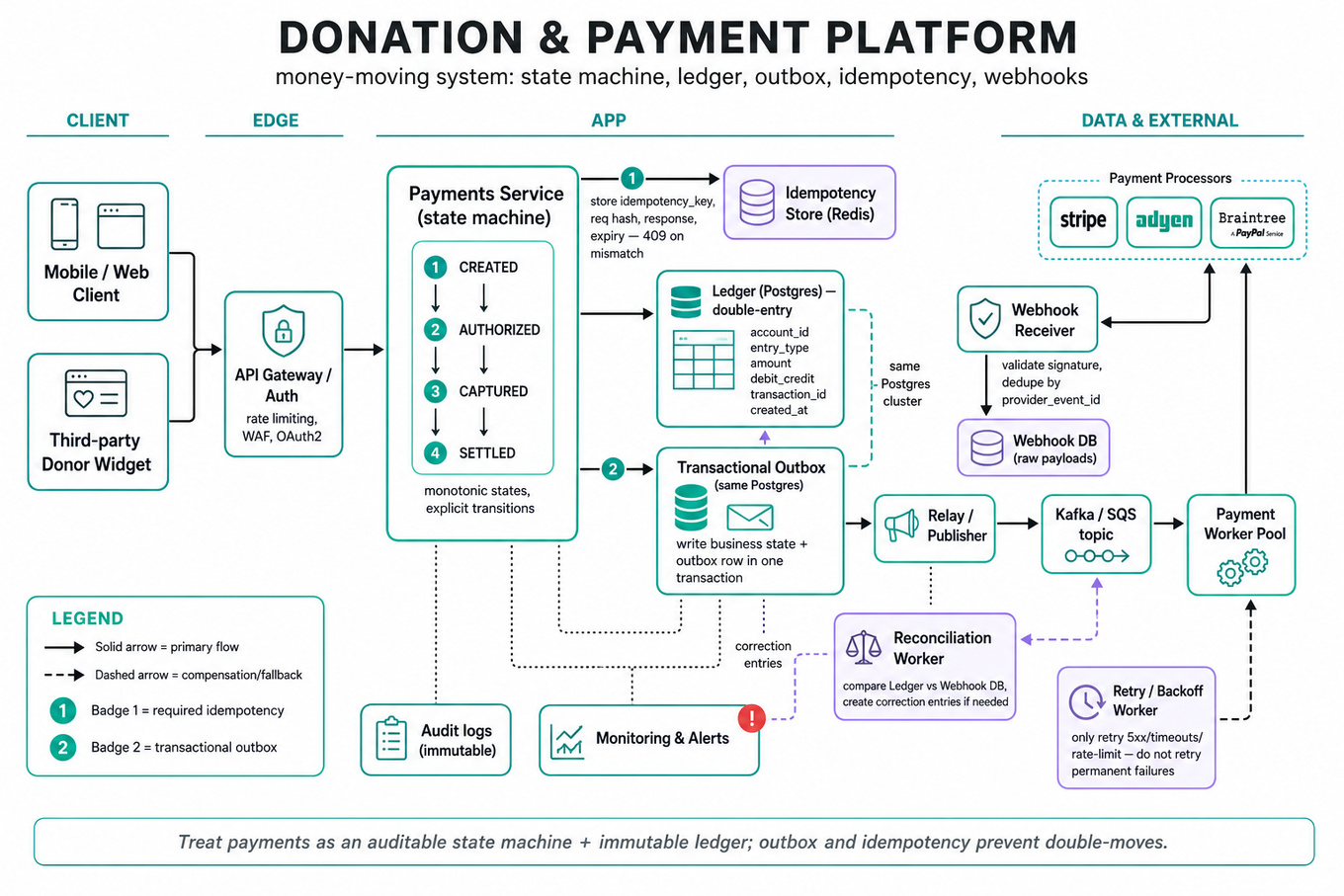
These interviews test whether you can design a money-moving backend system where correctness matters more than raw feature velocity. DoorDash cares because donations, customer charges, refunds, Dasher payouts, and pay adjustments all require reliable state transitions across internal services, external payment processors, and asynchronous retries. The interviewer is probing for idempotency, transactional integrity, failure recovery, data modeling, API design, and your ability to reason about partial failures without hand-waving. A strong answer treats payments as a state machine backed by an auditable ledger, not as a single charge() function call.
Core knowledge
-
Payment state machines should be explicit and monotonic:
CREATED → AUTHORIZED → CAPTURED → SETTLED, orPLEDGED → PAYMENT_PENDING → PAID → FAILED → REFUNDED. Avoid ambiguous booleans likeis_paid; they make retries, reversals, and reconciliation much harder. -
Idempotency keys are mandatory for any client- or worker-retryable operation. Store
idempotency_key, request hash, response body, status, and expiration. If the same key arrives with a different payload, return409 Conflictrather than executing a second charge or payout. -
Ledger modeling is safer than overwriting balances. Use immutable double-entry rows like
account_id,entry_type,amount,currency,debit_credit,transaction_id,created_at. The invariant is per transaction, which supports audits and correction entries. -
Transactional outbox prevents the classic “database write succeeded but event publish failed” bug. Write business state and an
outbox_eventsrow in the samePostgrestransaction, then have a relay publish toKafka,SQS, or another queue with idempotent consumers. -
Webhook reconciliation handles external payment processors such as
Stripe,Adyen, orBraintreeas eventually consistent sources of truth. Validate signatures, persist raw webhook payloads, dedupe by provider event ID, and reconcile processor status against internal state. -
Retry semantics need clear boundaries. Retry transient failures like
5xx, network timeouts, and rate limits using exponential backoff with jitter; do not blindly retry validation failures, insufficient funds, expired cards, or processor-declared permanent failures. -
Exactly-once payment execution is usually implemented as at-least-once delivery plus idempotent side effects. Queues may redeliver messages, workers may crash after calling a provider, and webhooks may arrive out of order; correctness comes from dedupe tables and state guards.
-
Payout computation should separate calculation from disbursement. For Dasher pay, compute immutable earning components per delivery, adjustment, bonus, or tip; aggregate into a payout batch; then move money only after the batch is finalized and auditable.
-
API design should expose stable resource-oriented endpoints:
POST /donations,GET /donations/{id},POST /payout-computations,POST /payouts/{id}/retry. IncludeIdempotency-Key, ISO-8601 timestamps, minor currency units like cents, and structured errors with retryability flags. -
Concurrency control matters for limited-time donation campaigns and batch payouts. Use unique constraints, conditional updates such as
WHERE status = 'PENDING', row locks where necessary, and optimistic version fields to prevent double capture, over-allocation, or duplicate batch execution. -
Observability should be designed into the workflow. Track
payment_success_rate,payment_failure_rate,retry_count,webhook_lag_seconds,stuck_pending_count,duplicate_request_count, andp99latency. Logs should includepayment_id,provider_charge_id,idempotency_key, andcorrelation_id. -
Compliance and security should keep card data out of your system unless absolutely necessary. Use provider tokenization, avoid storing PAN/CVV, encrypt sensitive fields, enforce least-privilege access, and design as though
PCI DSSscope reduction is a hard requirement.
Worked example
For “Design an async donation payment platform”, a strong candidate would first clarify scope: are donations one-time or recurring, do we support refunds, what payment processor is assumed, what traffic spike should we handle, and is the donation considered complete when the processor authorizes, captures, or settles funds? Then declare assumptions: use tokenized payment methods, store amounts in minor units, use Postgres for transactional records, and use a queue for asynchronous payment processing.
The answer can be organized around four pillars: data model, request flow, asynchronous worker processing, and reconciliation. The data model should include donations, payment_attempts, ledger_entries, webhook_events, and outbox_events, with unique constraints on idempotency_key and provider IDs. The request flow should return quickly after creating a PENDING donation and enqueueing work, rather than blocking the caller on a processor call that may timeout.
The worker should claim pending attempts, call the payment provider with its own idempotency key, and transition state only if the current state still allows it. Webhooks should be treated as authoritative signals but not blindly trusted: verify the signature, dedupe the event, and reconcile state transitions. One tradeoff to flag is synchronous versus asynchronous confirmation: synchronous gives the user immediate feedback but increases tail latency and timeout ambiguity; asynchronous improves resilience but requires a status endpoint and better UX around pending donations.
A strong close would say: “If I had more time, I’d go deeper on refund flows, backfill/reconciliation jobs, and operational dashboards for stuck payments and webhook lag.”
A second angle
For “Design a resilient dasher payment system”, the same core ideas apply, but the center of gravity shifts from customer charges to earned-balance correctness and payout batching. Instead of donation records, the key entities are deliveries, pay components, adjustments, ledger entries, payout batches, and disbursement attempts. The system must tolerate late corrections, duplicate delivery events, and retries from payout providers without paying a Dasher twice.
The important framing difference is that pay computation should be reproducible and auditable: given the same earning inputs and policy version, the result should be explainable. You would likely emphasize immutable earning events, batch finalization, and double-entry ledgers more than user-facing checkout latency. The same idempotency and reconciliation patterns still apply when calling external payout rails.
Common pitfalls
Pitfall: Treating payment as a single synchronous API call.
A tempting answer is “the API calls Stripe, stores success or failure, and returns.” That misses the hard part: provider timeouts, duplicate requests, delayed webhooks, and partial failures. A better answer models payment attempts, persists intermediate states, and reconciles asynchronously.
Pitfall: Saying “use
Kafka” without explaining correctness.
Queues do not solve duplicate execution by themselves. Messages can be delivered more than once, consumers can crash mid-processing, and ordering is not guaranteed globally. The stronger answer is “use at-least-once delivery with idempotent consumers, unique constraints, state-machine guards, and an outbox.”
Pitfall: Ignoring auditability and reversals.
For money systems, updating a balance column directly is usually not enough. Interviewers expect you to preserve history, support refunds or adjustments, and explain how finance or support can answer “what happened to this dollar?” Immutable ledger entries plus correction transactions land much better.
Connections
Interviewers may pivot from this topic into distributed transactions, event-driven architecture, rate limiting, database isolation levels, or observability for critical workflows. They may also ask you to compare Postgres transactions, Kafka-backed event streams, and scheduled batch jobs for different parts of the same payment lifecycle.
Further reading
-
Stripe API Idempotent Requests — Practical reference for idempotency-key behavior, replayed responses, and conflict handling.
-
Designing Data-Intensive Applications — Strong background on reliability, transactions, logs, streams, and distributed-system failure modes.
-
Martin Kleppmann, “Transactions: Myths, Surprises and Opportunities” — Useful context on transaction semantics and why distributed correctness is subtle.
Practice questions
Behavioral & Leadership
What's being tested
DoorDash behavioral interviews for Software Engineers test whether you can own ambiguous engineering work, communicate tradeoffs clearly, and resolve conflict without slowing execution. Interviewers are probing for evidence that you can make technical decisions under constraints: reliability vs. speed, short-term mitigation vs. long-term architecture, scope vs. quality, and team alignment vs. unilateral execution. DoorDash cares because marketplace systems involve many dependencies, high operational urgency, and customer-visible failures; a strong engineer must protect p99 latency, availability, data correctness, and team trust at the same time. The best answers show specific actions, measurable outcomes, and mature judgment—not just “I collaborated well.”
Core knowledge
-
STAR framing is the baseline: Situation, Task, Action, Result. For senior candidates, add a fifth element: Reflection. A strong answer spends less than 25% on context and more than 50% on actions, tradeoffs, and outcome.
-
Ownership means driving the problem to resolution even when you do not own every dependency. For a SWE, that can include writing an
RFC, creating a rollback plan, coordinating API contract changes, adding observability, and following up on post-launch defects. -
Conflict resolution should be framed around technical facts, customer impact, and reversible decisions. Instead of “I disagreed with my manager,” say: “We differed on whether to launch behind a feature flag or wait for full migration; I compared blast radius, rollback complexity, and
p95latency risk.” -
Tradeoff communication is strongest when quantified. Use dimensions like latency, availability, engineering effort, operational risk, migration complexity, and maintainability. For example: “Option A took two days and preserved the legacy path; Option B took two weeks but removed a high-severity failure mode.”
-
Reliability language helps behavioral answers sound engineering-grounded. Mention SLOs, error budgets, blast radius, rollback, canary release, feature flag, and runbook when relevant. Availability can be framed as:
-
Escalation judgment matters. Good engineers do not escalate every disagreement, but they escalate when the decision affects customer trust, launch safety, security, compliance, or cross-team commitments. A good phrase: “I tried to resolve it directly first, then escalated with options and evidence, not complaints.”
-
Disagreement with management should avoid ego framing. The interviewer wants to see backbone plus adaptability: “I presented the technical risk, recommended a safer rollout, committed once the decision was made, and added guardrails to reduce downside.”
-
Prioritization under pressure should connect urgency to impact. Use a simple model: Then explain what you paused, delegated, or explicitly deferred.
-
Ambiguity handling requires turning vague goals into engineering constraints. Ask: target users, traffic scale, read/write patterns, latency budget, failure modes, dependencies, rollout timeline, and success metrics. For DoorDash-like systems, distinguish synchronous user paths from asynchronous background processing.
-
Failure ownership is not self-blame; it is causal clarity. Strong answers name the missed signal, the flawed assumption, the guardrail added, and the measurable improvement. Example: “We missed a
p99regression in staging, so I added load-test coverage and production canary alerts.” -
Influence without authority often means aligning engineers around a decision artifact. A concise design doc with alternatives, risks, benchmarks, and migration steps beats informal persuasion. Mention mechanisms like
ADR,RFC, architecture review, or a written launch checklist. -
Team development for senior SWEs should stay technical. Good examples include mentoring through code reviews, raising testing standards, creating debugging playbooks, improving on-call readiness, or guiding a junior engineer through an incident—not general people management.
Worked example
For “Describe a conflict and how you resolved it,” a strong candidate frames the first 30 seconds by identifying the conflict type: technical design, prioritization, ownership boundary, or communication breakdown. They might say: “I’ll use an example where our team disagreed on whether to ship a synchronous service call in the checkout path or use an asynchronous workflow; the stakes were latency and reliability.” The answer skeleton should have four pillars: the technical context, the disagreement, the actions taken to align the team, and the measurable result.
A strong response clarifies that they did not treat the conflict as personal. They gathered data: baseline p95 and p99 latency, downstream service error rates, expected traffic, and rollback complexity. They then proposed two options in a short RFC: direct integration for faster delivery, or event-driven processing with more implementation effort but better isolation. The explicit tradeoff is speed versus blast radius: the synchronous path could launch sooner but risked user-facing failures if the dependency degraded; the asynchronous design reduced coupling but required more work around retries and idempotency.
The candidate should describe how they facilitated a decision: “I asked the skeptical engineer to review the failure-mode section, incorporated their concern, and we agreed on a hybrid: ship a minimal synchronous validation behind a feature flag, while moving non-critical work async.” The result should be concrete: reduced launch risk, no severity incidents, latency within budget, or faster rollback during a canary. Close with reflection: “If I had more time, I would have written the design doc earlier and aligned on decision criteria before implementation started.”
A second angle
For “Answer rapid-fire behavioral questions,” the same preparation needs to be compressed into crisp, modular stories. Instead of a full narrative, prepare 60- to 90-second versions of stories for conflict, failure, ambiguity, prioritization, and influence. The constraint is not depth of one answer but signal density: each response needs context, action, and result without rambling.
For example, if asked about prioritization under pressure, do not give a generic “I focused on business impact” answer. Say you had an incident, a launch deadline, and a code review queue; you prioritized the incident because it affected checkout availability, delegated reviews, and negotiated a launch scope cut. The same ownership theme applies, but the interviewer is testing whether your judgment remains clear under time pressure.
Common pitfalls
Pitfall: Giving a “conflict” story where nobody actually disagreed.
A weak answer says, “We had different opinions, but we talked and aligned,” with no technical tension. A stronger version names the disputed decision, the cost of each option, the evidence used, and how the final decision changed the implementation.
Pitfall: Over-indexing on being right.
Candidates often frame conflict as “I convinced everyone my design was better.” That can sound combative or immature. A better answer shows curiosity: you tested assumptions, incorporated valid concerns, and optimized for the system and team rather than personal preference.
Pitfall: Staying too high-level for a Software Engineer interview.
Answers like “I improved communication between stakeholders” are too vague. Ground the story in engineering artifacts: RFCs, dashboards, alerts, rollout plans, code reviews, API contracts, migration steps, test coverage, or incident follow-ups.
Connections
Interviewers may pivot from this topic into system design tradeoffs, especially reliability, rollout strategy, and dependency management. They may also probe debugging and incident response, asking how you handled production failures, on-call pressure, or ambiguous root causes. For senior candidates, expect follow-ups on technical leadership, mentoring, and influencing architecture decisions without direct authority.
Further reading
-
Google SRE Book: Embracing Risk — useful vocabulary for reliability tradeoffs, error budgets, and risk-based engineering decisions.
-
Architecture Decision Records by Michael Nygard — concise model for documenting technical disagreements and decisions.
-
Staff Engineer by Will Larson — practical examples of technical leadership, influence, and operating through ambiguity.
Practice questions