Lakehouse Table Transactions And Metadata
Asked of: Software Engineer
Last updated
What's being tested
Interviewers are probing your understanding of how a lakehouse implements ACID semantics, metadata management, and concurrent access at scale. Expect to demonstrate knowledge of transaction logs, snapshot isolation/MVCC, commit protocols, metadata indexing/pruning, and tradeoffs between consistency, latency, and scalability. Databricks cares because robust table transactions and compact metadata are central to correctness, query performance, and multi-tenant reliability on object stores.
Core knowledge
-
Delta Lake,Apache Iceberg,Apache Hudi— three common lakehouse formats that implement transaction/metadata layers on object stores; compare by metadata size, management model, and compaction strategies. -
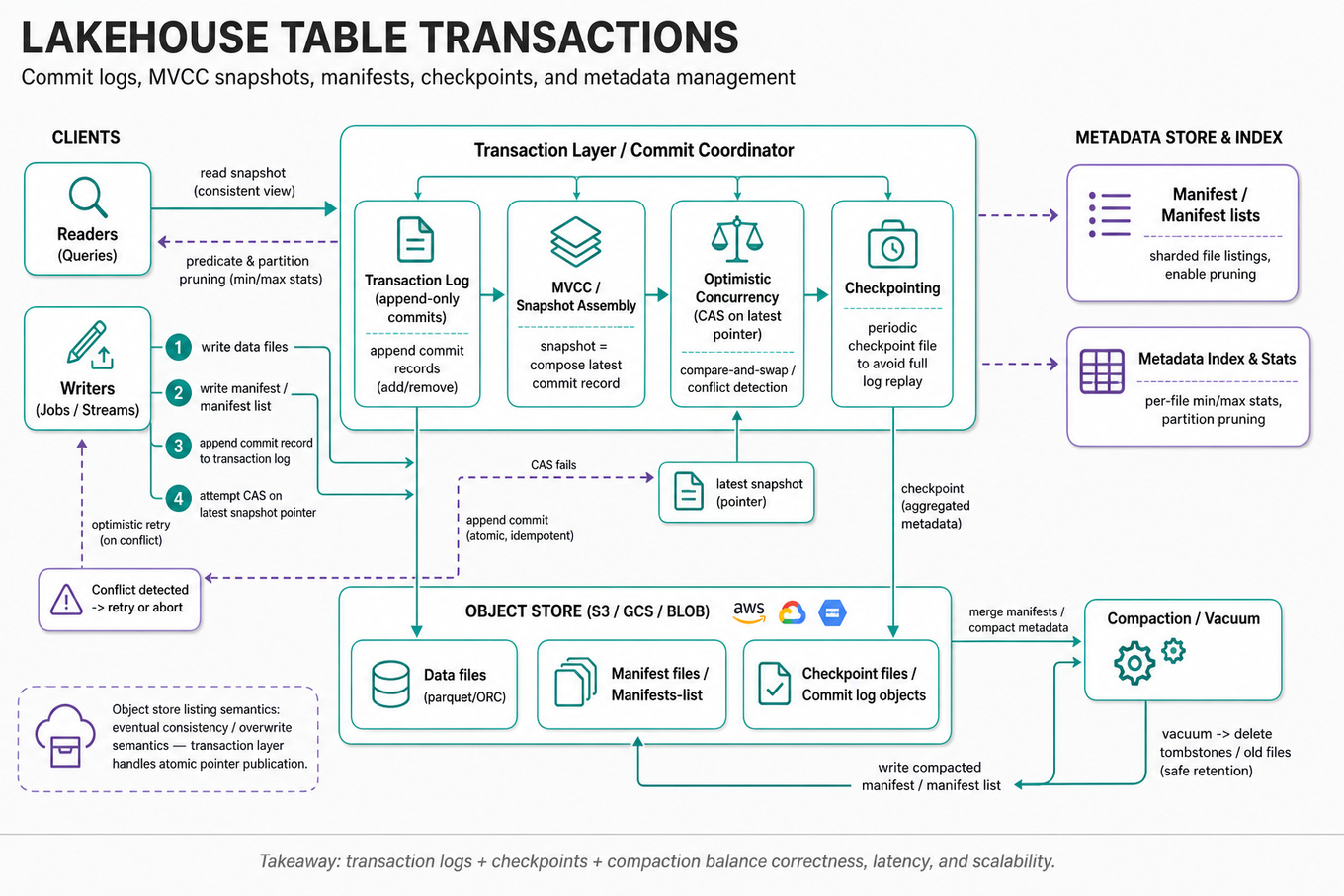
Transaction log / commit record — an append-only sequence that records file-level actions (add/remove); clients read the latest commit to assemble a table snapshot; logs must be atomic and idempotent.
-
Multi-Version Concurrency Control (MVCC) and Snapshot Isolation — readers see a consistent snapshot created at commit-time; writers produce a new snapshot by composing previous metadata plus changes; prevents read-write conflicts without locking readers.
-
Optimistic concurrency — writers compute new snapshot and attempt to atomically publish; conflict detection is typically a compare-and-swap on the latest log/manifest pointer; rollbacks require compensating commits or tombstones.
-
Manifest/manifest lists — metadata files (manifests) list data files for a snapshot; manifest lists scale metadata by sharding file listings and enable pruning during query planning.
-
Compaction and vacuuming — merging small metadata or data files improves query planning and IO; aggressive compaction reduces metadata files but increases CPU and temporary storage usage.
-
Checkpointing — periodic snapshots of in-memory/aggregated metadata produce a single checkpoint file so recovering the latest state avoids replaying the entire log; checkpoint frequency trades off recovery time vs write amplification.
-
Metadata pruning & partition pruning — push predicate filters into metadata level to avoid listing large numbers of files; maintain per-file min/max stats (e.g., min_ts, max_ts) for efficient pruning.
-
Consistency on object stores (
S3/GCS) — object stores have eventual consistency semantics for listing/overwrite historically; transaction layers use atomic rename/manifest pointers or a consensus service to guarantee linearizable commits. -
Garbage collection / retention policy — deleted files remain referenced by older snapshots until TTL; retention windows must balance time-travel requirements vs storage cost; implement safe GC by ensuring no active transaction references removed objects.
-
Performance numbers & thresholds — metadata operations (e.g., listing 100k files) dominate planning; formats target keeping manifest size < ~100k entries for plan-time performance; beyond ~1M entries, push to partition-level indices or catalog services.
-
Distributed commit coordination — small teams use file-atomic operations; large deployments use consensus (e.g.,
Raft/Paxos) or a centralized metastore for strong coordination and leader-based commit ordering.
Tip: design metadata APIs for idempotent retries (idempotency-key) and fast conflict detection to simplify client retry logic.
Worked example — designing a transactional metadata layer for a table
Frame the problem: clarify required guarantees (atomic commit? snapshot isolation? time-travel TTL?), expected workload (many small file writers vs large batch writes), and storage backend (S3/HDFS). A strong candidate outlines three pillars: the commit protocol (how a writer publishes a new snapshot), the metadata organization (log, checkpoints, manifests), and the cleanup/compaction lifecycle. Describe using an append-only transaction log where each commit writes a new JSON/Parquet entry and an atomic pointer update (or consensus-backed record) publishes the new head; readers reconstruct snapshots by reading the latest checkpoint plus subsequent commits. Call out a tradeoff: frequent checkpointing reduces recovery time but increases write amplification and storage I/O. Close by saying: if time permits, discuss implementing optimistic concurrency with per-commit version checks, instrumentation for commit conflicts, and a background compaction/vacuum service to collapse small files and prune old snapshots.
A second angle — supporting high-concurrency streaming writers
Reframe: now many writers concurrently append micro-batches to the same table (stream ingestion). Emphasize per-writer local buffering and aggregation to reduce commit rate, and use optimistic commits with conflict detection on path (file-level) rather than whole-table. Introduce a lightweight leasing or leader-election (short-duration leader) to serialize commits when conflict rates spike, trading some latency for lower aborts. Explain manifest sharding by partition (e.g., date-hour) so parallel commits touch disjoint manifests, minimizing contention. Also mention backpressure: if commit conflicts rise, throttle upstream producers or increase batch sizes to reduce throughput pressure on metadata.
Common pitfalls
Pitfall: assuming object-store PUTs are atomic and listing is strongly consistent.
Many designs incorrectly treat object-store listings as instantaneous; on S3 you must avoid protocols that rely on immediate list visibility and instead use atomic pointer files, checkpoints, or a consensus service for head updates.
Pitfall: designing metadata that grows linearly without compaction.
Naive logs/manifests will degrade query planning as commits accumulate; failing to implement checkpointing/compaction leads to O(N) recovery and O(N) planning cost, where N is number of commits.
Pitfall: hiding retention/GC tradeoffs from users.
Automatic deletion of old files to save cost can break reproducibility/time-travel; surface retention policies and offer safe GC that verifies no active snapshot references exist.
Connections
Implementing table transactions and metadata naturally leads to adjacent topics: catalog services (e.g., Hive Metastore or a custom catalog for fast metadata lookup) and query planning/optimizer integration (how metadata pruning feeds statistics). Interviewers may also pivot into distributed consensus (e.g., Raft) when discussing strong commit ordering or into storage-layout optimization (formatting, file sizes, columnar vs row).
Further reading
-
Delta Lake Transaction Log (Databricks) — concise overview of commit log, checkpoints, and time travel.
-
Apache Iceberg Design — explains manifest lists, snapshotting, and partition-evolution with strong scalability focus.
Related concepts
- Delta Lake ACID Transactions And Metadata
- Apache Spark Execution And DataFrame Fundamentals
- Distributed Query Execution, Shuffle, And Skew
- SQL Event Log AnalyticsData Manipulation (SQL/Python)
- SQL Log, Time-Window, And Graph QueriesData Manipulation (SQL/Python)
- Instrumentation, Logging, And Data Quality