SQL Log, Time-Window, And Graph Queries
Asked of: Data Scientist
Last updated
What's being tested
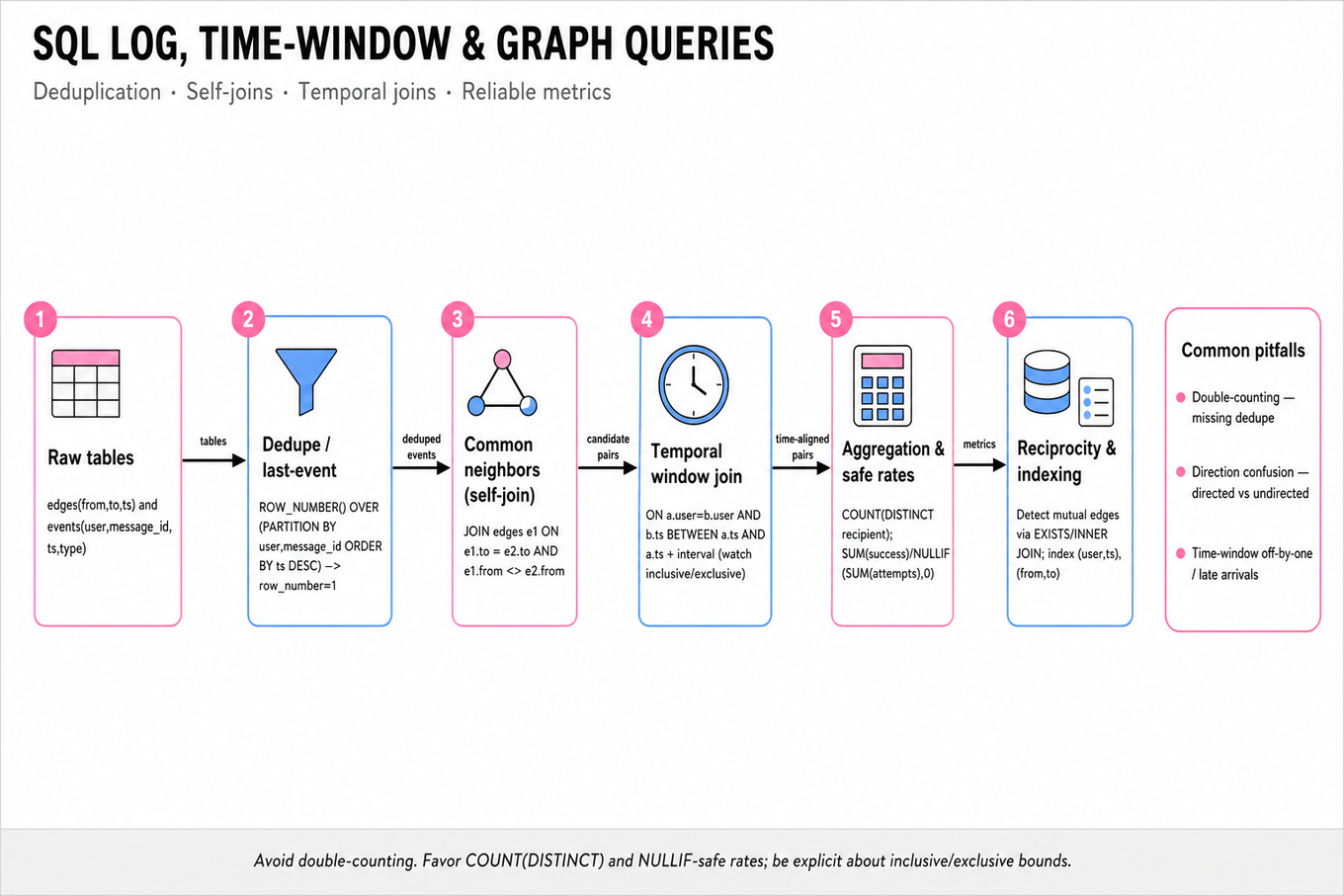
These problems test relational data manipulation skills: deriving graph relationships from directed-edge tables and computing time-windowed event metrics for deliverability. Interviewers probe correct use of joins, window functions, deduplication, temporal joins, and robust aggregation for metric accuracy.
Patterns & templates
-
SELF JOIN to find common neighbors: join
edges e1toedges e2one1.to = e2.towithe1.from <> e2.from, thenGROUP BYandCOUNT. -
Use
ROW_NUMBER() OVER (PARTITION BY user ORDER BY ts DESC)to deduplicate event streams; filterrow_number = 1for last-event-per-(user,message). -
Temporal joins: inequality join
ON a.user=b.user AND b.ts BETWEEN a.ts AND a.ts + intervalto capture events in a window; watch inclusive/exclusive bounds. -
Compute rates with safe division:
SUM(success) / NULLIF(SUM(attempts),0)to avoid divide-by-zero and report nulls meaningfully. -
Use
COUNT(DISTINCT id)when uniqueness matters (unique recipients), otherwise duplicates inflate metrics. -
For mutual edges (friendship), require both
(a->b)and(b->a)via self-join andEXISTSorINNER JOINto enforce reciprocity. -
Index strategy for queries: indexes on
(user, ts)and(from, to)speed joins; expectO(n log n)for sorting/window ops, linear for indexed lookups.
Common pitfalls
Pitfall: Double-counting — failing to dedupe message-level events (multiple opens for one message) inflates deliverability rates.
Pitfall: Direction confusion — treating directed edges as undirected when counting common friends yields incorrect reciprocity vs. common-neighbor answers.
Pitfall: Time-window boundaries — mixing inclusive/exclusive intervals or ignoring late-arriving events leads to off-by-one time-window errors.
Practice these the practice cards below cover the canonical variants — solve all of them and time yourself.
Practice questions
Related concepts
- SQL Event Log AnalyticsData Manipulation (SQL/Python)
- SQL Window Functions And Temporal JoinsData Manipulation (SQL/Python)
- SQL Window Functions And Analytical QueryingData Manipulation (SQL/Python)
- SQL/Python Joins, Aggregations, And Window FunctionsData Manipulation (SQL/Python)
- SQL Analytics Joins, Aggregations, And Windows
- SQL Analytical QueryingData Manipulation (SQL/Python)