Leadership Principles And STAR Stories
Asked of: Software Engineer
Last updated
What's being tested
Amazon behavioral interviews test whether you can demonstrate Leadership Principles through concrete engineering judgment, not whether you can recite values. For a Software Engineer, the interviewer is probing how you debug ambiguous systems, make tradeoffs under pressure, own production outcomes, raise quality bars, and work across teams without authority. Strong answers show specific technical context, measurable impact, and personal accountability: what you did, why it mattered, what alternatives you considered, and what you learned. Expect deep follow-ups on details like failure modes, metrics, incident timelines, code-review decisions, and whether your actions would scale beyond one heroic fix.
Core knowledge
-
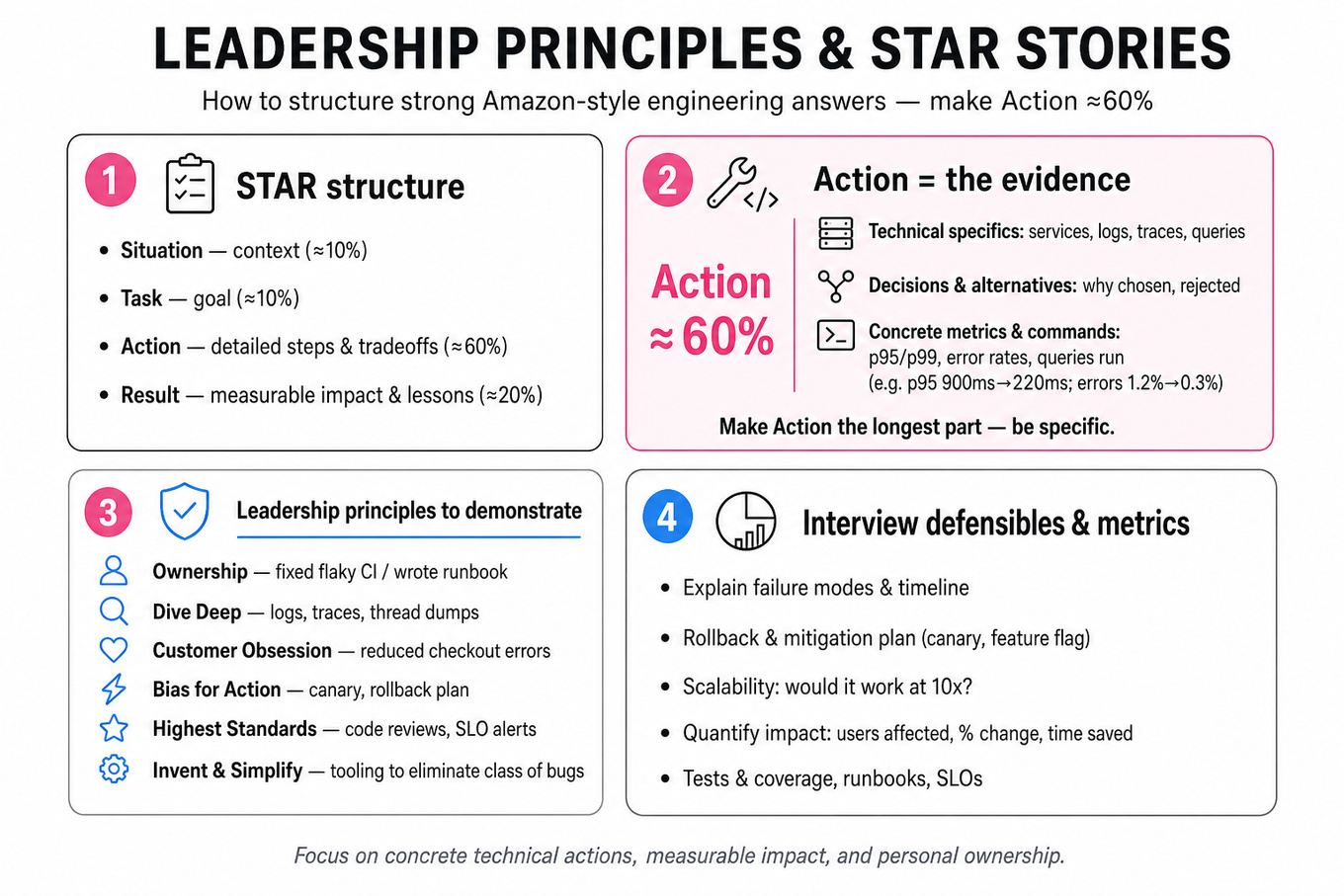
STAR means Situation, Task, Action, Result. For Amazon, the Action section should be the longest: roughly 10% context, 10% goal, 60% your decisions/actions, 20% measurable results and lessons.
-
Ownership stories should show you acted beyond your narrow ticket. Good SWE examples include fixing a flaky
`CI`pipeline, improving an unowned service’s`p99`latency, writing a runbook after an incident, or taking responsibility for a bad deployment even when another team contributed. -
Dive Deep requires technical specificity. Be ready to explain logs, dashboards, traces, database queries, thread dumps, memory profiles, cache behavior, retries, timeouts, race conditions, and why the first plausible root cause was wrong.
-
Customer Obsession for engineers usually maps to reliability, latency, correctness, accessibility, security, or developer experience. Tie work to concrete outcomes: reduced checkout errors from
`1.2%`to`0.3%`, cut`p95`API latency from`900ms`to`220ms`, or reduced support tickets by`35%`. -
Bias for Action is not “move fast and break things.” Strong answers show bounded risk: feature flags, canary deployments, rollback plans, read-only migrations, dark launches, rate limits, or temporary mitigations while a permanent fix is built.
-
Insist on the Highest Standards should include quality mechanisms, not perfectionism. Mention code reviews, test coverage, load testing, static analysis,
`SLO`alerts, backward-compatible APIs, migration validation, or eliminating an entire class of bugs through tooling. -
Invent and Simplify is especially relevant when you reduce operational complexity. Examples: replacing manual deployments with one-click pipelines, consolidating duplicate services, simplifying an API contract, removing a brittle dependency, or turning tribal knowledge into automation.
-
Have Backbone; Disagree and Commit should show respectful escalation using evidence. For SWE, evidence might include load-test results, error-budget burn, security risk, operational burden, or a prototype comparing two designs. Once a decision is made, show you supported execution.
-
Deliver Results stories need constraints. State the deadline, dependency, ambiguity, or resource limit. Then explain prioritization: what you cut, deferred, automated, delegated, or simplified to ship safely without hiding quality risks.
-
Earn Trust is demonstrated through transparency and follow-through. In engineering stories, this can mean posting an incident update, admitting a regression you caused, documenting tradeoffs, giving credit, asking for review early, or making a decision visible in an
`ADR`. -
Measured impact matters even when the story is behavioral. Use engineering metrics such as
`MTTR`,`MTTD`, deployment frequency, rollback rate,`p95`/`p99`latency, error rate, availability, test flakiness, build time, memory usage, CPU utilization, or defect escape rate. -
Follow-up readiness is critical. Interviewers often ask: “What exactly did you do?”, “What data did you inspect?”, “Who disagreed?”, “What would you do differently?”, “How did you know it worked?”, and “Was this really your contribution?”
Worked example
For “Answer Dive Deep and Ownership in LP interview”, a strong candidate should frame the story in the first 30 seconds as a production or near-production problem with measurable customer or operational impact. For example: “I’ll use a story where our order-status API had intermittent `5xx` spikes after a deployment; I was not the original owner, but I was on call and drove root cause, mitigation, and prevention.” Clarify the scale briefly: request volume, severity, affected customers, and whether there was an `SLA` or `SLO` at risk.
Organize the answer around four pillars: first, detection and triage; second, technical investigation; third, mitigation and communication; fourth, long-term prevention. In the investigation pillar, go beyond “I checked logs” and name the actual reasoning path: comparing deploy timestamps with error spikes, isolating one dependency, finding retry amplification, verifying with traces, and reproducing under load. A good tradeoff to flag is mitigation versus root cause: “I rolled back first to stop customer impact, then used the failed build in staging to preserve evidence and continue debugging.”
The result should include numbers: `5xx` rate dropped from `8%` to baseline, `MTTR` was `37 minutes`, and a follow-up change reduced similar incidents by adding timeout budgets, circuit breakers, and an alert on dependency saturation. Close with learning: “If I had more time, I would have added pre-production load tests for retry storms earlier and documented a dependency-failure checklist for the on-call rotation.” This shows you owned both the immediate fix and the systemic improvement.
A second angle
For “Answer Amazon-style leadership deep dives”, the same storytelling discipline applies, but the interviewer may focus less on one incident and more on decision-making, conflict, or influence. Suppose the story is about disagreeing with a proposed synchronous service call in a checkout path. The framing should emphasize the engineering tradeoff: synchronous simplicity versus availability risk, latency budget, and blast radius. Instead of centering the narrative on logs and root cause, center it on evidence, stakeholder alignment, and commitment after the decision. A strong answer would mention a prototype, `p99` latency estimates, failure-mode analysis, and how you either persuaded the team or committed to the chosen design while adding safeguards.
Common pitfalls
Pitfall: Giving a generic values answer instead of an engineering story.
A weak answer says, “I always take ownership and communicate well.” A stronger answer names the service, the bug, the metric, the decision you made, and the result. Amazon interviewers will keep drilling until they can separate your actual contribution from the team’s general effort.
Pitfall: Over-indexing on heroics and under-indexing on mechanisms.
“I stayed up all night and fixed production” may sound committed, but it can also signal fragile operations. Pair urgency with scalable mechanisms: alerts, runbooks, tests, deployment guards, code ownership, post-incident reviews, and prevention of repeat failures.
Pitfall: Hiding conflict, mistakes, or tradeoffs.
Perfect stories often sound rehearsed and shallow. It is usually better to say, “My first hypothesis was wrong,” “I shipped a mitigation with known limitations,” or “I disagreed with the design because of `p99` latency risk.” Then show how you used data, communicated clearly, and improved the system.
Connections
Interviewers often pivot from behavioral stories into system design, especially around reliability, scalability, and operational excellence. They may also ask for debugging deep dives, code quality tradeoffs, incident management, or cross-team design negotiation. Prepare each story so it can support both a leadership principle discussion and a technical follow-up.
Further reading
-
Amazon Leadership Principles — official source for the principles and the language interviewers use.
-
The Site Reliability Workbook — practical mechanisms for incident response, reliability, alerting, and operational ownership.
-
How Complex Systems Fail — Richard I. Cook — useful mental model for explaining incidents without oversimplifying root cause.
Featured in interview prep guides
Practice questions
- Describe Deadline, Mistake, Problem-Solving, and AI ExperiencesAmazon · Software Engineer · Onsite · medium
- Describe handling deadlines, pride, and conflictAmazon · Software Engineer · Technical Screen · easy
- Answer common internship behavioral questionsAmazon · Software Engineer · Technical Screen · hard
- Answer Dive Deep and Ownership in LP interviewAmazon · Software Engineer · Technical Screen · hard
- Explain owning and debugging infra modulesMicrosoft · Software Engineer · Technical Screen · hard
- Answer common Amazon behavioral questionsAmazon · Software Engineer · Technical Screen · hard
- Answer Amazon-style leadership deep divesAmazon · Software Engineer · Onsite · medium
- Discuss key behavioral experiencesAmazon · Software Engineer · Onsite · medium
- Discuss deadlines, feedback, and deep divesAmazon · Software Engineer · Technical Screen · medium
- Describe times exceeding and missing expectationsAmazon · Software Engineer · Technical Screen · medium
- Explain work-simulation approach under ambiguityAmazon · Software Engineer · Technical Screen · medium
- Demonstrate decision-making and collaboration behaviorsAmazon · Software Engineer · Technical Screen · medium
Related concepts
- Leadership Principles, Ownership, And Measurable ImpactBehavioral & Leadership
- Amazon Leadership Principles And STAR StoriesBehavioral & Leadership
- Stakeholder Leadership And STAR StorytellingBehavioral & Leadership
- Behavioral Ownership, Conflict, Ambiguity, And GrowthBehavioral & Leadership
- Behavioral Leadership, Ownership, And ComplianceBehavioral & Leadership
- Adobe Cross-Team Leadership And Impact Stories