LLM Evaluation and Red-Teaming Platforms
Asked of: Software Engineer
Last updated
What's being tested
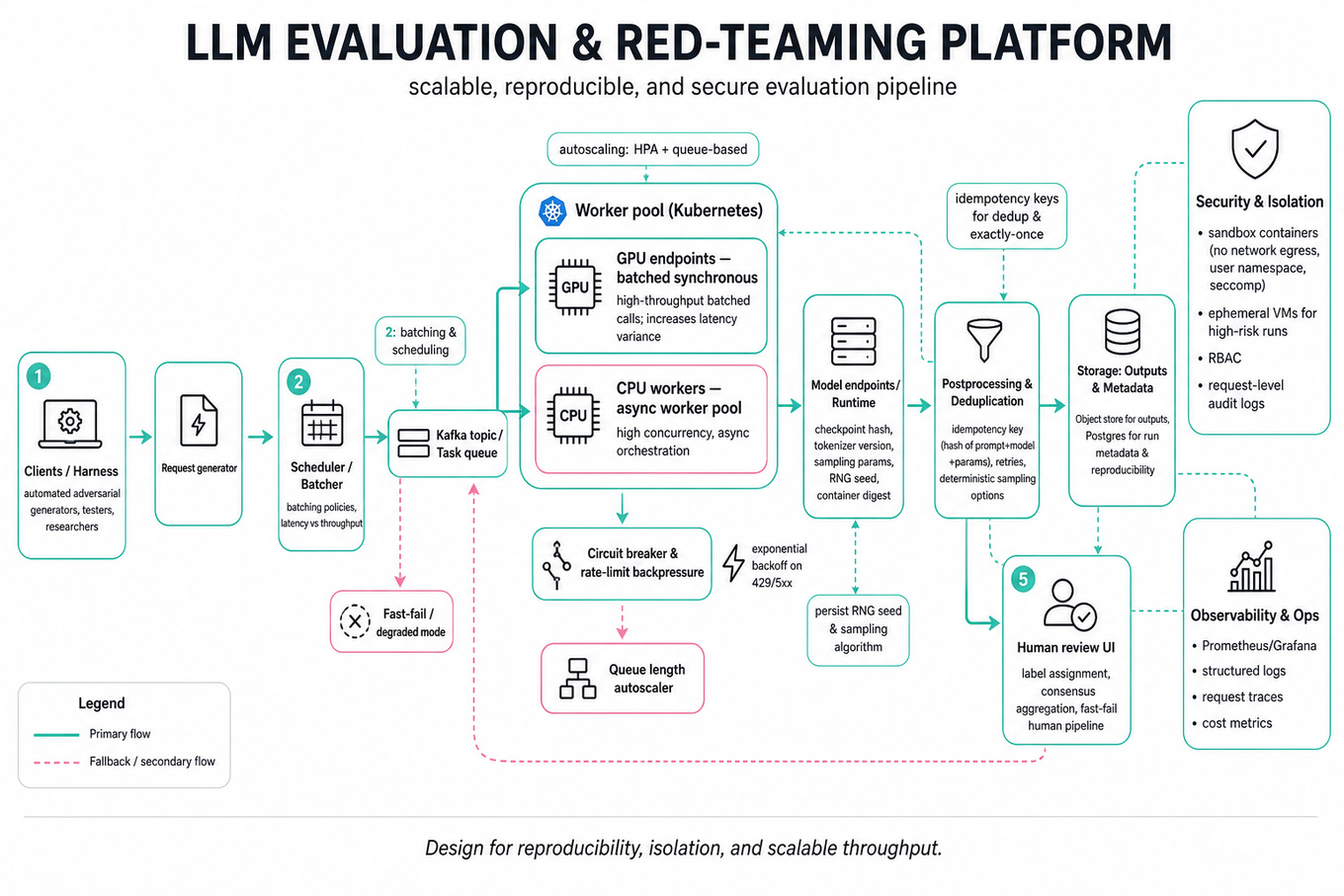
Interviewers are probing your ability to design and implement robust, scalable evaluation and red‑teaming platforms for large language models — the systems that generate, run, collect, and analyze adversarial and routine prompts at scale. Expect to show system-design skills (throughput/latency tradeoffs, orchestration, isolation), reproducibility and versioning practices, and operational concerns (cost, observability, security) that make such a platform production-ready for engineering teams.
Core knowledge
-
Evaluation pipeline stages: request generation, batching/scheduling, model invocation, postprocessing, human review, and metric aggregation; each stage must expose clear interfaces and retry semantics for failure isolation.
-
Orchestration primitives: use message queues like
`Kafka`or task queues for decoupling, and run workers on`Kubernetes`with autoscaling, resource requests/limits, and pod disruption budgets to balance throughput and cost. -
Model invocation patterns: prefer batched synchronous calls for throughput on GPU-backed endpoints, or asynchronous calls with worker pools for high-concurrency CPU endpoints; batching increases throughput but adds latency variance.
-
Idempotency and retries: issue an idempotency key per evaluation item (hash of prompt + model + params) so retries, deduplication, and exactly-once semantics are achievable at the application layer.
-
Reproducibility metadata: store model checkpoint hash, prompt text, tokenizer version, sampling params (temperature,
`top_k`,`top_p`), RNG seed, runtime binary/version, and container image digest alongside outputs for each run. -
Handling nondeterminism: to reproduce sampled outputs, persist the RNG seed and sampling algorithm; for batch-parallel hidden nondeterminism, prefer deterministic sampling or run with multiple seeds and aggregate behaviors.
-
Failure / rate‑limit backpressure: implement exponential backoff for 429/5xx responses, circuit breakers around endpoints, and queue length-based autoscaling; expose fast-fail modes for critical human-review pipelines.
-
Security and isolation: execute adversarial prompts in sandboxed containers (no network egress, user namespace, seccomp), use ephemeral VMs for high-risk content, and enforce RBAC and request-level auditing.
-
Human-in-the-loop UX and guarantees: label assignment, consensus aggregation, duplicative reviews for calibration, per-annotator quotas, and optimistic batching so humans review only deduplicated, filtered examples.
-
Storage and data lineage: store raw requests and responses in cheap object storage (
`S3`) and indexed metadata in`Postgres`/`Elasticsearch`; maintain immutable run artifacts and content-addressed identifiers for easy rollback. -
Metrics and aggregation: compute deterministic metrics (latency
`p50/p95/p99`, throughput), and behavioral metrics (failure rates, category-wise pass/fail); aggregate with time windows and export to`Prometheus`/`Grafana`. -
Sampling math for rare behaviors: to observe a rare behavior with true rate r at confidence c, sample size n satisfies , so . This informs budgeting for red-team effort.
Worked example — "Design a scalable LLM evaluation and red‑teaming platform with human review and reproducible runs"
Frame the problem: clarify throughput targets, acceptable latency for human-in-loop, threat model (malicious prompt classes), and what counts as a "finding" (binary flag, severity). Architect around three pillars: (1) ingestion & orchestration using `Kafka` to accept prompts and a controller that partitions workloads by risk/priority; (2) execution layer with autoscaled `Kubernetes` workers that support both CPU and GPU models with batching and idempotency keys; (3) storage & review where raw artifacts go to `S3`, metadata to `Postgres`, and a reviewer UI pulls deduplicated candidates. Explicit tradeoff: choose between aggressive batching (better GPU utilization) and low-latency human review — document SLA and let autoscaler weight worker types accordingly. For nondeterministic behaviors, show you’ll persist RNG seeds and model versions; for cost, add a caching layer keyed by content-addressed hashes to avoid re-evaluating identical prompts. Close by saying: if more time, you’d add automated prioritization (active learning) to surface high-value examples and implement offline A/B analyses for evaluation policies.
A second angle — "Implement a low-latency online safety filter for model responses"
Same fundamentals apply but constraints shift: strict `p99` latency budget (tens to hundreds of ms) and near-zero false negatives matter. You’d move from batch GPU invocations to lightweight, compiled filter models served on CPU or via distilled networks, colocated with the serving tier. Orchestration emphasizes synchronous validation with fallback strategies (safe template responses), and observability focuses on per-request traces to detect drift. Reproducibility needs are lighter (no human review immediate), but audit logs and cryptographic request signing become more critical for postmortem and compliance.
Common pitfalls
Pitfall: Ignoring nondeterminism — developers re-run a failing prompt and get different outputs; solution: require and log RNG seeds, sampling alg, model binary digest so individual runs are reproducible.
Pitfall: Designing for peak throughput only — teams forget human-review SLAs and latency-sensitive paths, causing reviewer queues to blow up; solution: explicitly model separate pipelines for high‑throughput automated tests and low‑latency human review.
Pitfall: Over-indexing on model internals in a systems interview — describing training changes or loss functions instead of concrete system tradeoffs (batching, idempotency, sandboxing) loses points; focus on engineering levers and measurable SLAs first.
Connections
These systems naturally pivot to adjacent problems: model serving and canary deployment (blue/green model rollouts with traffic splitting) and data pipeline engineering (streaming ingestion, schema evolution, and backfills). Interviewers may ask you to integrate evaluation outputs into CI/CD and monitoring stacks next.
Further reading
-
Designing Data-Intensive Applications (Martin Kleppmann) — strong treatment of distributed systems patterns useful for evaluation pipelines.
-
SRE Book — Monitoring Distributed Systems — practical guidance on SLAs, observability, and alerting patterns that apply directly.
Related concepts
- LLM Evaluation, Red-Teaming, And Safety Monitoring
- LLM Safety Evaluation and Red-Team Pipelines
- LLM Evaluation, Safety Monitoring, and Guardrails
- LLM Evaluation, Offline Metrics, Online Monitoring, and Regression Testing
- LLM Evaluation And Guardrails
- ML Evaluation, Uncertainty, And Safety GuardrailsML System Design