Model Weight Distribution and Safe Activation
Asked of: Software Engineer
Last updated
What's being tested
Candidates must demonstrate practical distributed-systems design for reliably delivering very large, immutable artifacts to thousands of workers while preventing partial or inconsistent activation. Interviewers probe system decomposition, transfer and verification algorithms, rollout/rollback strategies, and operational controls (timeouts, capacity, monitoring) that a Software Engineer would design and implement.
Core knowledge
-
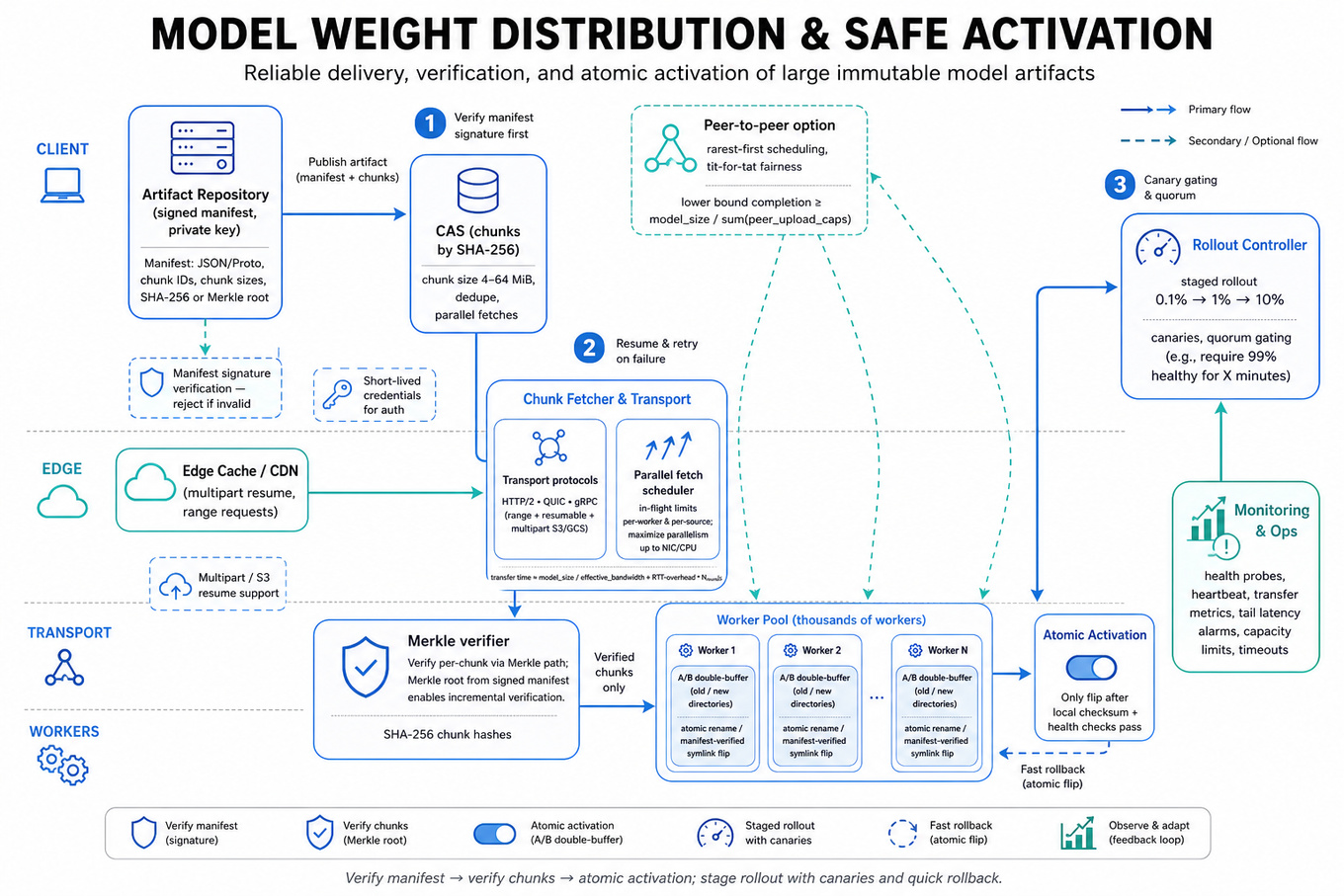
Artifact manifest: a signed JSON or protobuf listing chunk IDs, sizes, and chunk-level SHA-256 hashes (or Merkle root). The manifest is the single source of truth for integrity and versioning; verify signature before trusting any chunks.
-
Content-addressable storage (CAS) and chunking: split files into fixed-size chunks (e.g., 4–64 MiB) and store by chunk-hash to enable deduplication, parallel fetches, and chunk-level retries; chunk size trades off metadata overhead vs. parallelism.
-
Merkle tree: use a Merkle tree to allow incremental verification as chunks arrive; store the Merkle root in the signed manifest so you can verify partial downloads without rehashing the whole file.
-
Transport protocols & resume: support range requests and resumable uploads/downloads via
HTTP/2,QUICor chunkedgRPC; use server-side multipart APIs (S3/gcsstyle) so workers can resume without restarting from zero. -
Parallelism & scheduling: transfer time ~ model_size / effective_bandwidth + RTT-overhead * Nrounds; maximize parallel chunk fetches up to NIC/CPU limits while avoiding tail saturation; implement in-flight limits per-worker and per-source.
-
Peer-to-peer considerations: for P2P, schedule by rarest-first and enforce fair-upload with tit-for-tat; lower bound completion time is at least model_size / sum(peer_upload_caps) ignoring protocol overhead and scheduling inefficiencies.
-
Activation / atomic switch: implement A/B double-buffering (keep old and new directories) and an atomic
renameor manifest-verified symlink flip; only flip when local checksum and health checks pass to avoid partial exposure. -
Rollout, canaries, and quorum gating: staged rollout (e.g., 0.1%, 1%, 10%) with health probes; require a quorum (e.g., 99% of canary group healthy for X minutes) before next stage; provide fast rollback path with atomic flip.
-
Version integrity & auth: sign manifests with a private key and use short-lived credentials or signed URLs for chunk fetches; use mutual
TLSbetween control-plane and workers to prevent man-in-the-middle. -
Dealing with stalls & failures: detect stalled transfers with per-chunk timeouts + exponential backoff; blacklist bad sources; fall back to alternative mirrors or CAS stores; cap retry budget to avoid wasting bandwidth.
-
Capacity planning & CDN/caching: push artifacts to an edge cache/CDN for faster distribution; for large internal fleets, a two-tier strategy (seed storage + regional caches) reduces cross-region egress and load on origin.
-
Observability & SLOs: instrument
p50/p95/p99distribution time, chunk verification failures, activation latency, and rollback rates; implement alert thresholds and automated circuit-breakers to halt rollouts on anomalies.
Worked example — Design Safe Distribution and Activation of Model Weights
Start by clarifying constraints: maximum artifact size, worker disk and RAM, acceptable activation outage window, network topology, and security (who can sign). Organize the design into four pillars: (1) immutable artifact + signed manifest stored in CAS and edge caches; (2) resumable chunked transfer with parallelism and per-chunk SHA-256 verification (or Merkle proof); (3) safe activation via A/B double-buffering and atomic rename, gated by local checksum and health checks; (4) staged rollout & rollback controlled by a central controller that enforces quorum rules and can abort/rollback. For tradeoffs, explicitly discuss chunk size: larger chunks reduce metadata and hash overhead but increase wasted work on retries; pick 8–16 MiB for typical fleets as a balanced default. Closing: note operational controls — thresholded alerts, kill-switch to freeze activation, and a plan to handle partial rollouts; if more time, add adaptive chunk sizing based on per-region RTT/bandwidth and implement Merkle-tree-based fast verification.
A second angle — Design Peer-to-Peer Model Distribution Under a Shared Link Cap
When peers share strict upload/download caps, the problem shifts from pure server scaling to scheduling under constrained aggregate link budgets. The core primitives remain: signed manifest, chunking, and verification. The key differences are scheduling policies (rarest-first with upload quotas), a lower-bound argument on completion time using network flow (you cannot finish faster than model_size / sum(upload_caps) aggregated over time), and incentives/fairness to prevent freeloaders. Implementation details include splitting workers into swarms by region, seeding regional supernodes with high upload capacity, and using upload-token accounting so each peer contributes proportionally. Also add monitoring to detect slow swarms and fallback to origin fetch for stragglers.
Common pitfalls
Pitfall: underestimating tail latency and bandwidth variability.
Designs that assume uniform bandwidth will suffer long tails; always simulatep95/p99bandwidth and plan parallelism and retries to reduce tail impact.
Pitfall: exposing partial model state during activation.
An atomic flip using a signed manifest and double-buffered file layout avoids serving from a partially-downloaded directory; a naivecp-then-delete approach can expose inconsistent artifacts.
Pitfall: skipping cryptographic integrity or key-management details.
Saying "use checksums" is not enough—explain manifest signing, key rotation, revocation, and short-lived credentials for chunk fetches; otherwise an integrity threat model is incomplete.
Connections
Deployment pivots often lead to adjacent topics like model serving (hot-reload vs. cold-restart strategies) and CI/CD for large artifacts (retention, promotion pipelines). Interviewers may also pivot to network QoS and regional cache design or operational runbooks (automated rollback, disaster recovery).
Further reading
-
Amazon S3 Multipart Upload — practical reference for resumable, chunked uploads and part verification.
-
BitTorrent BEP 3 (protocol) — rarest-first scheduling and peer exchange principles for P2P distribution.
-
Merkle tree (Wikipedia) — concise explanation of incremental verification and root-based integrity.
Practice questions
- Design Large Model-Weight Distribution to GPU WorkersAnthropic · Software Engineer · Technical Screen · hard
- Design Peer-to-Peer Model Distribution Under a Shared Link CapAnthropic · Software Engineer · Technical Screen · medium
- Design Safe Distribution and Activation of Model WeightsAnthropic · Software Engineer · Onsite · medium
- Design Model Weight DistributionAnthropic · Software Engineer · Onsite · medium
Related concepts
- Distributed Training and GPU Efficiency for Autonomy Models
- GPU Credit Ledgers And Resource AccountingSystem Design
- Distributed GPU Computation And Parallel MLML System Design
- GPU Credit Ledgers And SchedulersSystem Design
- ML Inference APIs And GPU BatchingML System Design
- Distributed Training Parallelism And CollectivesML System Design