Off-Policy Evaluation and Safe Rollouts
Asked of: Data Scientist
Last updated
-
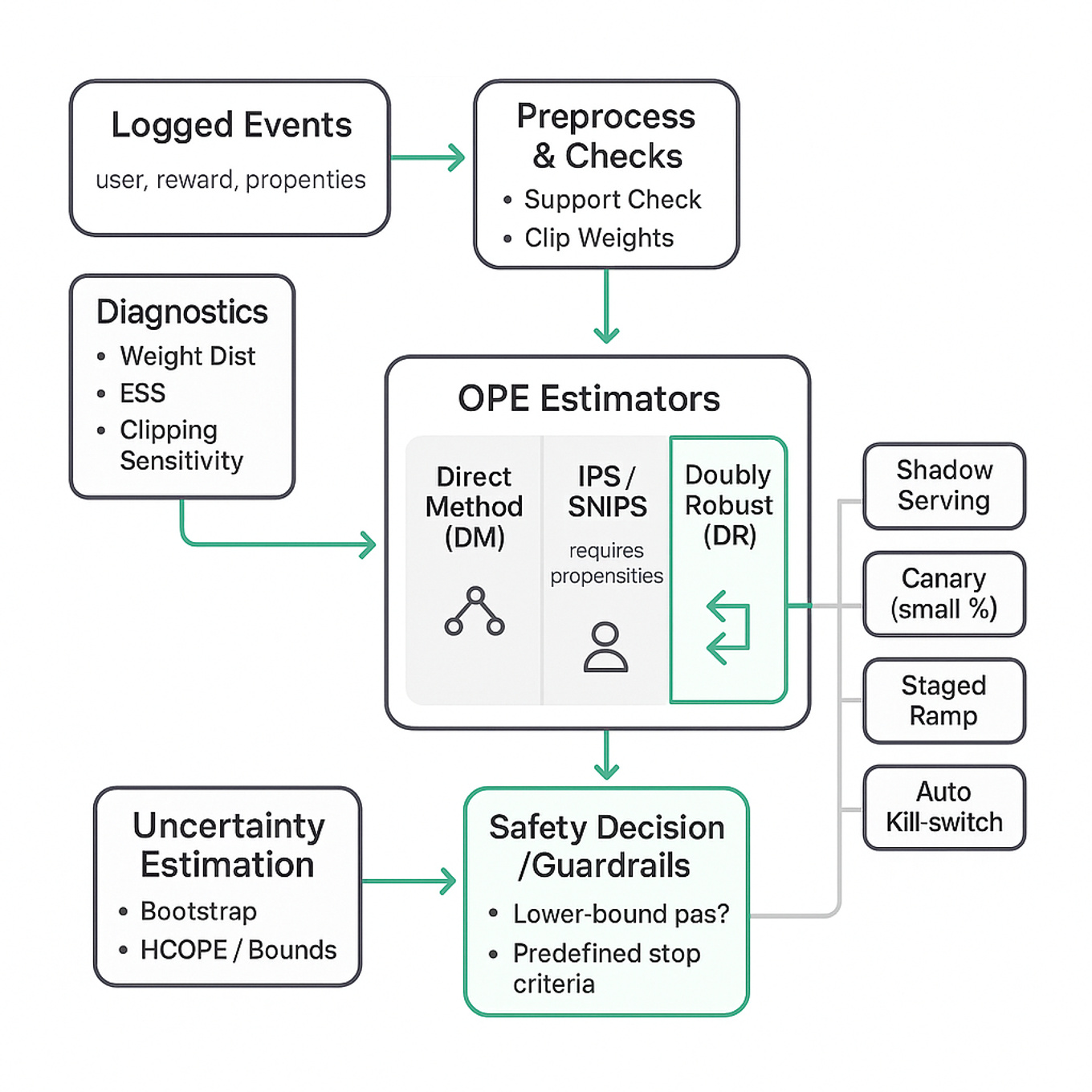
What it is Off-policy evaluation (OPE) estimates how a new policy would perform using historical logs collected under a different policy, avoiding risky online experiments. Safe rollouts use these estimates and uncertainty bounds to gradually ship a candidate policy (e.g., canary or shadow mode) while enforcing guardrails on user impact.
-
Why interviewers ask about it Consumer apps like Feed, Reels, or Ads can’t freely A/B test every idea; a bad launch can tank key metrics fast. Hiring managers want to know you can use logged data to de-risk changes, quantify uncertainty, and design rollout plans that protect users and revenue.
-
Core ideas to know
- Logged propensities are mandatory for IPS/SNIPS; without them, estimates can be arbitrarily biased.
- Direct Method, IPS, and Doubly Robust trade bias–variance; DR helps when either model or propensities are imperfect.
- Self-normalized IPS (SNIPS) reduces variance but introduces small bias; watch tail weights.
- Confidence intervals matter: bootstrap, concentration bounds, or HCOPE for safety guarantees.
- Sequential settings inflate variance; horizon length worsens importance weights in RL vs contextual bandits.
- Safe policy improvement (e.g., SPIBB) constrains changes where data are uncertain.
- Rollout tactics: canaries, shadow serving, interleaving, staged ramps, automatic kill-switches.
-
A common pitfall Candidates often quote a single metric (e.g., IPS uplift) without checking weight distribution or support mismatch. If a few impressions carry huge weights, your estimate is fragile—show diagnostics: effective sample size, clipping analyses, and sensitivity to propensity misspecification. Another miss is jumping straight to a 50% A/B after “good” offline results. Strong answers pair OPE with high-confidence bounds, then propose a guardrailed ramp with pre-defined stop criteria on core metrics and safety checks for long-tail cohorts.
-
Further reading
- Doubly Robust Policy Evaluation and Learning (Dudík, Langford, Li, ICML 2011) — foundational DR estimator balancing bias and variance; widely used in contextual bandits. (microsoft.com)
- High-Confidence Off-Policy Evaluation (Thomas, Theocharous, Ghavamzadeh, AAAI 2015) — methods to produce valid lower bounds from logs, directly informing safe deployment decisions. (people.cs.umass.edu)
- Counterfactual Reasoning and Learning Systems (Bottou et al., JMLR 2013) — industry-motivated treatment of counterfactual evaluation for ads/recs; great for practical intuition and system design. (jmlr.csail.mit.edu)