Ownership And Impact Storytelling
Asked of: Software Engineer
Last updated
What's being tested
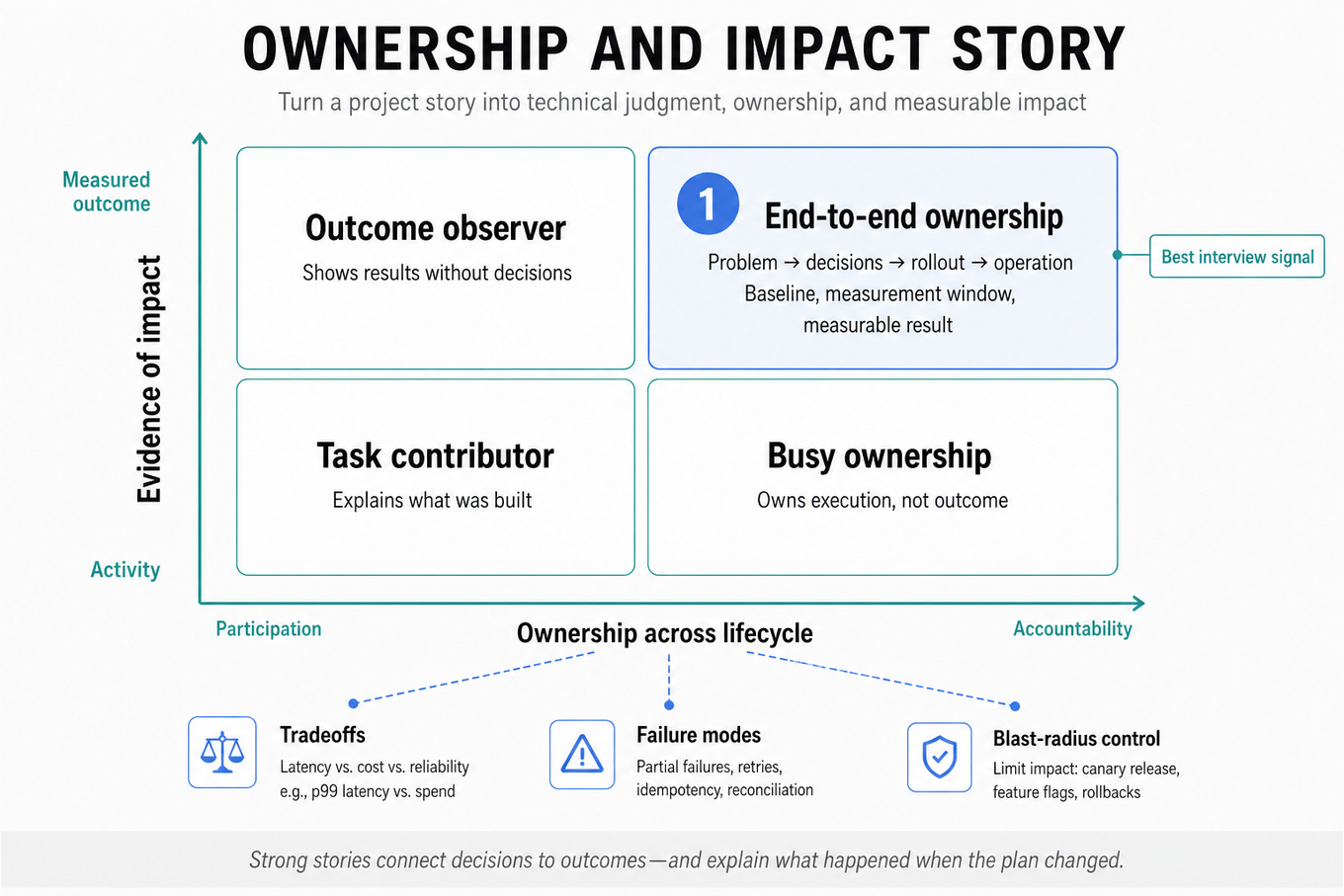
“What Project Are You Proudest Of?” tests whether you can explain end-to-end ownership of a software project: the problem, your specific technical decisions, execution through ambiguity, and measurable outcome. The interviewer is probing for technical judgment, not merely participation—how you diagnosed constraints, chose an architecture, handled failure modes, and influenced collaborators without overstating your role. Ramp operates financial workflows where reliability, correctness, security, and operational clarity matter, so a strong story connects engineering decisions to concrete improvements such as lower `p99` latency, fewer incidents, safer deployments, or improved reconciliation accuracy.
Core knowledge
-
Ownership means being accountable for the outcome across discovery, implementation, rollout, and operation—not personally writing every line. Distinguish your decisions from team contributions, and explain what you did when the original plan stopped working.
-
Use a problem-solution-impact structure: establish the user or system pain, describe constraints and alternatives, explain the implementation, then quantify results. “Built a service” is weak; “reduced timeout rate from 2% to 0.2% at 10× traffic” is credible.
-
Anchor impact in engineering metrics: availability, error rate, throughput,
`p50`/`p95`/`p99`latency, deployment frequency, rollback rate, mean time to recovery, cloud cost, or queue depth. State the baseline, measurement window, and whether the result was directly or indirectly attributable to your work. -
Explain tradeoffs explicitly. A synchronous
`Postgres`transaction may provide straightforward consistency but increase tail latency; an asynchronous queue improves resilience and throughput but introduces retries, duplicate delivery, observability needs, and eventual consistency. -
Demonstrate correctness under failure using concrete mechanisms: idempotency keys, unique constraints, transactional outbox, bounded retries with exponential backoff, dead-letter queues, and reconciliation jobs. For financial operations, “it usually works” is insufficient; explain how incorrect or duplicated writes are prevented.
-
Show how you reduced blast radius with feature flags, canary releases, backward-compatible schema migrations, rate limits, timeouts, circuit breakers, and staged rollouts. A good story includes what happens when a dependency is slow, unavailable, or returns malformed data.
-
Include operability as part of ownership. Mention structured logs, correlation IDs, dashboards, alerts tied to actionable symptoms, and runbooks. For an incident, distinguish detection time, diagnosis time, mitigation, permanent remediation, and the follow-up that prevented recurrence.
-
When describing a distributed design, identify the relevant consistency model. Strong consistency can simplify read-after-write behavior but costs latency or availability; eventual consistency scales well but requires user-visible status states, reconciliation, or compensating actions.
-
Make collaboration technical and specific. Describe how you aligned with another engineer on an API contract, negotiated schema ownership, reviewed a concurrency design, or used a design document to resolve disagreement. Avoid turning the answer into a project-management narrative.
-
Be precise about scope and counterfactuals. State whether you led the design, implemented the critical path, migrated existing traffic, or fixed production behavior. If several changes shipped together, explain how logs, staged rollout, comparison against baseline, or controlled exposure supports your impact claim.
-
For a project that changed direction, explain your debugging method: reproduce the issue, narrow the hypothesis, inspect traces and metrics, isolate the smallest failing component, test a fix, and verify regression coverage. Naming the discarded hypothesis often demonstrates more judgment than claiming the first design was perfect.
Worked example: What Project Are You Proudest Of?
In the first 30 seconds, I would choose one project with a clear engineering challenge and ask whether the interviewer wants the overview first or the technical deep dive. I would state the baseline, my role, the constraints—such as preserving API compatibility, avoiding duplicate financial writes, or maintaining a `p99` latency target—and the result I will measure. I would organize the answer around four pillars: why the existing system failed, the architecture and alternatives considered, my implementation and collaboration, and rollout plus operational impact. For example, I might describe replacing a fragile synchronous workflow with an idempotent, event-driven processing path backed by `Kafka`, a transactional outbox, and explicit status transitions. I would flag the central tradeoff: asynchronous processing improved resilience and throughput, but required idempotent consumers, retry handling, reconciliation, and a user-visible pending state. I would identify my personal ownership precisely, such as designing the state machine, implementing the consumer, adding metrics, and leading the staged migration while teammates owned adjacent clients. I would close with the measured outcome—lower timeout and duplicate-write rates, stable correctness checks, and improved recovery time—rather than claiming success from launch alone. If I had more time, I would also discuss load-test results, failure injection, rollback behavior, and what I would redesign after operating the system for several months.
A second angle
The same project can be framed less as an architecture win and more as an incident-to-prevention story when the interviewer emphasizes judgment under pressure. Start with the production symptom, explain how you separated application bugs from dependency or data issues using traces and logs, and describe the smallest safe mitigation. Then focus on the permanent fix: stronger invariants, better alerting, an idempotency boundary, and a regression test that captures the failure mode. This angle is especially useful when the project’s impact is reliability or correctness rather than a new feature.
Common pitfalls
Pitfall: Claiming impact without a baseline. “It made the system faster and more reliable” is not persuasive; give before-and-after values, the measurement method, and any confounding changes such as a traffic decrease or unrelated infrastructure upgrade.
A strong candidate avoids taking credit for the entire team’s work or, conversely, hiding behind “we.” The tempting answer lists everyone’s contributions equally; a better answer names collaborators, then clearly separates your decisions, implementation, and moments where you unblocked the outcome.
Pitfall: Describing architecture without operational depth. Saying “we used a queue for scalability” skips duplicate delivery, ordering, poison messages, backpressure, retries, and recovery; explain which guarantees were required and how the design enforced them.
Connections
The interviewer may pivot from ownership into system design, incident response, distributed-systems correctness, API evolution, observability, or testing strategy. Be ready to explain how the same project would behave under a dependency outage, a schema migration, a traffic spike, or a partial rollback.
Further reading
-
Site Reliability Engineering — Google’s practical treatment of service-level indicators, error budgets, incident response, and reliable system operation.
-
Accelerate, Nicole Forsgren, Jez Humble, and Gene Kim — connects deployment and operational capabilities to measurable software-delivery performance.
-
Designing Data-Intensive Applications — deep coverage of replication, consistency, streams, transactions, and failure tradeoffs.
Practice questions
Related concepts
- Behavioral Ownership, Impact, And LeadershipBehavioral & Leadership
- Project Ownership, Impact, And Team FitBehavioral & Leadership
- Behavioral Ownership, Metrics, And Product JudgmentBehavioral & Leadership
- Technical Leadership, Impact, And Trade-OffsBehavioral & Leadership
- Ownership, Prioritization, Ambiguity, and Project Deep DivesBehavioral & Leadership
- Adobe Cross-Team Collaboration And Impact Stories