PII, Fraud, And Underwriting Event Processing
Asked of: Software Engineer
Last updated
What's being tested
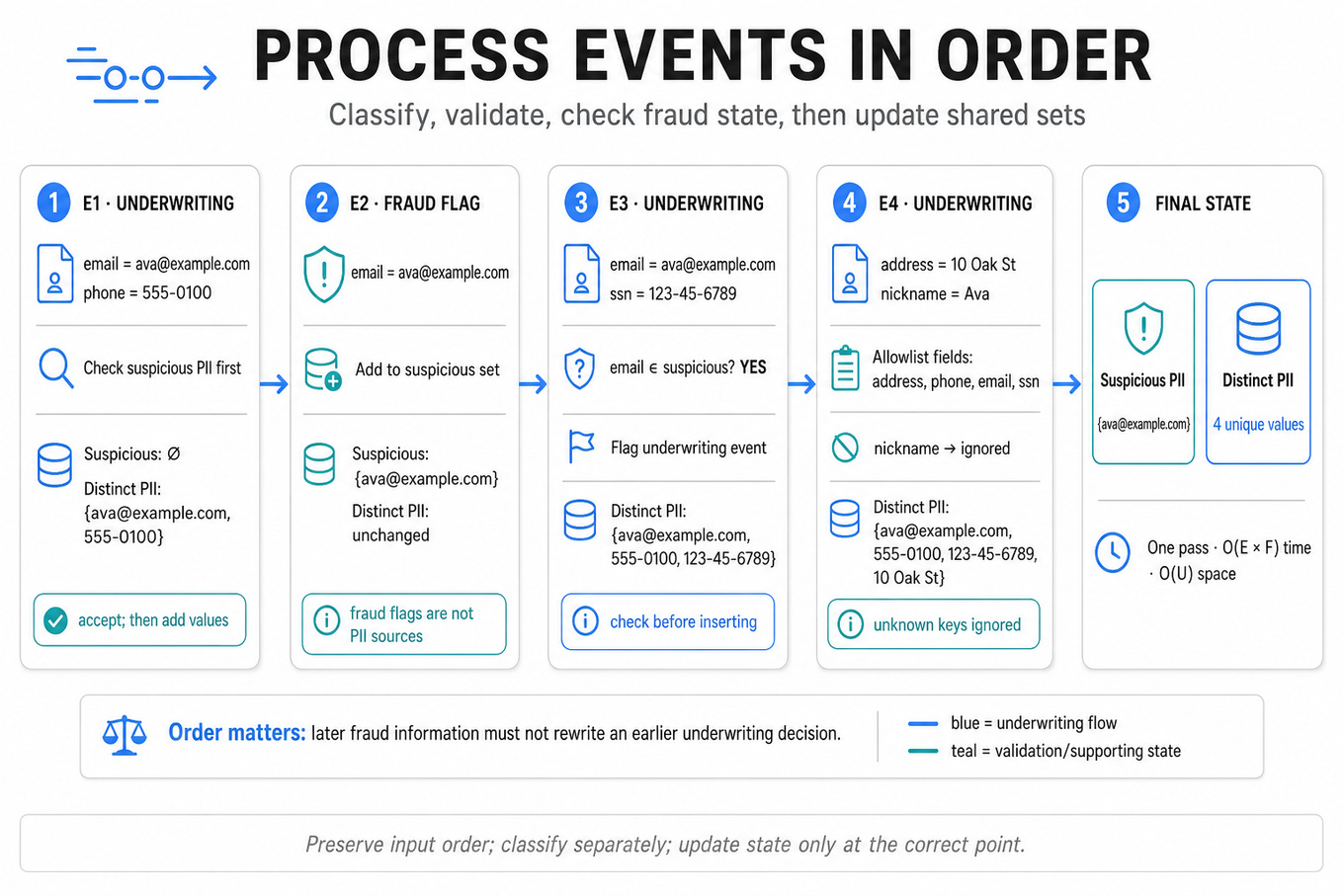
These problems test set-based deduplication, event-stream processing, field validation, and preserving temporal order. You must distinguish underwriting events from fraud flags, normalize eligible values, and update shared state at the correct point in processing.
Patterns & templates
-
Use a global
setfor distinct nonempty PII values; membership and insertion are expectedO(1)average, withO(U)space forUunique values. -
Iterate events once in input order; maintain state incrementally rather than rescanning prior events, yielding
O(E × F)time forEevents andFfields. -
Centralize recognized-field handling with an allowlist such as
{"address", "phone", "email", "ssn"}; ignore unknown keys explicitly. -
Normalize only as specified: exclude
null, missing, and empty-string values, but do not silently alter formatting unless the prompt requires it. -
For fraud propagation, check an underwriting event’s PII against the suspicious
setbefore adding its values; ordering changes the result. -
Separate event classification from value extraction with helpers like
is_underwriting(event)andextract_pii(event)to reduce branching and testing complexity. -
Preserve original event order; sorting can violate causality and incorrectly allow later fraud information to affect earlier underwriting decisions.
Common pitfalls
Pitfall: Counting fields or events instead of globally distinct values; the same email appearing repeatedly contributes only once.
Pitfall: Marking an underwriting event suspicious after inserting its own PII, which incorrectly makes self-introduced values trigger fraud.
Pitfall: Treating fraud flags as ordinary PII sources, or allowing missing, empty, and unrecognized fields into the set.
Practice these
The practice cards below cover the canonical variants — solve all of them and time yourself.
Practice questions
Related concepts
- Security, PII, And Secrets In Banking Systems
- Fraud, Credit Risk, And Risk ControlsProduct / Decision Making
- Fraud Risk Modeling And Real-Time DecisioningML System Design
- Missing Data, Imbalance, And Data QualityMachine Learning
- Fraud, Bot, And Fake Account Detection
- Financial Services Compliance And Fair LendingProduct / Decision Making