Production ML Systems, Evaluation, And Safety
Asked of: Software Engineer
Last updated
What's being tested
Candidates must show practical, systems-focused debugging and design skills for production ML: diagnosing pipeline and model failures, instrumenting reliable serving, and choosing safe rollout strategies. Interviewers probe the candidate’s ability to structure an investigation, read telemetry, and propose engineering fixes (retries, feature parity, canaries, rollbacks) rather than invent new ML algorithms.
Core knowledge
-
Data drift vs concept drift: know the difference—data distribution change (input features) vs label relationship change (P(y|x)); detect with population statistics, PSI, or simple KS tests on feature histograms.
-
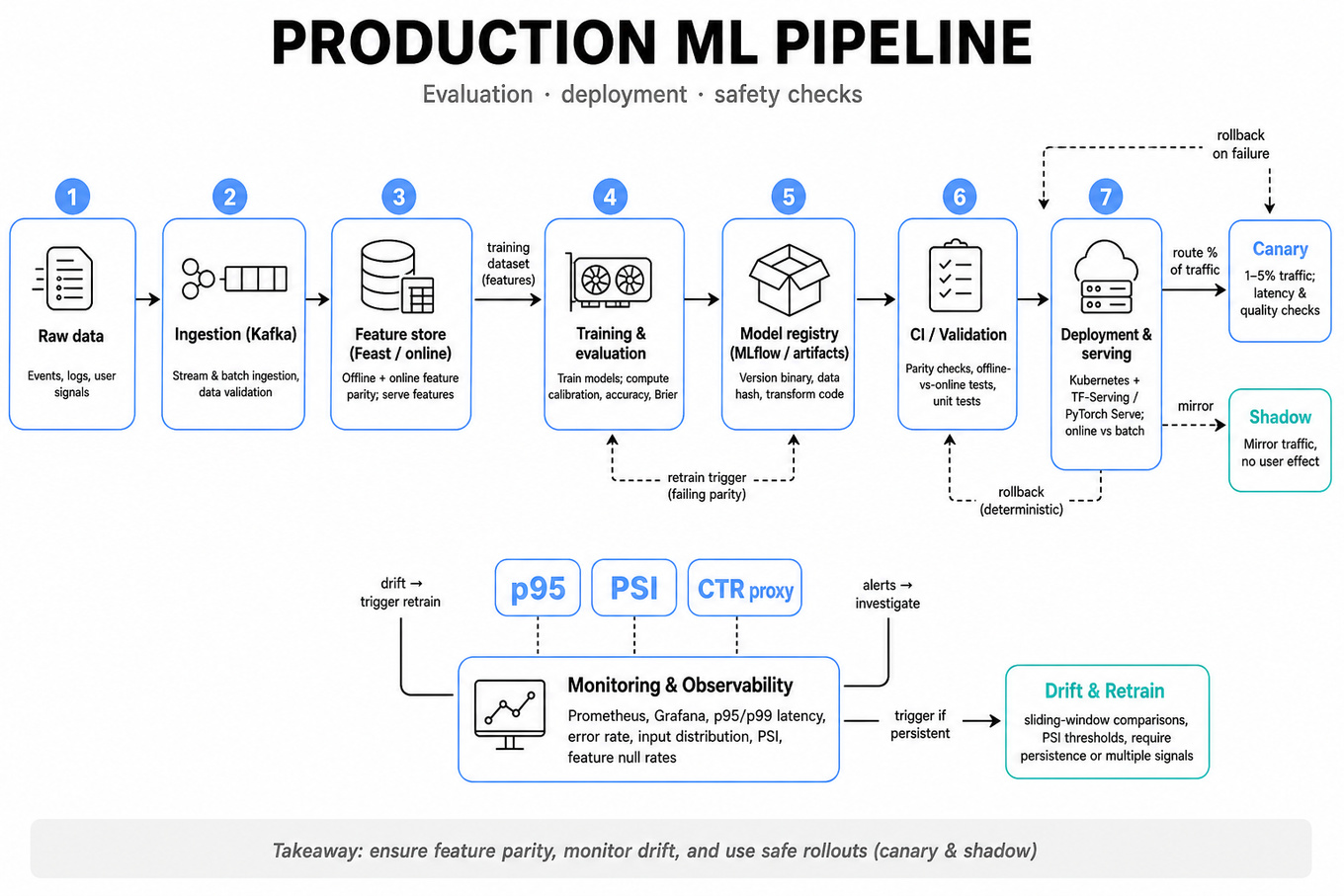
Feature parity: ensure offline-features and online-features are computed identically; mismatches are a top cause of production failures. Reproduce feature pipelines locally before blaming the model.
-
Model versioning and lineage: use
MLflowor artifact stores to track model binary, training data hash, feature-transformation code, and config; make rollbacks deterministic by pinning all artifacts. -
Serving patterns: know the tradeoffs of online inference (low latency, strong consistency) vs batch/async (higher throughput, relaxed freshness). Implement with
Kubernetes+TensorFlow Serving/PyTorch Serveor a lightweight microservice. -
Canary & shadow deployment: route a small % of live traffic to a new model (canary) for latency/quality checks; mirror traffic to a new model with no user effect (shadow) to validate parity.
-
Monitoring & SLOs: instrument
p95/p99latency, error rate, and throughput; add model-specific telemetry: input distribution summaries, feature null rates, and top-10 features by contribution. Alert on threshold breaches. -
Model evaluation signals: track surface metrics (
accuracy,precision,recall) plus calibration (reliability diagrams, Brier score) and production proxies (CTR, downstream conversion) when labels are delayed. -
Drift detection and retraining triggers: use sliding-window comparisons, population-stability-index (PSI), or statistical change detectors; avoid retraining on transient spikes — require persistence or multiple signals.
-
Observability tools: integrate
Prometheusfor metrics,Grafanadashboards, structured logs for request/response, and distributed traces to correlate model latency with upstream/downstream services. -
Operational robustness: implement idempotent requests, graceful degradation (cached fallback model), circuit breakers, and exponential backoff for retriable failures; log inputs that hit fallbacks for analysis.
-
Privacy & safety guardrails: enforce input sanitization and rate limits, redact PII before logging, and add a pre-check to block toxic or out-of-distribution inputs.
Tip: capture a reproducible failing request (input, feature values, model version) so engineers can replay production behavior locally.
Worked example — Debug a failing ML classifier
Start by framing: ask what “failing” means (latency, accuracy drop, calibration drift, or increased false positives), when it started, rollout/versions, and whether labels are available in production. Organize the investigation into three pillars: (1) reproduce the failure locally (replay production requests), (2) inspect pipeline differences (feature-parity, preprocessing), and (3) inspect runtime signals (latency, memory, OOMs, infra errors). Triage steps: check recent deployments and config changes, verify feature histograms for top features against training distribution, and run the model binary on a sample of production inputs to compare predicted scores and confidences. A concrete tradeoff to call out: if retraining is easy, you can quick-retrain on recent data, but that risks reinforcing label bias—prefer validating drift and running a controlled canary retrain. Close by proposing short-term mitigations (canary rollback, serving fallback) and long-term fixes (add feature-parity tests, automated drift alerts, and reproducible replay pipelines), and say: “if I had more time, I’d add a shadow test harness and automated A/B quality gates with live labels.”
A second angle — Design a response-ranking ML system
Ranking introduces high-throughput, latency-critical serving and heavy instrumentation needs. The same debugging primitives apply: ensure feature parity between offline ranker training and online scorer, use shadowing to mirror traffic to new ranking models, and monitor both ranking-specific metrics (NDCG, CTR at k) and system SLOs. Unique constraints include candidate-generation latency (multi-stage pipelines), stateful session features, and the need for online batch scoring or pre-computed candidate scores. A software engineer must design efficient feature lookup (in-memory cache or Redis), ensure deterministic sort order under ties, and provide fast rollbacks because model mistakes directly affect user experience and revenue.
Common pitfalls
Pitfall: Blaming the model first.
Jumping to retrain without checking feature pipelines or infra issues wastes time. A better approach is to first reproduce requests end-to-end and confirm that the model gets the same inputs offline as online.
Pitfall: Relying solely on offline metrics.
Offline evaluation (e.g., cross-val accuracy) can miss production mismatches. Always correlate with production telemetry, shadow experiments, and delayed-label feedback loops.
Pitfall: Over-alerting on transient noise.
Triggering retrains or rollbacks on single spikes causes churn. Require multiple corroborating signals (persisting drift, label degradation, increased error rates) before automating heavyweight changes.
Connections
Interviewers may pivot to adjacent systems topics: feature stores and their consistency semantics, or deployment pipelines like CI/CD for models and canary automation. They might also ask about distributed tracing and SLO-driven incident response for ML services.
Further reading
-
Hidden Technical Debt in Machine Learning Systems — Sculley et al., NIPS 2015 — seminal paper on production ML failure modes and engineering debt.
-
Designing Data-Intensive Applications — Martin Kleppmann — practical reference for durable storage, stream processing, and system reliability patterns relevant to ML serving.
Practice questions
- Design Video Generation OrchestrationOpenAI · Software Engineer · Technical Screen · medium
- Design a Text-to-Video Generation SystemOpenAI · Software Engineer · Onsite · hard
- Explain your perspective on AI safetyOpenAI · Software Engineer · Onsite · hard
- Design an enterprise RAG assistant for internal docsOpenAI · Software Engineer · Technical Screen · hard
- Discuss views on AI safety and its impactsOpenAI · Software Engineer · Onsite · medium
- Implement and Debug Backprop in NumPyOpenAI · Software Engineer · Technical Screen · medium
- Debug a Machine Learning PipelineOpenAI · Software Engineer · Technical Screen · medium
- Design an End-to-End ML SystemOpenAI · Software Engineer · Technical Screen · hard
- Design a response-ranking ML systemOpenAI · Software Engineer · Technical Screen · hard
- Debug a failing ML classifierOpenAI · Software Engineer · Technical Screen · hard
Related concepts
- Production ML Pipelines And System DesignML System Design
- Production ML Serving, Feature Stores, And MonitoringML System Design
- Production ML Infrastructure and MonitoringBehavioral & Leadership
- ML Evaluation, Uncertainty, And Safety GuardrailsML System Design
- Applied Machine Learning Modeling And EvaluationMachine Learning
- ML System Design, Recommenders, Forecasting And AllocationMachine Learning