Sandboxed Cloud IDEs And DevBoxes
Asked of: Software Engineer
Last updated
What's being tested
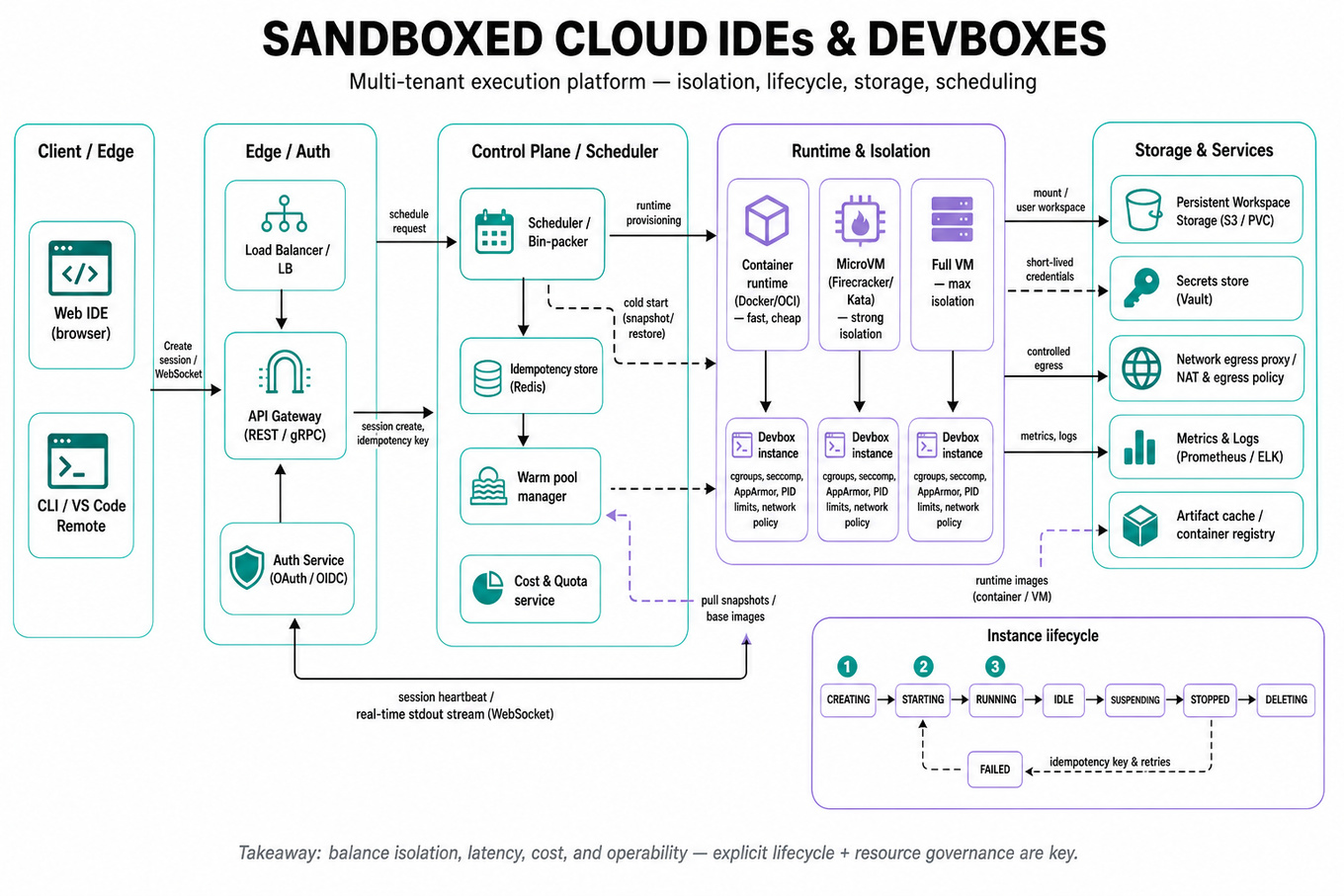
This tests whether you can design a multi-tenant execution platform where untrusted user code runs safely, interactively, and cost-effectively. Interviewers are probing your ability to combine sandboxing, resource scheduling, persistent developer state, real-time streaming, and operability into one coherent distributed system. OpenAI cares because many engineering systems involve executing arbitrary workloads, isolating tenants, streaming outputs, and managing expensive compute under strict reliability and security constraints. A strong answer is not “put containers on Kubernetes”; it explains where isolation boundaries live, how lifecycle state transitions work, how data survives restarts, and how the system fails safely.
Core knowledge
-
Isolation boundary choice is the central design decision. Plain
Dockercontainers are fast and cheap but share the host kernel; microVMs such asFirecrackerorKata Containersprovide stronger isolation with higher startup and memory overhead; full VMs maximize isolation but are slower and costlier. -
Threat model should be explicit: users may run fork bombs, crypto miners, kernel exploits, data exfiltration attempts, or noisy-neighbor workloads. Defenses include seccomp, AppArmor/SELinux, read-only base images, dropped Linux capabilities, cgroups, network egress policies, per-tenant secrets isolation, and short-lived credentials.
-
Resource governance usually combines hard limits and fair scheduling. Use cgroups for CPU shares, memory limits, PID limits, disk quotas, and network bandwidth. Capacity planning starts with , then reserves headroom for spikes and bin-packing fragmentation.
-
Lifecycle management should be modeled as a state machine:
CREATING -> STARTING -> RUNNING -> IDLE -> SUSPENDING -> STOPPED -> DELETING, withFAILEDand retry transitions. Make operations idempotent using request IDs or a Stripe-style idempotency key, because orchestration calls will time out and be retried. -
Cold start latency matters for interactive IDEs. Techniques include warm pools, pre-pulled images, snapshot/restore, layered filesystems, and prebuilt dev images. A realistic target might be sub-5s for warm starts and 20–60s for cold starts, depending on image size and VM isolation.
-
Persistent workspace state is separate from ephemeral compute. Store source code and user files on a durable volume such as
EBS,PersistentVolume,Ceph, or networked filesystem; store metadata inPostgres; store snapshots and large artifacts inS3-style object storage. Compute nodes should be disposable. -
File synchronization has tradeoffs. A mounted network filesystem gives immediate persistence but can add latency and consistency edge cases. Local disk plus periodic snapshots improves performance but risks recent-data loss. Collaborative editing requires an explicit protocol such as Operational Transform or CRDTs, not just shared files.
-
Real-time terminal, logs, and editor output are usually streamed over
WebSocket,SSE, or a bidirectional RPC stream. The system needs backpressure, reconnect tokens, cursor/session replay, and durable log storage. Interactive terminal traffic is latency-sensitive; build logs are throughput-sensitive. -
Control plane vs data plane separation keeps the design understandable. The control plane handles auth, workspace metadata, scheduling decisions, billing state, and lifecycle APIs. The data plane runs sandboxes, proxies terminal traffic, mounts storage, enforces quotas, and streams logs.
-
Scheduler design should account for placement constraints: tenant isolation, available CPU/memory/GPU, image locality, region, workspace volume locality, and anti-affinity for noisy tenants. At small scale,
Kubernetesis enough; at larger scale, custom schedulers may optimize bin packing, warm pool utilization, and preemption. -
Network security should default deny. Use per-sandbox network namespaces, egress allowlists, metadata service blocking, service mesh or sidecar proxy for controlled access, and tenant-scoped DNS. If sandboxes need internet access, add rate limits, abuse detection hooks, and audit logs.
-
Observability must span both product and infrastructure behavior without drifting into product strategy. Track
p50/p95/p99startup latency, workspace crash rate, sandbox OOM kills, CPU throttling, disk usage, failed attach attempts, log-stream lag, scheduler queue time, and host saturation. Use structured logs, traces, and per-tenant audit events.
Worked example
For Design a sandboxed cloud IDE, a strong candidate starts by clarifying the interaction model: “Are users editing code in a browser, running arbitrary commands, and expecting a persistent filesystem across sessions? What scale should I assume: 10K concurrent workspaces, mostly CPU-only, with startup latency under 10 seconds for warm workspaces?” Then they declare a threat model: user code is untrusted, tenants must not access each other’s files or secrets, and the platform must tolerate abusive resource usage.
The answer can be organized around four pillars: frontend/editor session, workspace control plane, sandbox execution plane, and storage/streaming/observability. The frontend connects to an IDE gateway over WebSocket for terminal I/O, language server traffic, and logs. The control plane stores workspace metadata in Postgres, authenticates users, enforces RBAC, and drives a lifecycle state machine. The execution plane schedules each workspace onto a worker running either containers with hardened profiles or microVMs using Firecracker.
A specific tradeoff to call out is container speed versus VM isolation. For an internal trusted platform, hardened containers on Kubernetes may be acceptable; for arbitrary public code execution, microVMs are safer because they reduce shared-kernel risk, even if they increase cold-start time and memory overhead. Workspace files should live on durable volumes or object-backed snapshots so that compute nodes can die without data loss. Close by saying that with more time you would detail collaborative editing consistency, abuse prevention, and region-aware capacity planning.
A second angle
For Design multi-tenant CI/CD workflow system, the same execution-platform concepts apply, but the workload is batch-oriented instead of interactive. CI jobs care less about sub-second terminal latency and more about queueing, reproducibility, artifact retention, cache efficiency, and deterministic retry semantics. The scheduler now places short-lived runners, streams build logs, uploads artifacts to S3, and records run state transitions such as QUEUED -> RUNNING -> SUCCEEDED/FAILED/CANCELED. Isolation remains critical because pull requests can run attacker-controlled code, but the design may favor ephemeral runners that are destroyed after each job rather than long-lived persistent workspaces. The strongest answers explicitly contrast interactive devboxes with CI: devboxes optimize warm continuity, while CI optimizes clean-room repeatability.
Common pitfalls
Pitfall: Saying “use
Kubernetesand containers” as the whole isolation story.
That answer misses the main risk: containers share a kernel and require careful hardening. A better answer names the threat model, compares containers, microVMs, and VMs, and then justifies the chosen boundary based on trust level, startup latency, and cost.
Pitfall: Treating workspace storage as if it lives inside the sandbox.
If the sandbox dies, the user’s state should not disappear. Strong designs separate ephemeral compute from durable workspace data, define snapshot or volume semantics, and explain what happens during worker failure, reconnect, and concurrent edits.
Pitfall: Over-indexing on feature details before defining the control plane.
Candidates sometimes spend five minutes on editor themes, plugins, or language-server behavior while ignoring lifecycle APIs, scheduling, quotas, and failure handling. Lead with the distributed-system backbone first; then add IDE-specific protocols like terminal streaming, file watching, and language server routing.
Connections
Interviewers can pivot from here into container orchestration, distributed job scheduling, real-time messaging, workflow engines, or secure multi-tenancy. Related designs include online judges, serverless functions, notebook platforms, remote build systems, and CI/CD runners.
Further reading
-
Firecracker: Lightweight Virtualization for Serverless Applications — useful background on microVM isolation and fast startup tradeoffs.
-
Borg, Omega, and Kubernetes paper lineage — foundational reading on cluster scheduling, bin packing, and workload isolation.
-
The Datacenter as a Computer, Barroso, Clidaras, Hölzle — strong systems background for resource management, utilization, and large-scale operational tradeoffs.