CI/CD Orchestration Platforms
Asked of: Software Engineer
Last updated
What's being tested
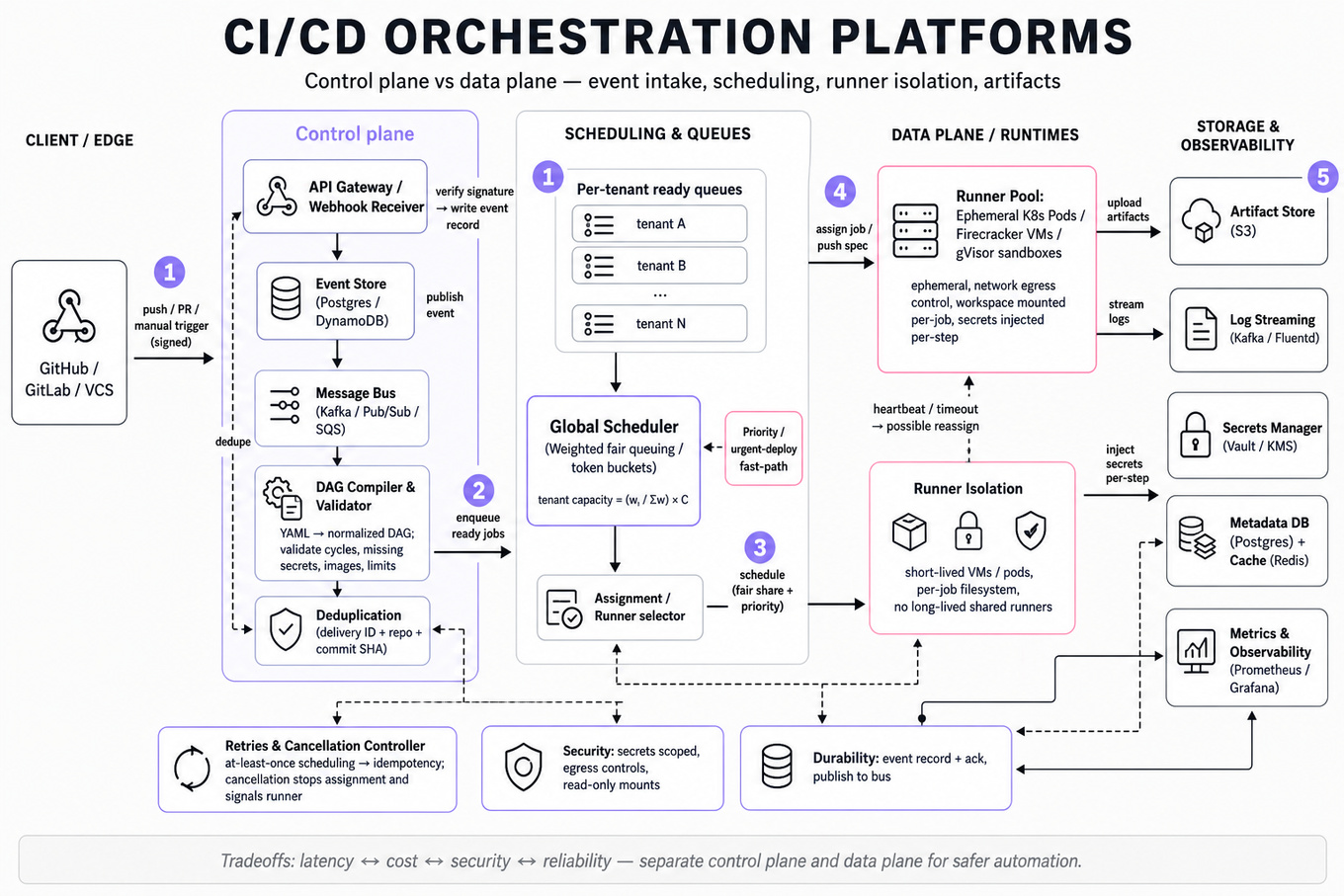
A strong answer shows you can design a multi-tenant distributed workflow system where code pushes, pull requests, and manual triggers become durable, isolated, observable build/test/deploy executions. Interviewers are probing for practical backend judgment: event intake, workflow parsing, dependency planning, scheduling fairness, runner isolation, artifact/log storage, retries, cancellation, and failure recovery. OpenAI cares because internal engineering velocity depends on safe automation: a CI/CD system must run untrusted code, protect secrets, scale bursty workloads, and provide deterministic enough behavior that engineers trust it. The best candidates separate control plane responsibilities from data plane execution and make explicit tradeoffs around latency, cost, security, and reliability.
Core knowledge
-
Control plane vs data plane is the organizing split. The control plane handles
GitHubwebhooks, workflow validation, DAG planning, scheduling, metadata, permissions, and APIs; the data plane runs jobs on isolated runners, streams logs, uploads artifacts, and reports heartbeats. -
Workflow representation should compile user config like
YAMLinto a normalized directed acyclic graph. Nodes are jobs or steps; edges encodeneedsdependencies. Validate cycles, missing secrets, unknown images, and resource limits before enqueueing so bad workflows fail fast. -
Event intake must be durable and idempotent. Use a webhook receiver that verifies signatures, writes an event record to
PostgresorDynamoDB, and publishes toKafka,SQS, orPub/Sub. Deduplicate using provider delivery IDs plus repository and commit SHA. -
Scheduling needs both dependency awareness and tenant fairness. A common design uses a ready-queue per tenant plus a global scheduler implementing weighted fair queuing or token buckets. Approximate share as , while preserving priority for urgent deploy jobs.
-
Runner isolation is central because builds execute arbitrary code. Prefer ephemeral
Kubernetespods, short-lived VMs, or sandboxed containers usinggVisor/Firecracker; avoid long-lived shared runners unless heavily locked down. Mount workspaces read/write per job and inject secrets only at step scope. -
Execution semantics should be stated clearly. At-least-once scheduling is easier: a job may be assigned twice after timeout, so runners and artifact writes need idempotency keys. Exactly-once execution is rarely worth promising; instead provide deterministic run IDs, attempt numbers, and safe cancellation.
-
State model typically includes
WorkflowRun,JobRun,StepRun,Artifact, andLogChunk. Store authoritative state transitions in a transactional DB, e.g.QUEUED -> RUNNING -> SUCCEEDED|FAILED|CANCELED|TIMED_OUT, and make transitions monotonic to survive duplicate runner messages. -
Logs and artifacts have different storage paths. Stream live logs through
WebSocket/SSEbacked byRedisor a pub/sub channel, then persist compressed chunks toS3/GCS. Store artifacts in object storage with content hashes, TTL policies, size quotas, and signed download URLs. -
Caching improves cost and latency but introduces correctness and security risks. Dependency caches should be keyed by lockfile hash, OS, architecture, and toolchain version, e.g.
npm-lock-sha + linux-amd64 + node20. Never let untrusted forks write caches consumed by protected branches. -
Secrets management should use scoped, audited retrieval from
Vault, cloud KMS, or a platform secret store. Runners should receive short-lived tokens, redact known secret values in logs, block secret exposure to forked pull requests, and separate build-time credentials from deploy credentials. -
Failure handling includes retries, timeouts, heartbeats, and leases. The scheduler assigns a job with a lease; runners renew heartbeats every few seconds. If lease expiry exceeds, say, heartbeat interval, mark the attempt lost and requeue if retry budget remains.
-
Observability and SLOs should cover platform health and user experience. Track queue wait time, run duration, runner utilization, cache hit rate, job failure rate, scheduler lag, log streaming latency, artifact upload failures, and
p95/p99API latency. Alert on saturation before builds stall.
Worked example
For Design multi-tenant CI/CD workflow system, start by clarifying scope: “Are we designing GitHub Actions-like CI only, or also deployment? How many tenants, runs per day, average job duration, and do we run untrusted external pull requests?” Then declare assumptions: thousands of repos, bursty traffic after work hours, untrusted code, and a requirement for live logs, artifacts, cancellation, and retry.
Organize the answer around four pillars: intake and planning, orchestration and scheduling, secure execution, and storage/observability. For intake, describe a signed webhook receiver that persists events, deduplicates deliveries, fetches workflow config, validates it, and compiles it into a DAG. For orchestration, describe a scheduler that moves runnable DAG nodes into per-tenant queues, applies weighted fairness, assigns jobs to runners with leases, and reacts to heartbeats and terminal status updates.
For execution, propose ephemeral Kubernetes pods or VM-backed runners, with per-job workspaces, short-lived credentials, network egress policy, and step-level secret injection. For storage, use a relational database for run/job state, object storage for artifacts and archived logs, and SSE/WebSocket for live log streaming. A specific tradeoff to flag is container pods versus microVMs: pods are cheaper and faster to start, while Firecracker-style microVMs provide stronger isolation for untrusted workloads at higher cold-start and operational cost. Close by saying that, with more time, you would detail deployment gates, cache poisoning defenses, and multi-region failover for the control plane.
A second angle
For Design a CI/CD pipeline with scheduler, the center of gravity shifts from end-to-end platform components to scheduling policy and execution semantics. You should spend more time on ready queues, dependency resolution, worker leases, starvation prevention, priority classes, and backpressure. A good framing is: “The pipeline compiler produces a DAG; the scheduler’s job is to maintain the set of runnable nodes and allocate scarce runner capacity fairly.” The tricky tradeoff is fairness versus latency: strict per-tenant fairness prevents noisy neighbors but can underutilize specialized runners like GPU or ARM builders. A strong answer proposes separate pools by resource type and a fairness layer within each pool, with controlled work stealing when capacity would otherwise sit idle.
Common pitfalls
Pitfall: Treating the system as a linear script runner instead of a distributed DAG orchestrator.
A tempting answer is “webhook triggers a build server, build server runs tests, then deploys.” That misses parallelism, partial retries, dependency ordering, cancellation, and recovery after scheduler or runner crashes. A better answer explicitly models workflows, jobs, attempts, leases, and state transitions.
Pitfall: Hand-waving security with “run it in Docker.”
Containers are not a complete isolation boundary when tenants execute untrusted code and secrets are present. Interviewers expect discussion of ephemeral runners, scoped credentials, fork PR restrictions, cache isolation, image provenance, network policy, and log redaction. You do not need to design a full kernel sandbox, but you must show awareness of the threat model.
Pitfall: Over-indexing on one technology before explaining requirements.
Saying “use Kubernetes, Kafka, Postgres, and S3” is not a design by itself. Lead with invariants: durable events, idempotent processing, fair scheduling, isolated execution, and observable state. Then map those invariants to concrete technologies and explain why each choice is replaceable.
Connections
Interviewers may pivot from CI/CD orchestration into distributed task queues, workflow engines like Temporal or Argo Workflows, container orchestration on Kubernetes, or artifact/package registry design. They may also ask about deployment strategies such as blue-green, canary, rollback, and progressive delivery, but keep the answer grounded in backend system design rather than product release policy.
Further reading
-
Borg, Omega, and Kubernetes — explains scheduling and cluster-management ideas behind modern container orchestration.
-
The Tail at Scale — useful for reasoning about latency, retries, hedging, and large distributed systems under load.
-
Temporaldocumentation — a concrete reference for durable workflow execution, retries, timers, and activity heartbeats.
Featured in interview prep guides
Practice questions
Related concepts
- CI/CD Workflow OrchestrationSystem Design
- CI/CD, Release Engineering, And GPU Test InfrastructureSystem Design
- CI/CD, Jenkins, Blue-Green, Canary, And Rollbacks
- Sandboxed Cloud IDEs And DevBoxesSystem Design
- Scalable Service And Distributed System DesignSystem Design
- Scalable Distributed System ArchitectureSystem Design