CI/CD, Release Engineering, And GPU Test Infrastructure
Asked of: Software Engineer
Last updated
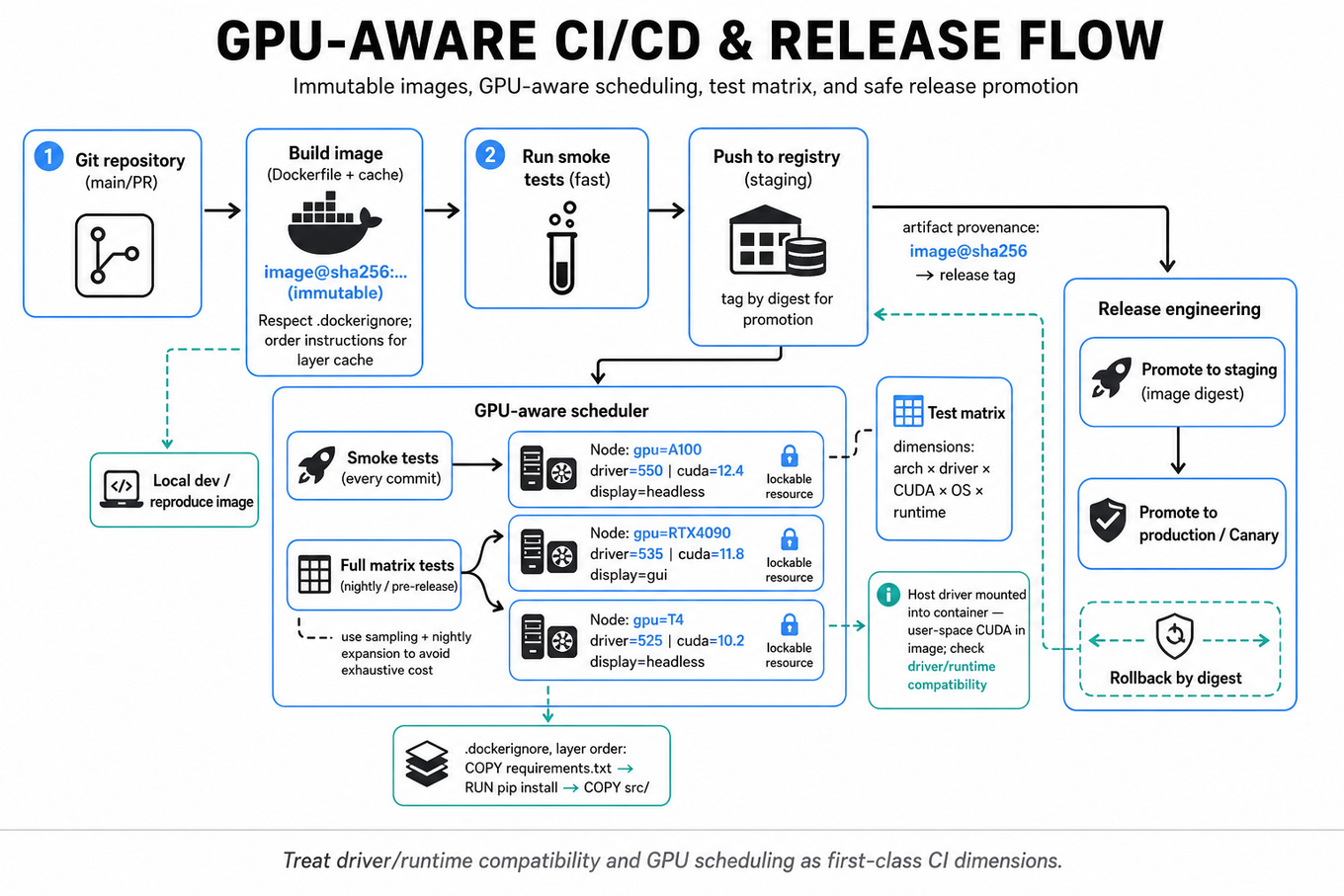
What's being tested
This area tests whether you can design a reliable CI/CD and release engineering system for software that depends on scarce, stateful, hardware-specific GPU resources. NVIDIA cares because many failures only appear under a particular driver, CUDA version, kernel, GPU architecture, graphics stack, or container runtime configuration, so “tests pass on my laptop” is not enough. Interviewers are probing for practical engineering judgment: image reproducibility, Git workflow discipline, artifact provenance, GPU-aware scheduling, flaky-test containment, rollback strategy, and debugging under constrained hardware availability. A strong answer balances correctness, throughput, security, and debuggability rather than simply saying “run tests in Docker and Jenkins.”
Core knowledge
-
Container image lifecycle starts with a
Dockerfile, build context, layered filesystem, cache lookup, image tagging, push to a registry, and pull onto workers. Know that tags likelatestare mutable; immutable digests such asimage@sha256:...are safer for reproducible CI and release promotion. -
Docker layer caching is highly sensitive to instruction order. Put slow-changing dependency installation before fast-changing source copies, e.g.
COPY requirements.txtthenRUN pip install, thenCOPY src/. Large build contexts slow builds and can leak secrets, so use.dockerignoreaggressively. -
GPU containers do not package the host kernel driver in the normal application image. With
NVIDIA Container Toolkit, the host driver is mounted into the container while user-space libraries such asCUDA,cuDNN, or application dependencies may come from the image. Compatibility between host driver and containerCUDAruntime is a key failure mode. -
Driver/runtime compatibility should be treated as an explicit test dimension. A reasonable matrix might include
GPUarchitecture, driver branch,CUDAversion, OS base image, and graphics API. Exhaustive testing grows as , so use smoke tests on every commit and broader matrix tests nightly or pre-release. -
GPU-aware CI scheduling requires labeling workers by hardware and software capability:
gpu=A100,gpu=RTX4090,driver=550,cuda=12.4,display=headless. InJenkins, this often means node labels, lockable resources, or custom queue logic to avoid two jobs fighting for the same physicalGPU. -
Headless graphics testing may need
Xvfb,EGL,Vulkan,Wayland,nvidia-drm, or device mounts such as/dev/nvidia0,/dev/nvidiactl, and/dev/dri. A strong answer clarifies whether tests are compute-only,OpenGL,Vulkan,CUDAinterop, or full display-stack tests. -
Test sharding improves throughput by splitting suites across machines, but
GPUtests can be stateful and non-uniform. Use historical duration data to balance shards, isolate tests that mutate globalGPUstate, and capture shard metadata so failures are reproducible with the same binary, image digest, driver,GPU, and seed. -
Flaky-test policy should distinguish infrastructure flakes from product regressions. Retries can reduce noise, but blind retrying hides defects. Track
flake_rate = flaky_failures / total_runs, quarantine known flakes, require owners, and preserve first-failure logs, core dumps, screenshots, traces, andnvidia-smisnapshots. -
Artifact provenance is central to release engineering. Every build should record Git commit SHA, image digest, compiler version, dependency lockfile, test matrix, driver version,
GPUmodel, and CI run URL. Release candidates should be promoted from tested artifacts, not rebuilt from source under slightly different conditions. -
Git workflow for CI should make integration risk visible. Common choices include trunk-based development with short-lived branches, protected main, mandatory code review, required CI checks, and merge queues. For release stabilization, use release branches plus cherry-picks, but avoid long-lived divergence that makes bisecting painful.
-
Regression bisecting depends on deterministic builds and clean history. If a
GPUtest starts failing, you want to rungit bisectagainst the same container image recipe, test command, seed, and hardware pool. Squash-heavy histories may simplify review but can reduce bisect resolution if commits bundle unrelated changes. -
Security boundaries matter because
GPUCI often runs privileged-ish workloads. Avoid mounting the hostDockersocket into untrusted jobs, restrict registry credentials, scan images with tools likeTrivyorGrype, pin base images, and treat external pull requests differently from trusted internal branches.
Worked example
For Design a Dockerized GPU test pipeline, a strong candidate would first clarify the test type: “Are these CUDA compute tests, graphics rendering tests, or both? Do we need multiple GPU models and driver versions? Are tests triggered per commit, nightly, or for release candidates?” Then they would declare assumptions: internal codebase, Jenkins or similar CI orchestrator, private image registry, Linux GPU workers, and a mix of smoke and full regression tests.
The answer should be organized around four pillars. First, define the container build flow: build application/test images from pinned base images, use dependency lockfiles, tag with Git SHA, push to a private registry, and run by immutable digest. Second, define GPU worker orchestration: label workers by GPU, driver, CUDA, OS, and graphics stack; schedule jobs only where requirements match; use resource locking so tests do not contend for the same device.
Third, cover test execution and observability: shard tests, set deterministic seeds, capture logs, test reports, nvidia-smi, driver info, screenshots or rendered frames, core dumps, and performance counters where relevant. Fourth, cover release gates: smoke tests on pull requests, expanded matrix on main or nightly, full qualification for release branches, and promotion only of tested artifacts.
One explicit tradeoff to flag is matrix completeness versus CI latency. Testing every commit on every GPU and driver is ideal but usually impossible, so you would run a fast representative subset on each change and reserve the full cross-product for scheduled or release-gating jobs. A good close would be: “If I had more time, I’d add automatic flake classification, historical shard balancing, and a dashboard showing failure rate by GPU, driver, image digest, and test owner.”
A second angle
For Explain container image flow in CI/CD, the framing is narrower: the interviewer is less interested in GPU scheduling and more interested in whether you understand what happens between git push and a running container. You would describe the build context, Dockerfile execution, layer cache, image ID, tags, registry authentication, push/pull behavior, and how the runtime starts the container from the pulled layers. The GPU-specific transfer is that a “working” image is not self-contained unless the target host has a compatible driver and runtime hook. The key design answer is to pin artifacts by digest, separate build-time and run-time secrets, and record image provenance so a test failure can be reproduced exactly. Instead of talking about large test matrices, you would emphasize reproducibility, cache invalidation, registry promotion, and tag immutability.
Common pitfalls
Pitfall: Treating containers as full virtual machines.
A tempting answer is “Docker packages everything, so GPU tests will run the same everywhere.” That misses the host kernel, device files, GPU driver, container runtime, and display stack, all of which can affect behavior. A better answer explicitly separates what lives in the image from what is supplied by the host.
Pitfall: Designing only the happy path.
Many candidates describe build, test, and deploy stages but skip failure handling. For GPU CI, the hard parts are queue starvation, flaky tests, machine contamination between jobs, driver mismatches, insufficient logs, and non-reproducible failures. Interviewers want to hear how you debug and contain those issues, not just how you start jobs.
Pitfall: Over-indexing on tools instead of invariants.
Saying “I’ll use Jenkins, Docker, and Kubernetes” is not a design. The stronger answer names the invariants: immutable artifacts, pinned dependencies, hardware-aware scheduling, isolated execution, traceable provenance, explicit release gates, and rollback from known-good artifacts. Tools should support those properties, not replace the reasoning.
Connections
The interviewer may pivot from here into distributed job scheduling, observability, build systems, dependency management, or release rollback design. For NVIDIA specifically, expect follow-ups around CUDA, NVIDIA Container Toolkit, driver compatibility, graphics headless rendering, and debugging intermittent hardware-dependent failures.
Further reading
-
Dockerfile reference — useful for precise behavior around layers, cache, build arguments, secrets, and image construction.
-
NVIDIA Container Toolkit documentation — explains how
GPUdevices and host drivers are exposed to containers. -
Jenkins Pipeline documentation — practical reference for pipeline stages, agents, artifacts, credentials, and parallel execution.
Featured in interview prep guides
Practice questions
- Explain container image flow in CI/CDNVIDIA · Software Engineer · Technical Screen · medium
- Design a Dockerized GPU test pipelineNVIDIA · Software Engineer · Online Assessment · hard
- Build a Jenkins CI for graphics testsNVIDIA · Software Engineer · Online Assessment · hard
- Define a Git workflow for CINVIDIA · Software Engineer · Online Assessment · medium
- Implement a Python test harnessNVIDIA · Software Engineer · Online Assessment · medium
- Demonstrate software engineering fundamentalsNVIDIA · Software Engineer · Onsite · medium
Related concepts
- CI/CD Workflow OrchestrationSystem Design
- CI/CD Orchestration PlatformsSystem Design
- CI/CD, Jenkins, Blue-Green, Canary, And Rollbacks
- Intermediate Representations, DAGs, And Test Workflow CompilationCoding & Algorithms
- Production Hardening and TestingSoftware Engineering Fundamentals
- Production ML Pipelines And System DesignML System Design