OpenAI Software Engineer Interview Prep Guide
Everything OpenAI actually asks Software Engineer candidates — concept walkthroughs, worked examples, and the real interview questions, drawn from candidate reports. Free to read.
Last updated
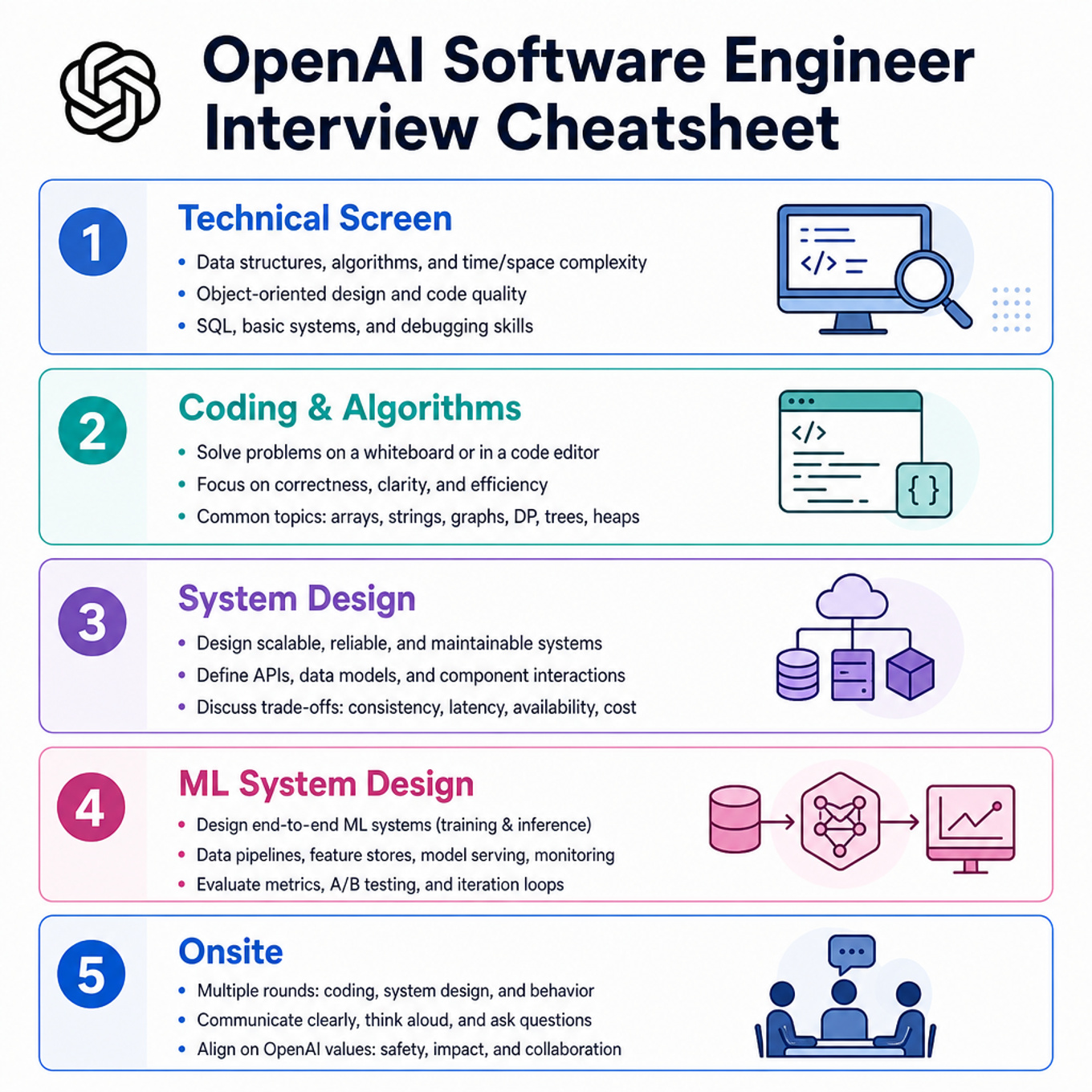
Technical Screen
Coding & Algorithms
- Binary Serialization And Codecs — covered in depth under Onsite below.
What's being tested
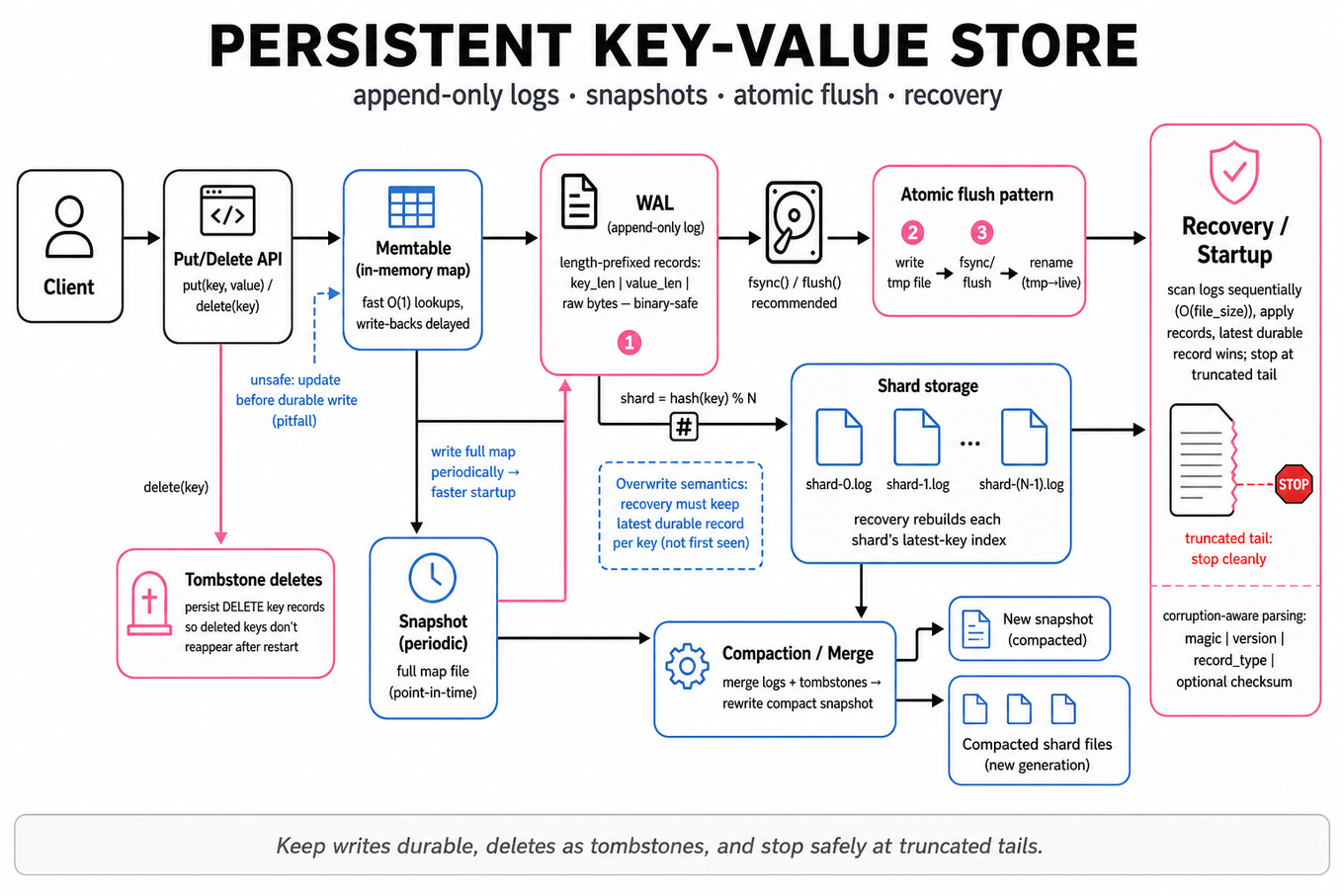
Persistent key-value stores test whether you can combine clean in-memory data structures with binary-safe serialization and file I/O. Interviewers are probing for correctness across overwrites, deletes, restarts, partial writes, arbitrary bytes, and simple durability tradeoffs.
Patterns & templates
-
Length-prefixed serialization — encode
key_len,value_len, then raw bytes;O(k+v)per record and binary-safe for Unicode/null bytes. -
Append-only log — implement
put()/delete()as record appends; recovery scans sequentially inO(file_size)and keeps latest value per key. -
Snapshot plus mutation log — periodically write full
mapstate, then replay newer mutations; faster startup than replaying an unbounded log. -
Atomic flush pattern — write to
tmp, callflush()/fsync(), thenrename(); avoids replacing good state with a partial file. -
Tombstone deletes — persist deletes as
DELETE keyrecords; do not just remove from memory or deleted keys reappear after restart. -
Shard by hash — choose shard with
hash(key) % num_shards; keeps files smaller, but recovery must rebuild each shard’s latest-key index. -
Corruption-aware parsing — include
magic,version,record_type, and optional checksum; stop cleanly at truncated tail records.
Common pitfalls
Pitfall: Using delimiters like newline or comma breaks for arbitrary byte keys/values; prefer explicit lengths.
Pitfall: Updating the in-memory map before a failed disk write can acknowledge data that will disappear after restart.
Pitfall: Forgetting overwrite semantics causes recovery to return the first value for a key instead of the latest durable record.
Practice these
The practice cards below cover the canonical variants — solve all of them and time yourself.
Practice questions
System Design

What's being tested
This tests whether you can design a distributed resource-accounting system where money-like credits control access to scarce GPU capacity. OpenAI cares because multi-tenant GPU platforms must prevent overspend, enforce fairness, recover from failures, and still keep scheduling latency low under heavy concurrency. The interviewer is probing for ledger correctness, idempotent APIs, quota enforcement, scheduling tradeoffs, and the ability to reason about partial failures without hand-waving “exactly once.” A strong Software Engineer answer separates the source of truth for credits from fast-path admission control and explains how reconciliation keeps them consistent.
Core knowledge
-
Ledger-first accounting is the safest model: store immutable debit/credit entries rather than mutating a single balance as truth. Balance is derived as , often materialized for speed. This gives auditability, replay, backfill, and easier recovery after bugs.
-
Reservation versus consumption is central for GPUs. Admission should place a hold for estimated cost, actual job telemetry later records usage, and completion releases or debits the difference. A typical formula is
cost = gpu_seconds * gpu_type_rate * priority_multiplier, with heterogeneous devices likeA100andH100priced differently. -
Idempotency keys prevent duplicate charges when clients retry. APIs like
POST /reservationsandPOST /usage-eventsshould accept a client-generatedidempotency_keyand return the original result for the same tenant/key/body. Stripe’s pattern is the model: dedupe at the operation boundary, not just in the client. -
Transactional consistency matters at the credit boundary. For a single tenant balance, a
Postgresrow withSELECT ... FOR UPDATE, an atomic conditional update, orSERIALIZABLEtransaction can enforceavailable >= hold_amount. At very high scale, shard bytenant_idand keep all balance-affecting operations for a tenant on the same shard. -
Fast-path quota enforcement often uses cached counters, but the cache cannot be the authority for billable state.
Redistoken buckets or local scheduler caches can reject obvious over-limit requests quickly, while successful admissions still need a durable ledger reservation. If the cache and ledger disagree, the ledger wins. -
At-least-once events are normal; design consumers to be idempotent. Usage collectors may emit duplicate or delayed
job_started,heartbeat, andjob_finishedevents. Use event IDs, monotonic sequence numbers per job, or(job_id, interval_start, interval_end)uniqueness to avoid double debiting. -
Scheduler integration should combine credit eligibility with cluster constraints. A job is schedulable only if it passes credit checks, tenant quota, GPU availability, placement constraints, and priority. Algorithms include weighted fair queuing, dominant resource fairness for multi-resource jobs, and priority queues with aging to prevent starvation.
-
Leases handle abandoned reservations. A reservation should have
expires_atand be renewable by scheduler heartbeats; if the job never starts or the scheduler crashes, a sweeper releases the hold. Leases must be long enough to avoid false expiration during transient outages but short enough to free stranded credits. -
Double-entry accounting reduces ambiguity for transfers and purchases. A customer top-up credits the tenant account and debits a revenue or liability account; GPU usage debits tenant credits and credits an internal compute account. Even if the implementation is simplified, this mental model helps avoid “credits disappeared” bugs.
-
Vector clocks and expirations appear when credits have multiple grants with different validity windows or are updated in multiple regions. If operations are partially ordered, a vector clock can detect concurrent updates rather than incorrectly overwriting one. For most SWE designs, prefer single-writer per tenant; use vector clocks only when multi-master writes are a hard requirement.
-
Reconciliation is a first-class subsystem. Periodic jobs compare ledger reservations, scheduler job state, GPU telemetry, and invoices: “reserved but never started,” “running without reservation,” “usage with no completion,” and “negative available balance.” Reconciliation should produce compensating ledger entries, not edit historical rows.
-
Observability should expose correctness and latency metrics:
reservation_success_rate,insufficient_credit_rejects,ledger_write_latency_p99,scheduler_admission_latency_p99,orphaned_holds_count,negative_balance_count, andusage_event_lag_seconds. Alert on invariants, not just CPU or queue depth.
Worked example
For Design GPU credit allocator, start by framing the first 30 seconds around scope: “Are credits prepaid or postpaid? Do we need hard prevention of overspend or eventual billing? What GPU types and scheduling latency are expected? Is this single-region or multi-region?” Then declare assumptions: prepaid credits, hard admission control, heterogeneous GPUs, and thousands to millions of tenants with jobs lasting seconds to days. Organize the answer into four pillars: a durable ledger service, a reservation/hold API, scheduler admission flow, and reconciliation/observability.
The core flow is: client submits job, scheduler asks credit service for a reservation based on estimated cost, credit service atomically creates a hold if available balance is sufficient, scheduler places the job, usage events convert holds into debits, and leftover hold is released on completion. The data model should include accounts, ledger_entries, reservations, jobs, and usage_events, with unique constraints on idempotency_key and job_id event intervals. For concurrency, say explicitly that balance-affecting writes for a tenant are serialized, either via a database transaction on a tenant balance row or by routing a tenant to a single ledger partition.
A useful tradeoff to flag is strict correctness versus scheduling latency. A synchronous ledger call on every admission prevents overspend but adds latency and creates a dependency; preallocated per-scheduler credit buckets reduce latency but can strand capacity and require careful reconciliation. Close by saying that, with more time, you would dig into multi-region failover, GPU preemption/refunds, and how to test invariants with fault injection.
A second angle
For Design credit balance with vector-clock expirations, the same accounting principles apply, but the interviewer is emphasizing causality and per-user state management rather than scheduler flow. The key difference is that credits may arrive from multiple grants, expire at different times, and be consumed concurrently. A strong design uses immutable credit lots with grant_id, amount, remaining, expires_at, and consumes earliest-expiring credits first, similar to FEFO inventory accounting.
If writes are single-region, you can avoid vector-clock complexity by serializing updates per user. If multi-region concurrent debits are required, vector clocks help detect “these two spends happened without seeing each other,” after which you either reject one, merge with compensating debt, or require a conflict-resolution policy. The interviewer will expect you to explain the cost of vector clocks: metadata grows with writers, comparisons are partial orders, and conflict resolution is a product-visible behavior even if the implementation is technical.
Common pitfalls
Pitfall: Treating balance as a mutable integer with
balance -= cost.
That answer misses auditability, retries, and reconciliation. A better answer uses immutable ledger entries, a materialized balance for performance, and transactional holds to prevent overspend.
Pitfall: Claiming “exactly-once billing” because events are delivered through
Kafka.
Distributed systems rarely give end-to-end exactly-once semantics across clients, queues, databases, and schedulers. Say “at-least-once delivery with idempotent processing and unique operation IDs,” then show where deduplication happens.
Pitfall: Designing the scheduler and ignoring the money boundary.
A GPU scheduler that only optimizes utilization can admit jobs that tenants cannot pay for, while a credit service that ignores scheduling can hold credits forever for jobs that never run. Land better by describing the contract between scheduler and ledger: reserve, renew, consume, release, and reconcile.
Connections
Interviewers may pivot from here into rate limiting, distributed transactions, idempotent payment processing, fair scheduling, or multi-region consistency. They may also ask for a deeper dive on one component, such as implementing a token bucket, designing ledger schemas in Postgres, or handling delayed usage events from a telemetry pipeline.
Further reading
-
Designing Data-Intensive Applications — Chapters on transactions, replication, partitioning, and stream processing map directly to ledger correctness and reconciliation.
-
Stripe API Idempotent Requests — Practical model for safe retries around money-like operations.
-
Dominant Resource Fairness: Fair Allocation of Multiple Resource Types — Seminal scheduling paper for fair allocation across heterogeneous resources.
Practice questions
- CI/CD Orchestration Platforms — covered in depth under Onsite below.
What's being tested
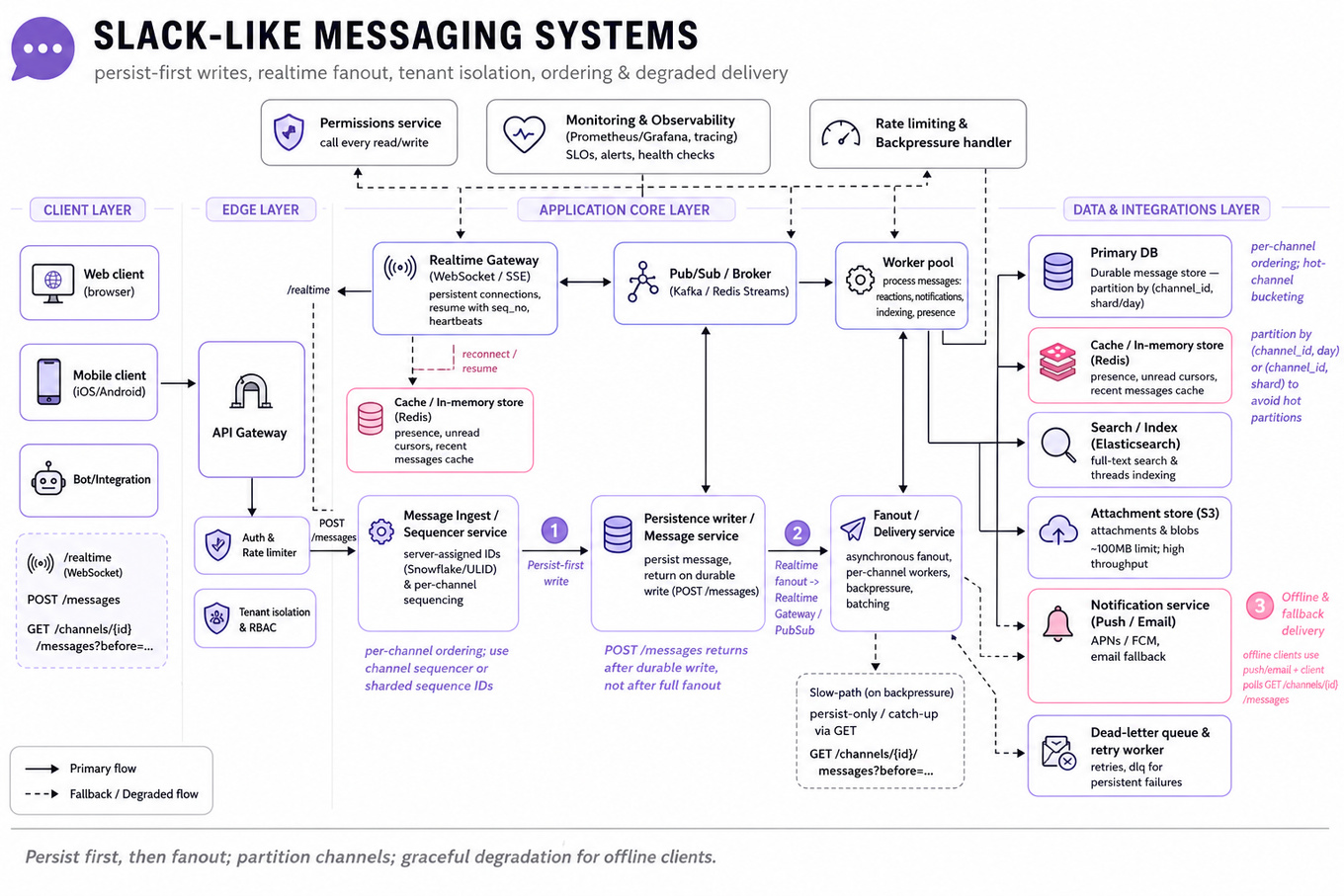
Interviewers are probing whether you can design a real-time multi-tenant messaging system with clear data models, APIs, delivery semantics, storage strategy, and failure handling. A strong answer balances low-latency fanout, durable message history, permissions, search, notifications, and operational concerns without overbuilding every subsystem. OpenAI cares because many products involve collaborative, streaming, user-facing systems where correctness, privacy, latency, and graceful degradation all matter. The interviewer is not looking for “use WebSockets and Kafka” as a slogan; they want to see how you reason through tradeoffs like online vs offline delivery, channel fanout, ordering, tenant isolation, and backpressure.
Core knowledge
-
Core entities usually include
User,Workspace,Channel,Membership,Message,Thread,Reaction,Attachment, andReadReceipt. Model workspace-scoped IDs and permissions explicitly; multi-tenant systems fail when access checks are treated as an afterthought instead of part of every read/write path. -
API design should separate durable writes from real-time delivery. Typical endpoints:
POST /messages,GET /channels/{id}/messages?before=...,POST /channels/{id}/join, and a persistent connection endpoint like/realtime.POST /messagesshould return after persistence, not after every recipient receives the message. -
Persistent connections are commonly implemented with WebSockets, Server-Sent Events, or long polling.
WebSocketsupports bidirectional events for typing indicators and presence;SSEis simpler for server-to-client streams. For mobile and unreliable networks, clients need reconnect tokens, heartbeats, and “resume from sequence number.” -
Message durability belongs in a primary store such as
DynamoDB,Cassandra,ScyllaDB,MySQL, orPostgres, depending on scale. A common schema is partition bychannel_idand sort bymessage_tsor monotonically increasingmessage_id. Hot channels can overload a single partition, so consider bucketed partitions like(channel_id, day)or(channel_id, shard). -
Ordering semantics should be stated precisely. Global total ordering is expensive and usually unnecessary; Slack-like systems commonly need per-channel ordering. Use server-assigned Snowflake-style IDs,
ULID, or a sequencer per channel. If clients send messages concurrently, show optimistic local rendering but reconcile against server order. -
Fanout strategy depends on channel size. For small channels, fanout-on-write pushes an event to each online member’s connection server and notification pipeline. For very large channels, fanout-on-read or hybrid fanout avoids writing millions of inbox rows. A useful threshold: direct messages and small groups fan out eagerly; channels with 100k+ members need pull-based consumption and pagination.
-
Real-time delivery architecture often uses connection gateways plus an internal event bus. A request service persists the message, publishes
MessageCreated(channel_id, seq)toKafka,Pulsar,Redis Streams, orNATS, and gateway servers subscribed to relevant channels deliver to connected clients. Gateways should be stateless except for ephemeral connection mappings. -
Delivery guarantees should be practical: usually at-least-once delivery with client-side de-duplication by
message_id. Exactly-once end-to-end is rarely worth claiming. Clients should maintainlast_seen_seqper channel and call a history API to fill gaps after reconnect or missed events. -
Presence and typing indicators are ephemeral, not durable messages. Store presence in
Rediswith TTLs and heartbeat updates, e.g.,presence:user_id -> online until t. Avoid writing every typing event to durable storage; throttle events and treat them as best-effort to reduce load. -
Read receipts and unread counts can be modeled as
last_read_message_idper(user_id, channel_id). Unread count can be computed as messages after the marker for small channels, but at scale you may maintain counters or approximate badges. Be careful with edits, deletes, hidden messages, and per-user visibility. -
Search indexing is a separate read path. Persist messages first, then asynchronously index into
Elasticsearch,OpenSearch, or a dedicated search service. Search documents should include workspace, channel, sender, timestamp, permissions metadata, and tokenized content; results must be filtered by current membership and retention policy. -
Security and compliance include authentication, authorization, tenant isolation, audit logs, encryption, retention, and deletion. Use workspace-scoped authorization checks on every message fetch and publish path. Encrypt in transit with
TLS; encrypt at rest with managed keys, and discuss enterprise features like legal holds only at a high level unless prompted.
Worked example
For “Design a Slack-like messaging platform”, start by clarifying scope: “Are we designing team chat with workspaces, channels, DMs, message history, search, notifications, and presence? What scale should I assume: 10M daily users, 100k messages/sec peak, and p99 send-to-display under 500ms for online users?” Then declare your assumptions: per-channel ordering is required, offline users can catch up via history, and message persistence is the source of truth. Organize the answer around four pillars: data model, write/read APIs, real-time delivery, and storage/indexing/notifications. For the write path, say the client calls POST /messages, the message service validates membership, assigns message_id and channel sequence, writes to the message store, then publishes an event to an internal bus. For the read path, online clients receive events over WebSocket, while reconnecting clients use GET /messages?after_seq=... to fill gaps. For storage, use a channel-partitioned message table, but call out hot partitions for giant channels and propose bucketing or hybrid fanout. A concrete tradeoff to flag: fanout-on-write gives lower latency for small groups but explodes for large public channels, so use a hybrid strategy based on member count and online subscriber count. Close by saying: “If I had more time, I’d drill into search indexing, retention/deletion semantics, notification ranking, and operational metrics like p99 delivery latency, reconnect gap rate, and message send error rate.”
A second angle
For “Design an AI chatbot with browser storage”, the same messaging concepts apply, but the constraints shift toward client-side state, streaming, and privacy. Instead of multi-user channels and workspace permissions, the core entities are local conversations, messages, model responses, and session metadata stored in browser storage such as IndexedDB. Real-time delivery becomes token streaming from a backend relay using SSE or WebSocket, with the client appending partial assistant messages as chunks arrive. The main design decision is whether conversation history is purely local or synced to a server; browser-only storage improves privacy but complicates cross-device continuity, backup, and quota handling. You should also discuss not exposing provider API keys in the browser, using a stateless relay, and handling refresh/reconnect without duplicating assistant responses.
Common pitfalls
Pitfall: Jumping straight to
KafkaandWebSocketswithout defining guarantees.
A weak answer lists technologies before explaining semantics. A better answer says, “We provide durable persistence before acknowledgement, at-least-once real-time delivery, client de-duplication by message_id, and history replay after reconnect,” then chooses tools that support those properties.
Pitfall: Treating all channels the same size.
Designs that fan out every message to every member work for DMs and small teams but collapse for huge announcement channels. Segment the problem: small channels get eager push, large channels get subscription-based delivery for online users and pull-based history for everyone else.
Pitfall: Ignoring authorization on read paths.
Many candidates remember to check membership on POST /messages but forget search, history pagination, attachments, notifications, and WebSocket subscriptions. Strong answers make authorization a cross-cutting invariant: every event and query is scoped by workspace, channel membership, retention policy, and user visibility.
Connections
Interviewers may pivot from this into notification systems, search indexing, distributed ID generation, rate limiting, or multi-tenant authorization. They may also ask you to zoom into client behavior: offline sync, local caching, optimistic UI, retry logic, and streaming responses for AI chat interfaces.
Further reading
-
The Log: What every software engineer should know about real-time data’s unifying abstraction — Jay Kreps’ classic explanation of logs as the backbone of event-driven systems.
-
Designing Data-Intensive Applications — Martin Kleppmann’s book covers replication, partitioning, consistency, and stream processing tradeoffs directly relevant to messaging systems.
-
Slack Engineering Blog — practical posts on operating large-scale collaboration infrastructure, reliability, and client/server performance.
Practice questions
- Sandboxed Cloud IDEs And DevBoxes — covered in depth under Onsite below.

What's being tested
Interviewers are probing whether you can design systems that behave correctly under retries, duplicate requests, concurrent writes, and partial failures. For a Software Engineer, the key skill is turning vague reliability requirements into concrete API contracts, storage invariants, and concurrency-control mechanisms. OpenAI cares because user-facing and internal systems often run in distributed environments where clients retry, services crash mid-operation, and multiple workers may mutate the same logical state. A strong answer shows you can reason about correctness first, then choose practical mechanisms like idempotency keys, compare-and-swap, transactions, locks, MVCC, or vector clocks based on the failure model.
Core knowledge
-
Idempotency means applying the same logical operation multiple times has the same externally visible effect as applying it once.
PUT /resource/{id}is naturally idempotent;POST /chargeis not unless you add an idempotency key and persist the first result. -
Deduplication requires durable state, not just in-memory caches, if the effect being protected is durable. A common pattern, used by systems like
Stripe, is storing(client_id, idempotency_key) -> request_hash, status, response_body, expires_atand replaying the original response on retry. -
Request identity and operation identity are different. A retry should reuse the same idempotency key; a new user action should not. To prevent accidental key reuse, store a request fingerprint such as
SHA256(method, path, canonical_body)and reject mismatches with409 Conflict. -
Exactly-once execution is usually not achievable end-to-end in distributed systems; practical systems provide at-least-once delivery plus idempotent side effects. The goal is “exactly-once observable effect,” achieved with atomic writes, dedupe tables, conditional updates, or transactional outbox patterns.
-
Atomicity boundaries matter. If you write
ordersand then writeidempotency_keys, a crash between them can create duplicates. Prefer one database transaction: insert dedupe record, perform mutation, store response, then commit. InPostgres, useINSERT ... ON CONFLICTplus row-level locking. -
Concurrency control choices trade throughput for simplicity. Pessimistic locking serializes conflicting operations with mutexes or
SELECT ... FOR UPDATE; optimistic concurrency control reads a version, computes changes, then commits only ifversion = old_version, retrying on conflict. -
Compare-and-swap is the core primitive behind many safe updates:
UPDATE accounts SET balance = balance - 10, version = version + 1 WHERE id = ? AND version = ?. If affected rows = 0, another writer won; retry or surface a conflict. -
Isolation levels determine which anomalies can occur.
READ COMMITTEDmay allow lost updates unless guarded by conditional updates;REPEATABLE READavoids non-repeatable reads;SERIALIZABLEis safest but can reduce throughput via aborts. Know anomalies: lost update, write skew, phantom read. -
MVCC stores multiple versions so readers do not block writers. In an in-memory database design, each record can carry
(value, version/timestamp); transactions read from a snapshot and validate write sets at commit. This supports high read concurrency but needs garbage collection of old versions. -
Lock granularity is a major design lever. A global lock is simple but caps throughput; per-key locks scale for independent keys; range locks are needed for predicates like “all keys with prefix X.” For hot keys, consider batching, sharding by sub-key, or single-writer queues.
-
Vector clocks capture partial ordering in distributed updates. A vector clock
VdominatesWif for every nodei,V[i] >= W[i]and for somej,V[j] > W[j]; otherwise the versions are concurrent. They are useful when multiple replicas accept writes and conflicts must be detected, not overwritten silently. -
TTL and retention are correctness parameters, not cleanup details. Idempotency records must live at least as long as client retry windows and network uncertainty, often 24 hours to several days. Too short creates duplicate effects; too long increases storage and may block legitimate key reuse.
Worked example
For Prevent Duplicate Request Processing, a strong candidate starts by clarifying: “Are duplicate requests caused by client retries, load balancer retries, worker crashes, or all of them? What side effect are we protecting: payment, account creation, job enqueue, or state mutation? Do clients supply an idempotency key, or must the server generate operation identity?” Then they would state an assumption: the operation is non-idempotent, such as creating a charge or consuming credits, and clients retry on timeout.
The answer skeleton should have four pillars. First, define the API contract: clients send Idempotency-Key, scoped by user or tenant, and must reuse it for retries of the same logical action. Second, persist a dedupe record in a durable store with fields like key, request_hash, status, response, and expires_at. Third, make the dedupe check and business mutation atomic using a database transaction, conditional insert, or row lock. Fourth, specify retry behavior: if the key is complete, return the stored response; if in progress, return 409, 202, or block briefly; if the request hash differs, reject.
A key tradeoff to flag is whether to store the full response or only the resulting resource ID. Full response replay gives clients stable behavior across retries, but consumes more storage and may expose stale formatting if response schemas change. Storing only the resource ID is lighter but requires reconstructing the response and handling cases where downstream state changed.
A good close would be: “If I had more time, I’d discuss TTL sizing, multi-region behavior, observability for duplicate suppression rate, and how to test crash points between dedupe insert, side effect, and commit.”
A second angle
For Design an in-memory database, the same ideas appear inside the storage engine rather than at the API edge. Instead of deduplicating HTTP requests, you must prevent inconsistent reads and writes when many clients call GET, SET, DELETE, or transaction APIs concurrently. The design might begin with a thread-safe hash map plus per-key locks, then evolve toward snapshot isolation using MVCC if readers need consistent views without blocking writers. The important constraint shift is that latency may be microseconds to low milliseconds, so a simple global mutex is often unacceptable beyond small workloads. You should explicitly discuss whether the database supports single-key atomic operations only, multi-key transactions, or serializable transactions, because each choice changes the concurrency-control design.
Common pitfalls
Pitfall: Treating idempotency as “just retry safely.”
The tempting answer is “make the endpoint idempotent and retry with exponential backoff,” but that skips the hard part: where operation identity is stored and how it is atomically tied to the side effect. A better answer names the dedupe table, the unique constraint, the transaction boundary, and what happens after a crash or timeout.
Pitfall: Overusing global locks.
A global mutex is easy to explain for an in-memory key-value store, but it usually fails the scalability discussion. It is acceptable as a baseline, but you should quickly move to per-key locks, lock striping, optimistic concurrency, or MVCC, and explain which operations still require broader coordination.
Pitfall: Ignoring ambiguous outcomes.
If a client times out after sending a request, it may not know whether the server committed the mutation. The wrong answer is to let the client “try again and hope”; the stronger answer is to make retries query or reuse the same idempotency record so the system can return the original outcome deterministically.
Connections
Interviewers may pivot from here into distributed transactions, consensus with Raft, database isolation levels, replication conflict resolution, or rate limiting for retry storms. For in-memory database variants, expect follow-ups on persistence via write-ahead logging, sharding, and hot-key mitigation.
Further reading
-
Designing Data-Intensive Applications — Martin Kleppmann’s chapters on replication, transactions, and consistency are directly relevant to these designs.
-
Stripe API Idempotent Requests — practical example of idempotency keys, response replay, and request-parameter validation.
-
Time, Clocks, and the Ordering of Events in a Distributed System — foundational paper for reasoning about ordering, causality, and concurrent distributed events.
Practice questions
ML System Design
- LLM Chat Applications, RAG, And ML Evaluation — covered in depth under Onsite below.
Onsite
Coding & Algorithms
What's being tested
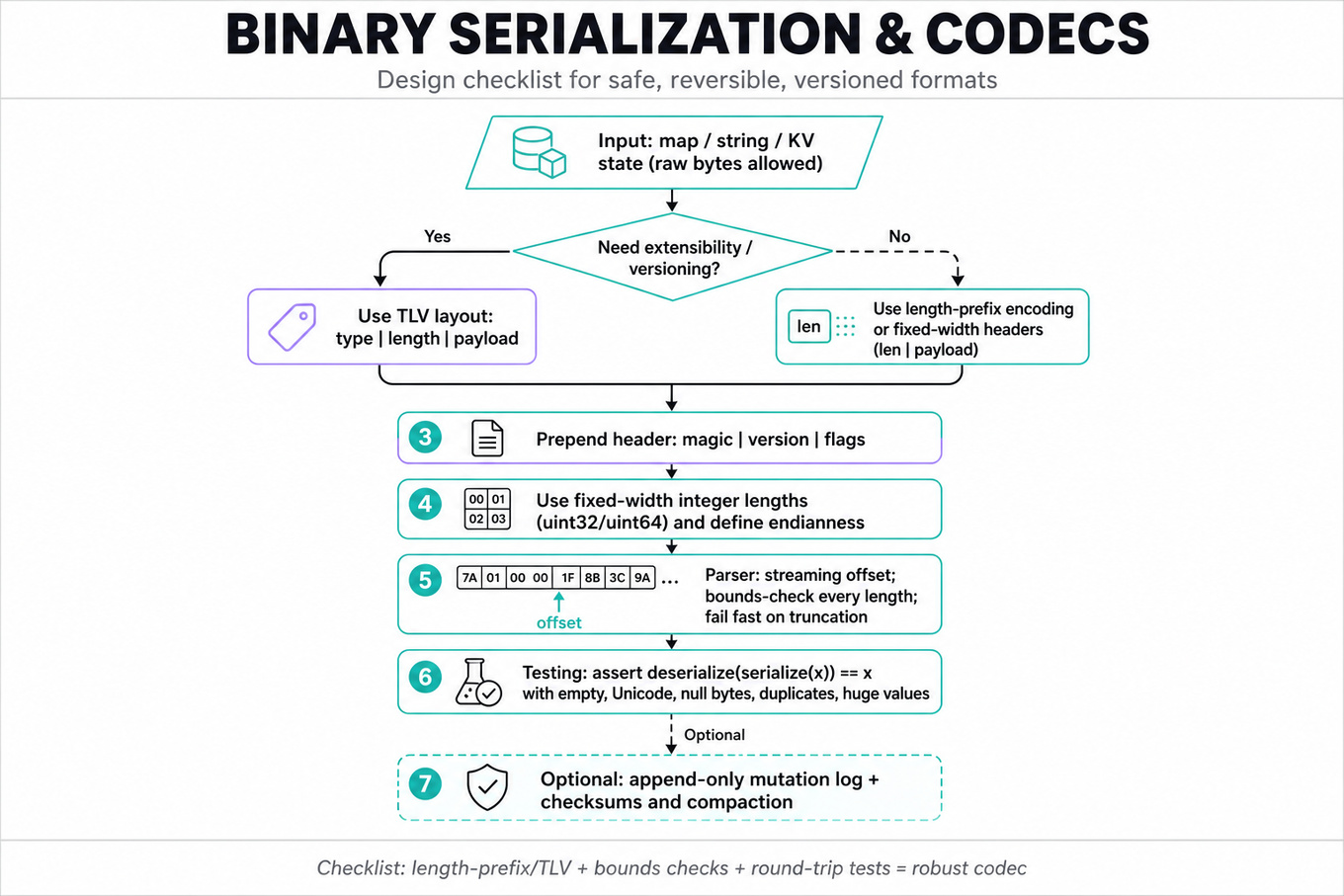
These problems test reversible serialization: converting maps, strings, or KV-store state into bytes and reconstructing the exact original data. Interviewers probe whether you can design binary-safe codecs that handle arbitrary bytes, Unicode, empty values, large inputs, malformed payloads, and format evolution without relying on fragile delimiters.
Patterns & templates
-
Length-prefix encoding — write
len(key) | key | len(value) | value;O(total_bytes)time, delimiter-free, handles arbitrary characters. -
Fixed-width integer headers — use
uint32oruint64lengths with explicit endianness; reject negative, overflowed, or truncated lengths. -
Type-length-value (
TLV) layout — encodetype | length | payloadfor extensible records; useful for versioned KV entries and metadata. -
Round-trip invariant — always test
deserialize(serialize(x)) == x; include empty map, empty string, Unicode, null bytes, duplicates, and huge values. -
Streaming parser — maintain an
offset, bounds-check before every read, and fail fast on trailing bytes or incomplete records. -
Versioned format header — prefix with
magic | version | flags; enables backward-compatible changes and early rejection of invalid data. -
Persistent mutation log — append
PUT/DELETErecords and replay into a map; optionally add checksums and compaction for robustness.
Common pitfalls
Pitfall: Using
:or,delimiters breaks as soon as keys or values contain the delimiter; prefer length-prefixing or escaping with strict decoding.
Pitfall: Forgetting bounds checks lets malformed input panic, over-read, or allocate massive buffers; validate every declared length before slicing.
Pitfall: Treating strings as characters instead of bytes causes Unicode bugs; serialize UTF-8 bytes and define whether keys/values are
stror rawbytes.
Practice these
The practice cards below cover the canonical variants — solve all of them and time yourself.
Practice questions
System Design
What's being tested
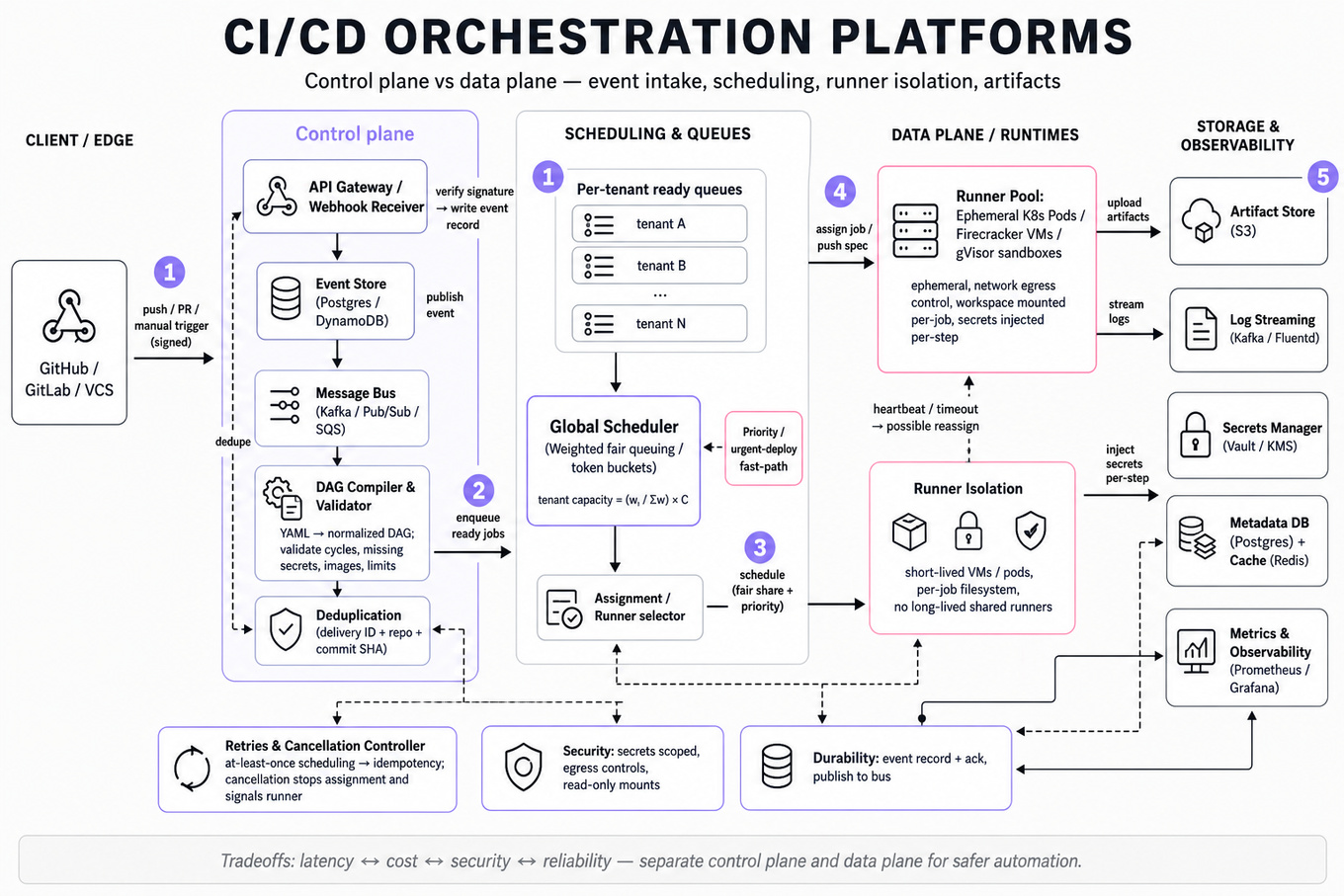
A strong answer shows you can design a multi-tenant distributed workflow system where code pushes, pull requests, and manual triggers become durable, isolated, observable build/test/deploy executions. Interviewers are probing for practical backend judgment: event intake, workflow parsing, dependency planning, scheduling fairness, runner isolation, artifact/log storage, retries, cancellation, and failure recovery. OpenAI cares because internal engineering velocity depends on safe automation: a CI/CD system must run untrusted code, protect secrets, scale bursty workloads, and provide deterministic enough behavior that engineers trust it. The best candidates separate control plane responsibilities from data plane execution and make explicit tradeoffs around latency, cost, security, and reliability.
Core knowledge
-
Control plane vs data plane is the organizing split. The control plane handles
GitHubwebhooks, workflow validation, DAG planning, scheduling, metadata, permissions, and APIs; the data plane runs jobs on isolated runners, streams logs, uploads artifacts, and reports heartbeats. -
Workflow representation should compile user config like
YAMLinto a normalized directed acyclic graph. Nodes are jobs or steps; edges encodeneedsdependencies. Validate cycles, missing secrets, unknown images, and resource limits before enqueueing so bad workflows fail fast. -
Event intake must be durable and idempotent. Use a webhook receiver that verifies signatures, writes an event record to
PostgresorDynamoDB, and publishes toKafka,SQS, orPub/Sub. Deduplicate using provider delivery IDs plus repository and commit SHA. -
Scheduling needs both dependency awareness and tenant fairness. A common design uses a ready-queue per tenant plus a global scheduler implementing weighted fair queuing or token buckets. Approximate share as , while preserving priority for urgent deploy jobs.
-
Runner isolation is central because builds execute arbitrary code. Prefer ephemeral
Kubernetespods, short-lived VMs, or sandboxed containers usinggVisor/Firecracker; avoid long-lived shared runners unless heavily locked down. Mount workspaces read/write per job and inject secrets only at step scope. -
Execution semantics should be stated clearly. At-least-once scheduling is easier: a job may be assigned twice after timeout, so runners and artifact writes need idempotency keys. Exactly-once execution is rarely worth promising; instead provide deterministic run IDs, attempt numbers, and safe cancellation.
-
State model typically includes
WorkflowRun,JobRun,StepRun,Artifact, andLogChunk. Store authoritative state transitions in a transactional DB, e.g.QUEUED -> RUNNING -> SUCCEEDED|FAILED|CANCELED|TIMED_OUT, and make transitions monotonic to survive duplicate runner messages. -
Logs and artifacts have different storage paths. Stream live logs through
WebSocket/SSEbacked byRedisor a pub/sub channel, then persist compressed chunks toS3/GCS. Store artifacts in object storage with content hashes, TTL policies, size quotas, and signed download URLs. -
Caching improves cost and latency but introduces correctness and security risks. Dependency caches should be keyed by lockfile hash, OS, architecture, and toolchain version, e.g.
npm-lock-sha + linux-amd64 + node20. Never let untrusted forks write caches consumed by protected branches. -
Secrets management should use scoped, audited retrieval from
Vault, cloud KMS, or a platform secret store. Runners should receive short-lived tokens, redact known secret values in logs, block secret exposure to forked pull requests, and separate build-time credentials from deploy credentials. -
Failure handling includes retries, timeouts, heartbeats, and leases. The scheduler assigns a job with a lease; runners renew heartbeats every few seconds. If lease expiry exceeds, say, heartbeat interval, mark the attempt lost and requeue if retry budget remains.
-
Observability and SLOs should cover platform health and user experience. Track queue wait time, run duration, runner utilization, cache hit rate, job failure rate, scheduler lag, log streaming latency, artifact upload failures, and
p95/p99API latency. Alert on saturation before builds stall.
Worked example
For Design multi-tenant CI/CD workflow system, start by clarifying scope: “Are we designing GitHub Actions-like CI only, or also deployment? How many tenants, runs per day, average job duration, and do we run untrusted external pull requests?” Then declare assumptions: thousands of repos, bursty traffic after work hours, untrusted code, and a requirement for live logs, artifacts, cancellation, and retry.
Organize the answer around four pillars: intake and planning, orchestration and scheduling, secure execution, and storage/observability. For intake, describe a signed webhook receiver that persists events, deduplicates deliveries, fetches workflow config, validates it, and compiles it into a DAG. For orchestration, describe a scheduler that moves runnable DAG nodes into per-tenant queues, applies weighted fairness, assigns jobs to runners with leases, and reacts to heartbeats and terminal status updates.
For execution, propose ephemeral Kubernetes pods or VM-backed runners, with per-job workspaces, short-lived credentials, network egress policy, and step-level secret injection. For storage, use a relational database for run/job state, object storage for artifacts and archived logs, and SSE/WebSocket for live log streaming. A specific tradeoff to flag is container pods versus microVMs: pods are cheaper and faster to start, while Firecracker-style microVMs provide stronger isolation for untrusted workloads at higher cold-start and operational cost. Close by saying that, with more time, you would detail deployment gates, cache poisoning defenses, and multi-region failover for the control plane.
A second angle
For Design a CI/CD pipeline with scheduler, the center of gravity shifts from end-to-end platform components to scheduling policy and execution semantics. You should spend more time on ready queues, dependency resolution, worker leases, starvation prevention, priority classes, and backpressure. A good framing is: “The pipeline compiler produces a DAG; the scheduler’s job is to maintain the set of runnable nodes and allocate scarce runner capacity fairly.” The tricky tradeoff is fairness versus latency: strict per-tenant fairness prevents noisy neighbors but can underutilize specialized runners like GPU or ARM builders. A strong answer proposes separate pools by resource type and a fairness layer within each pool, with controlled work stealing when capacity would otherwise sit idle.
Common pitfalls
Pitfall: Treating the system as a linear script runner instead of a distributed DAG orchestrator.
A tempting answer is “webhook triggers a build server, build server runs tests, then deploys.” That misses parallelism, partial retries, dependency ordering, cancellation, and recovery after scheduler or runner crashes. A better answer explicitly models workflows, jobs, attempts, leases, and state transitions.
Pitfall: Hand-waving security with “run it in Docker.”
Containers are not a complete isolation boundary when tenants execute untrusted code and secrets are present. Interviewers expect discussion of ephemeral runners, scoped credentials, fork PR restrictions, cache isolation, image provenance, network policy, and log redaction. You do not need to design a full kernel sandbox, but you must show awareness of the threat model.
Pitfall: Over-indexing on one technology before explaining requirements.
Saying “use Kubernetes, Kafka, Postgres, and S3” is not a design by itself. Lead with invariants: durable events, idempotent processing, fair scheduling, isolated execution, and observable state. Then map those invariants to concrete technologies and explain why each choice is replaceable.
Connections
Interviewers may pivot from CI/CD orchestration into distributed task queues, workflow engines like Temporal or Argo Workflows, container orchestration on Kubernetes, or artifact/package registry design. They may also ask about deployment strategies such as blue-green, canary, rollback, and progressive delivery, but keep the answer grounded in backend system design rather than product release policy.
Further reading
-
Borg, Omega, and Kubernetes — explains scheduling and cluster-management ideas behind modern container orchestration.
-
The Tail at Scale — useful for reasoning about latency, retries, hedging, and large distributed systems under load.
-
Temporaldocumentation — a concrete reference for durable workflow execution, retries, timers, and activity heartbeats.
Practice questions
What's being tested
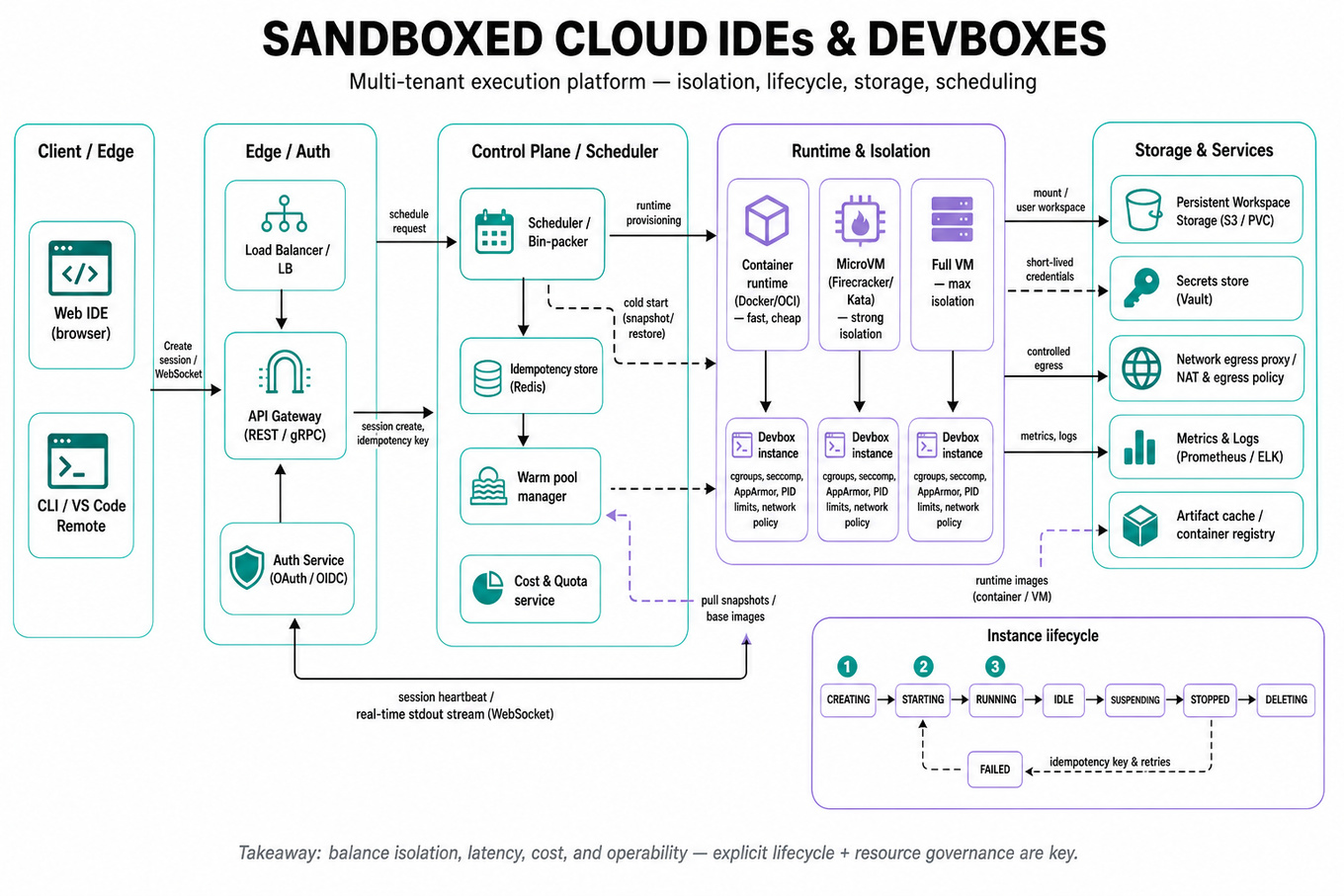
This tests whether you can design a multi-tenant execution platform where untrusted user code runs safely, interactively, and cost-effectively. Interviewers are probing your ability to combine sandboxing, resource scheduling, persistent developer state, real-time streaming, and operability into one coherent distributed system. OpenAI cares because many engineering systems involve executing arbitrary workloads, isolating tenants, streaming outputs, and managing expensive compute under strict reliability and security constraints. A strong answer is not “put containers on Kubernetes”; it explains where isolation boundaries live, how lifecycle state transitions work, how data survives restarts, and how the system fails safely.
Core knowledge
-
Isolation boundary choice is the central design decision. Plain
Dockercontainers are fast and cheap but share the host kernel; microVMs such asFirecrackerorKata Containersprovide stronger isolation with higher startup and memory overhead; full VMs maximize isolation but are slower and costlier. -
Threat model should be explicit: users may run fork bombs, crypto miners, kernel exploits, data exfiltration attempts, or noisy-neighbor workloads. Defenses include seccomp, AppArmor/SELinux, read-only base images, dropped Linux capabilities, cgroups, network egress policies, per-tenant secrets isolation, and short-lived credentials.
-
Resource governance usually combines hard limits and fair scheduling. Use cgroups for CPU shares, memory limits, PID limits, disk quotas, and network bandwidth. Capacity planning starts with , then reserves headroom for spikes and bin-packing fragmentation.
-
Lifecycle management should be modeled as a state machine:
CREATING -> STARTING -> RUNNING -> IDLE -> SUSPENDING -> STOPPED -> DELETING, withFAILEDand retry transitions. Make operations idempotent using request IDs or a Stripe-style idempotency key, because orchestration calls will time out and be retried. -
Cold start latency matters for interactive IDEs. Techniques include warm pools, pre-pulled images, snapshot/restore, layered filesystems, and prebuilt dev images. A realistic target might be sub-5s for warm starts and 20–60s for cold starts, depending on image size and VM isolation.
-
Persistent workspace state is separate from ephemeral compute. Store source code and user files on a durable volume such as
EBS,PersistentVolume,Ceph, or networked filesystem; store metadata inPostgres; store snapshots and large artifacts inS3-style object storage. Compute nodes should be disposable. -
File synchronization has tradeoffs. A mounted network filesystem gives immediate persistence but can add latency and consistency edge cases. Local disk plus periodic snapshots improves performance but risks recent-data loss. Collaborative editing requires an explicit protocol such as Operational Transform or CRDTs, not just shared files.
-
Real-time terminal, logs, and editor output are usually streamed over
WebSocket,SSE, or a bidirectional RPC stream. The system needs backpressure, reconnect tokens, cursor/session replay, and durable log storage. Interactive terminal traffic is latency-sensitive; build logs are throughput-sensitive. -
Control plane vs data plane separation keeps the design understandable. The control plane handles auth, workspace metadata, scheduling decisions, billing state, and lifecycle APIs. The data plane runs sandboxes, proxies terminal traffic, mounts storage, enforces quotas, and streams logs.
-
Scheduler design should account for placement constraints: tenant isolation, available CPU/memory/GPU, image locality, region, workspace volume locality, and anti-affinity for noisy tenants. At small scale,
Kubernetesis enough; at larger scale, custom schedulers may optimize bin packing, warm pool utilization, and preemption. -
Network security should default deny. Use per-sandbox network namespaces, egress allowlists, metadata service blocking, service mesh or sidecar proxy for controlled access, and tenant-scoped DNS. If sandboxes need internet access, add rate limits, abuse detection hooks, and audit logs.
-
Observability must span both product and infrastructure behavior without drifting into product strategy. Track
p50/p95/p99startup latency, workspace crash rate, sandbox OOM kills, CPU throttling, disk usage, failed attach attempts, log-stream lag, scheduler queue time, and host saturation. Use structured logs, traces, and per-tenant audit events.
Worked example
For Design a sandboxed cloud IDE, a strong candidate starts by clarifying the interaction model: “Are users editing code in a browser, running arbitrary commands, and expecting a persistent filesystem across sessions? What scale should I assume: 10K concurrent workspaces, mostly CPU-only, with startup latency under 10 seconds for warm workspaces?” Then they declare a threat model: user code is untrusted, tenants must not access each other’s files or secrets, and the platform must tolerate abusive resource usage.
The answer can be organized around four pillars: frontend/editor session, workspace control plane, sandbox execution plane, and storage/streaming/observability. The frontend connects to an IDE gateway over WebSocket for terminal I/O, language server traffic, and logs. The control plane stores workspace metadata in Postgres, authenticates users, enforces RBAC, and drives a lifecycle state machine. The execution plane schedules each workspace onto a worker running either containers with hardened profiles or microVMs using Firecracker.
A specific tradeoff to call out is container speed versus VM isolation. For an internal trusted platform, hardened containers on Kubernetes may be acceptable; for arbitrary public code execution, microVMs are safer because they reduce shared-kernel risk, even if they increase cold-start time and memory overhead. Workspace files should live on durable volumes or object-backed snapshots so that compute nodes can die without data loss. Close by saying that with more time you would detail collaborative editing consistency, abuse prevention, and region-aware capacity planning.
A second angle
For Design multi-tenant CI/CD workflow system, the same execution-platform concepts apply, but the workload is batch-oriented instead of interactive. CI jobs care less about sub-second terminal latency and more about queueing, reproducibility, artifact retention, cache efficiency, and deterministic retry semantics. The scheduler now places short-lived runners, streams build logs, uploads artifacts to S3, and records run state transitions such as QUEUED -> RUNNING -> SUCCEEDED/FAILED/CANCELED. Isolation remains critical because pull requests can run attacker-controlled code, but the design may favor ephemeral runners that are destroyed after each job rather than long-lived persistent workspaces. The strongest answers explicitly contrast interactive devboxes with CI: devboxes optimize warm continuity, while CI optimizes clean-room repeatability.
Common pitfalls
Pitfall: Saying “use
Kubernetesand containers” as the whole isolation story.
That answer misses the main risk: containers share a kernel and require careful hardening. A better answer names the threat model, compares containers, microVMs, and VMs, and then justifies the chosen boundary based on trust level, startup latency, and cost.
Pitfall: Treating workspace storage as if it lives inside the sandbox.
If the sandbox dies, the user’s state should not disappear. Strong designs separate ephemeral compute from durable workspace data, define snapshot or volume semantics, and explain what happens during worker failure, reconnect, and concurrent edits.
Pitfall: Over-indexing on feature details before defining the control plane.
Candidates sometimes spend five minutes on editor themes, plugins, or language-server behavior while ignoring lifecycle APIs, scheduling, quotas, and failure handling. Lead with the distributed-system backbone first; then add IDE-specific protocols like terminal streaming, file watching, and language server routing.
Connections
Interviewers can pivot from here into container orchestration, distributed job scheduling, real-time messaging, workflow engines, or secure multi-tenancy. Related designs include online judges, serverless functions, notebook platforms, remote build systems, and CI/CD runners.
Further reading
-
Firecracker: Lightweight Virtualization for Serverless Applications — useful background on microVM isolation and fast startup tradeoffs.
-
Borg, Omega, and Kubernetes paper lineage — foundational reading on cluster scheduling, bin packing, and workload isolation.
-
The Datacenter as a Computer, Barroso, Clidaras, Hölzle — strong systems background for resource management, utilization, and large-scale operational tradeoffs.
Practice questions
ML System Design

What's being tested
You’re being tested on whether you can design a production-grade LLM chat application: streaming UX, backend orchestration, secure API access, conversation state, retrieval, ranking, and evaluation loops. OpenAI cares because the hardest parts are rarely “call the model API”; they are latency, reliability, privacy, abuse prevention, state consistency, and making model outputs observable enough to improve. The interviewer is probing whether you can separate concerns between browser, backend, model provider, retrieval layer, and evaluation pipeline while making explicit tradeoffs. Strong answers sound like software architecture with ML-aware interfaces, not like a research discussion about model internals.
Core knowledge
-
Streaming response delivery is central to chat UX. Common choices are server-sent events (
SSE), WebSockets, or HTTP chunked transfer.SSEis usually simpler for one-way token streaming;WebSocketsfit bidirectional collaboration, cancellation, or multi-agent updates. -
Frontend conversation state should distinguish ephemeral UI state from durable history. Browser-only designs may use
IndexedDBorlocalStorage, but sensitive chats, cross-device sync, and enterprise retention usually require server-side storage with encryption, deletion, and access controls. -
Backend relay services protect credentials and policy. The browser should not hold raw provider API keys; a backend can authenticate users, enforce quotas, add system prompts, redact secrets, call the model API, and stream tokens back to the client.
-
Rate limiting should be layered: per-user, per-IP, per-org, per-model, and sometimes per-token. Algorithms include token bucket and leaky bucket; token-based limits are often better than request counts because one request may consume 100 tokens or 100k tokens.
-
Conversation persistence needs an append-only model. Store
conversation_id,message_id,role,content,created_at,parent_message_id, model metadata, and status. This supports retries, regeneration, branching conversations, audit trails, and partial responses after stream interruption. -
Retrieval-augmented generation (
RAG) adds a retrieval path before generation: ingest documents, chunk them, embed chunks, search a vector index, optionally rerank, then pass top passages into the prompt. Typical vector stores use approximate nearest neighbor search such asHNSW; exact search becomes expensive beyond millions of chunks. -
Chunking strategy is a software tradeoff, not just an ML detail. Small chunks improve precise retrieval but lose context; large chunks preserve context but waste prompt budget. A common starting point is 300–800 tokens per chunk with overlap, plus document title and ACL metadata.
-
Enterprise access control must happen during retrieval, not after generation. Filter candidate chunks by user permissions, tenant, document classification, and freshness before they enter the prompt. “Retrieve everything, then ask the model not to reveal secrets” is an unacceptable security boundary.
-
Reranking and response ranking are service-level components. A first-stage retriever returns maybe 50–200 candidates; a reranker or verifier reduces to 5–20 high-confidence passages. For response ranking, generate multiple candidates, score them using heuristics, preference models, or LLM judges, then return the best with traceable metadata.
-
Evaluation harnesses should be designed as repeatable software systems. Maintain golden prompts, expected citations, policy checks, latency budgets, and regression tests. Useful metrics include retrieval
Recall@k, answer faithfulness, citation precision, refusal correctness,p50/p95/p99latency, error rate, and cost per successful answer. -
Failure handling matters because model calls are slow and expensive. Support cancellation, timeout budgets, exponential backoff, idempotency keys for retries, partial transcript recovery, model fallback, and graceful degradation such as “retrieval unavailable; answer from conversation only” when appropriate.
-
Observability needs request-level tracing across UI, backend, retrieval, ranking, and model calls. Log prompt template version, retrieved document IDs, token counts, latency by stage, finish reason, safety outcomes, and user feedback, while redacting sensitive content and respecting retention rules.
Worked example
For Design ChatGPT homepage with streaming choices, start by clarifying whether the page is authenticated, whether conversations persist across devices, which clients are supported, and what streaming semantics are expected: token-by-token, sentence-by-sentence, or final-only fallback. Then state assumptions: a web SPA, authenticated users, server-side conversation history, and a backend relay that calls an LLM provider rather than exposing secrets to the browser. Organize the answer around four pillars: frontend state and rendering, backend streaming API, persistence and retry semantics, and safety/limits/observability.
On the frontend, describe a message composer, optimistic user-message insertion, a streaming assistant placeholder, cancellation, and reconnection behavior. On the backend, propose POST /conversations/{id}/messages returning an SSE stream, with the server persisting the user message, invoking the model, streaming deltas, and committing the final assistant message when complete. For persistence, use a relational store such as Postgres for metadata and messages, with object storage if attachments or long transcripts are needed. The explicit tradeoff to flag is SSE versus WebSockets: SSE is simpler and robust for one-way model output, while WebSockets are more flexible but add connection management complexity. Close by saying that, with more time, you would cover abuse detection, prompt-injection handling for tool calls, multi-region failover, and an eval dashboard tracking latency, cost, and bad-output reports.
A second angle
For Design an enterprise RAG assistant for internal docs, the same core architecture shifts from chat transport to retrieval correctness and authorization. The browser and streaming path still matter, but the critical path becomes document ingestion, ACL-aware retrieval, reranking, prompt construction, citation display, and audit logging. A strong answer should explicitly say that permissions are enforced before retrieved chunks are placed into context, and that each answer should cite source documents with stable IDs. The main tradeoff is freshness versus retrieval performance: near-real-time indexing helps users trust the system, but batch indexing is simpler and cheaper. Evaluation also changes: instead of only tracking chat latency, you measure whether the assistant retrieved the right internal document, cited it correctly, and avoided hallucinating unsupported policy.
Common pitfalls
Pitfall: Treating the model API call as the whole system.
A weak answer says “the frontend sends the prompt to the LLM and displays the response.” A stronger answer adds a backend relay, authentication, streaming, persistence, rate limits, cancellation, retry behavior, logging, and a plan for partial failures.
Pitfall: Hand-waving RAG security.
A tempting but wrong design retrieves documents globally and asks the generator to obey access rules. The better design filters by tenant and document ACL before ranking, logs which chunks were used, and treats the prompt as an untrusted boundary rather than a security mechanism.
Pitfall: Over-indexing on ML details instead of SWE responsibilities.
Do not spend most of the interview comparing transformer architectures or training losses. Mention retrievers, rerankers, and evaluators as components with APIs, latency, cost, and observability requirements; then focus on how they fit into a reliable user-facing system.
Connections
Interviewers may pivot into distributed rate limiting, API design for streaming, vector search infrastructure, browser storage security, ranking service design, or online evaluation and A/B rollout mechanics. Be ready to discuss how latency budgets, state consistency, and access control change when the system moves from a toy chatbot to enterprise or high-traffic production use.
Further reading
-
OpenAI Cookbook — practical examples for streaming, retrieval, evals, and production integration patterns.
-
Retrieval-Augmented Generation for Knowledge-Intensive NLP Tasks — the original RAG paper; useful for understanding the retriever-generator split.
-
HNSW: Efficient and Robust Approximate Nearest Neighbor Search — background on the graph-based ANN approach used by many vector search systems.
Practice questions
Behavioral & Leadership
What's being tested
Interviewers are probing engineering ownership: whether you can take end-to-end responsibility for a real system, explain tradeoffs clearly, diagnose failures, and improve reliability without hiding behind team boundaries. For OpenAI, this also includes whether you understand AI safety as an engineering responsibility: building products that are robust, observable, abuse-resistant, and aligned with intended use. A strong Software Engineer answer should connect hands-on implementation details—APIs, rollouts, monitoring, incident response, code quality—to broader user and societal risk without drifting into product strategy or ML research. The interviewer is looking for judgment: when you move fast, when you slow down, when you escalate, and how you communicate uncertainty.
Core knowledge
-
End-to-end ownership means you can describe the system from user request to storage, serving, monitoring, deployment, and on-call behavior. For a backend service, be ready to discuss
APIcontracts, database choices, dependency failures, retry behavior,p95/p99latency, error budgets, and rollback paths. -
Tradeoff reasoning should be explicit, not implied. For example: “We chose
PostgresoverDynamoDBbecause relational integrity and transactional updates mattered more than horizontal write scale at our expected load of ~1k writes/sec.” Good answers name the rejected option and the constraint that drove the decision. -
Production readiness is broader than “the code worked.” Mention observability through structured logs, metrics, traces, dashboards, alert thresholds, and runbooks. A credible owner knows the service’s normal
QPS, latency distribution, saturation points, dependency health, and leading indicators before users complain. -
Incident diagnosis should follow a disciplined loop: detect, triage, mitigate, root-cause, remediate, and communicate. Use concrete signals: deploy timestamp, error-rate spike, dependency timeout, cache hit-rate drop, queue depth, database lock contention, or elevated
5xxresponses. Avoid jumping straight to blame. -
Safety-by-design for AI products means layering safeguards around uncertain model behavior. Software engineers may implement permission checks, rate limits, abuse detection hooks, moderation calls, output filters, audit logs, staged rollout gates, user reporting flows, and kill switches—not just rely on the model to behave.
-
Risk assessment can be framed as , then reduced through prevention, detection, and response. For example, prompt-injection leakage may be low-frequency but high-impact, so mitigations include tool permission boundaries, scoped credentials, allowlisted actions, and red-team test cases.
-
Defense in depth matters because no single control is perfect. In an AI assistant with tool use, combine input validation, least-privilege service tokens, sandboxed execution, output review for sensitive actions, per-user quotas, and audit trails. The interviewer wants to see multiple independent failure barriers.
-
Communication under ambiguity is a core leadership signal. Strong answers separate facts from hypotheses: “We know error rate rose after deploy
abc123; we suspect the new cache key path; mitigation is rollback while one engineer validates logs.” This is better than confident but unsupported storytelling. -
Cross-functional collaboration for a SWE means translating technical constraints for PMs, designers, policy, security, research, or support without outsourcing decisions. Say what you needed from each group, what you owned technically, and how you resolved disagreement through data, prototypes, staged launches, or documented tradeoffs.
-
Launch discipline includes feature flags, canaries, shadow traffic, staged percentage rollouts, automatic rollback, and post-launch monitoring. For high-risk AI features, a 1% rollout with human review and strict rate limits may be preferable to a big-bang launch, even if the implementation is complete.
-
Code quality as ownership includes test coverage at the right layer: unit tests for edge cases, integration tests for service contracts, load tests for capacity, and regression tests for prior incidents. Mention code review standards, migration plans, backwards compatibility, and how you avoided creating operational debt.
-
Leadership without authority is often tested. A strong senior-ish SWE can say, “I did not manage the team, but I wrote the design doc, aligned reviewers, split the work, owned the riskiest component, and drove the postmortem.” Ownership is behavior, not title.
Worked example
For “Explain Your Engineering Ownership”, start by framing the scope in the first 30 seconds: “I’ll use a recent backend project where I owned the API design, data model, rollout, and production reliability; the team was four engineers, and the system handled about 20k requests/minute.” Clarify what “owned” means: design decisions, implementation, on-call readiness, launch criteria, and post-launch improvements. Organize the answer around four pillars: problem/context, architecture and key tradeoffs, execution and collaboration, and production outcome.
A strong skeleton might be: first, explain the user or system problem in one sentence; second, describe the architecture using concrete components like REST endpoints, Redis caching, Postgres transactions, worker queues, or feature flags; third, name the hardest tradeoff; fourth, describe what broke or almost broke and what you changed. One explicit tradeoff could be choosing synchronous validation for correctness despite added p95 latency, then mitigating that latency with caching and timeout budgets. Include a real failure mode: “During canary, queue depth grew because retry backoff was too aggressive; we rolled back, added jittered exponential backoff, and created an alert on queue age.” Close by quantifying impact: lower latency, fewer incidents, higher reliability, faster developer iteration, or safer launch. If you had more time, say what you would improve next—such as load testing to 3x peak, reducing operational complexity, or adding stronger auditability.
A second angle
For “Explain your perspective on AI safety”, the same ownership mindset applies, but the frame shifts from “did you ship a reliable system?” to “did you anticipate and reduce harm from a system whose behavior can be probabilistic and user-facing?” A Software Engineer should avoid giving only philosophical opinions; instead, translate values into mechanisms: permission boundaries, abuse monitoring, escalation paths, staged rollouts, and incident response. The constraints are different because the failure mode may be misuse, data exposure, jailbreaks, or unsafe tool execution rather than a classic outage. A strong answer acknowledges uncertainty: safety is not a binary property, so you build measurable controls, evaluate them continuously, and make it cheap to disable or constrain risky behavior. The close should connect safety to product quality: trustworthy systems are more useful because users and developers can rely on them.
Common pitfalls
Pitfall: Giving a generic ownership story with no technical spine.
A weak answer says, “I led the project, coordinated stakeholders, and delivered on time.” A better answer names the system boundary, the hardest technical decision, the operational risk, the failure mode encountered, and the measurable result. Behavioral answers for SWE roles still need engineering depth.
Pitfall: Treating AI safety as either pure ethics or pure compliance.
It is tempting to say, “AI should be fair, transparent, and regulated,” then stop. That may sound thoughtful, but it does not show what you would build. Ground the answer in concrete engineering controls: least privilege, eval gates, logging, rollback, abuse throttling, human review for high-impact actions, and secure handling of user data.
Pitfall: Overclaiming certainty.
Bad answers imply, “We solved safety by adding a filter,” or “The incident can’t happen again.” Stronger answers describe residual risk and layered mitigation: “This reduces accidental exposure, but does not eliminate prompt injection, so we also scoped tool permissions and monitor anomalous access patterns.” Interviewers trust candidates who can reason under uncertainty.
Connections
Interviewers may pivot from here into system design, especially reliability, observability, and rollout strategy. They may also probe incident response, security/privacy engineering, or API design for AI products with tool use, user data, and third-party integrations. Be prepared to move from a behavioral story into concrete architecture details quickly.
Further reading
-
Google Site Reliability Engineering — practical foundation for error budgets, incident response, postmortems, monitoring, and operational ownership.
-
NIST AI Risk Management Framework 1.0 — structured vocabulary for mapping, measuring, managing, and governing AI-related risk.
-
OpenAI System Cards — examples of how model capabilities, limitations, evaluations, and mitigations are communicated for real AI systems.
Practice questions