Sequence Transformation, Normalization, And Ordering
Asked of: Software Engineer
Last updated
What's being tested
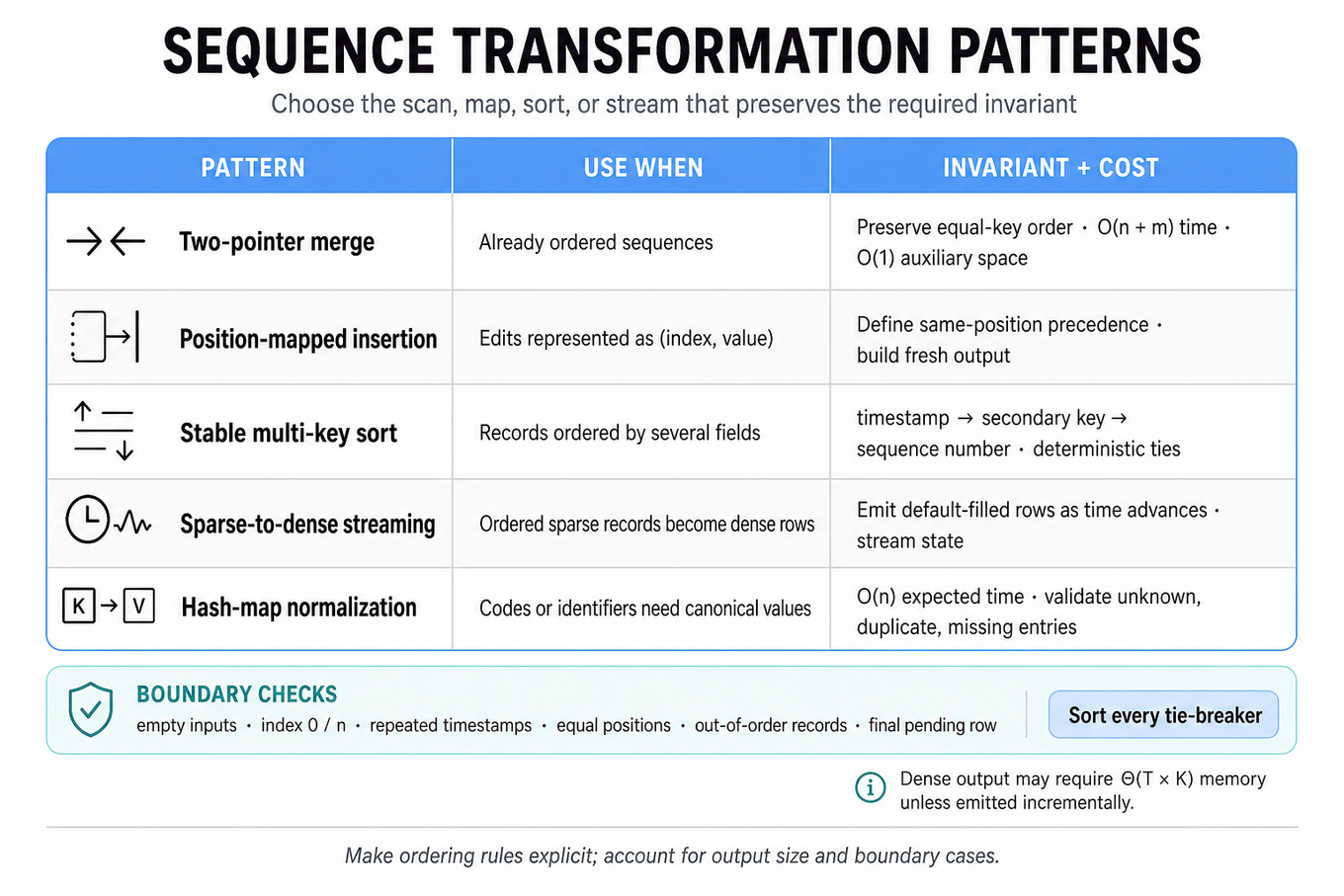
These problems test sequence transformation: merging, normalizing, and ordering records while preserving stated positional or temporal invariants. You should recognize when a two-pointer scan, stable sort, hash map, or streaming state machine gives the required complexity rather than repeatedly inserting or rescanning.
Patterns & templates
-
Two-pointer merge for already ordered sequences —
O(n + m)time andO(1)auxiliary space; preserve equal-key ordering explicitly. -
Position-mapped insertion — represent edits as
(index, value)pairs, merge by index, and define whether same-position inserts use left/right input precedence. -
Stable multi-key sorting — sort by
(timestamp, secondary_key, sequence_number); include a deterministic final tie-breaker rather than relying on incidental input order. -
Sparse-to-dense streaming — track the current timestamp and emit default-filled rows when time advances; avoid storing the entire stream when inputs are ordered.
-
Hash-map normalization — map codes or identifiers to canonical values in
O(n)expected time; validate unknown, duplicate, and missing entries. -
Output-size accounting — distinguish input space from output space; a dense result may inherently require
Θ(T × K)memory unless emitted incrementally. -
Boundary invariants — test empty inputs, insertions at
0andn, repeated timestamps, equal positions, out-of-order records, and the final pending row.
Common pitfalls
Pitfall: Sorting only by timestamp produces nondeterministic results for ties; specify every ordering key and document its precedence.
Pitfall: Mutating a sequence while iterating shifts later positions; compute output indices or build a fresh result instead.
Pitfall: Claiming
O(n)while repeatedly scanning for the next timestamp hides quadratic behavior; state assumptions about sorted input and validate them.
Practice these
The practice cards below cover the canonical variants — solve all of them and time yourself.
Practice questions
Related concepts
- Stateful Stream Processing And Time SchedulingCoding & Algorithms
- Streaming, Large Inputs, And External MemorySoftware Engineering Fundamentals
- Data Pipeline Reliability And Stream ProcessingData Manipulation (SQL/Python)
- SQL/Python Data Manipulation And JoinsData Manipulation (SQL/Python)
- Event Filtering, Deduplication, And Time WindowingData Manipulation (SQL/Python)
- Sequence Optimization With Limited FlipsCoding & Algorithms