Snapshot Iterators And Versioned Sets
Asked of: Software Engineer
Last updated
What's being tested
Candidates must demonstrate design and implementation of snapshot semantics over a mutable set, showing mastery of persistent data structures, iterator stability, and complexity trade-offs. Interviewers probe whether you can provide iterators that reflect a point-in-time view while keeping add()/remove() fast and memory usage bounded.
Patterns & templates
- Copy-on-write at mutation: on
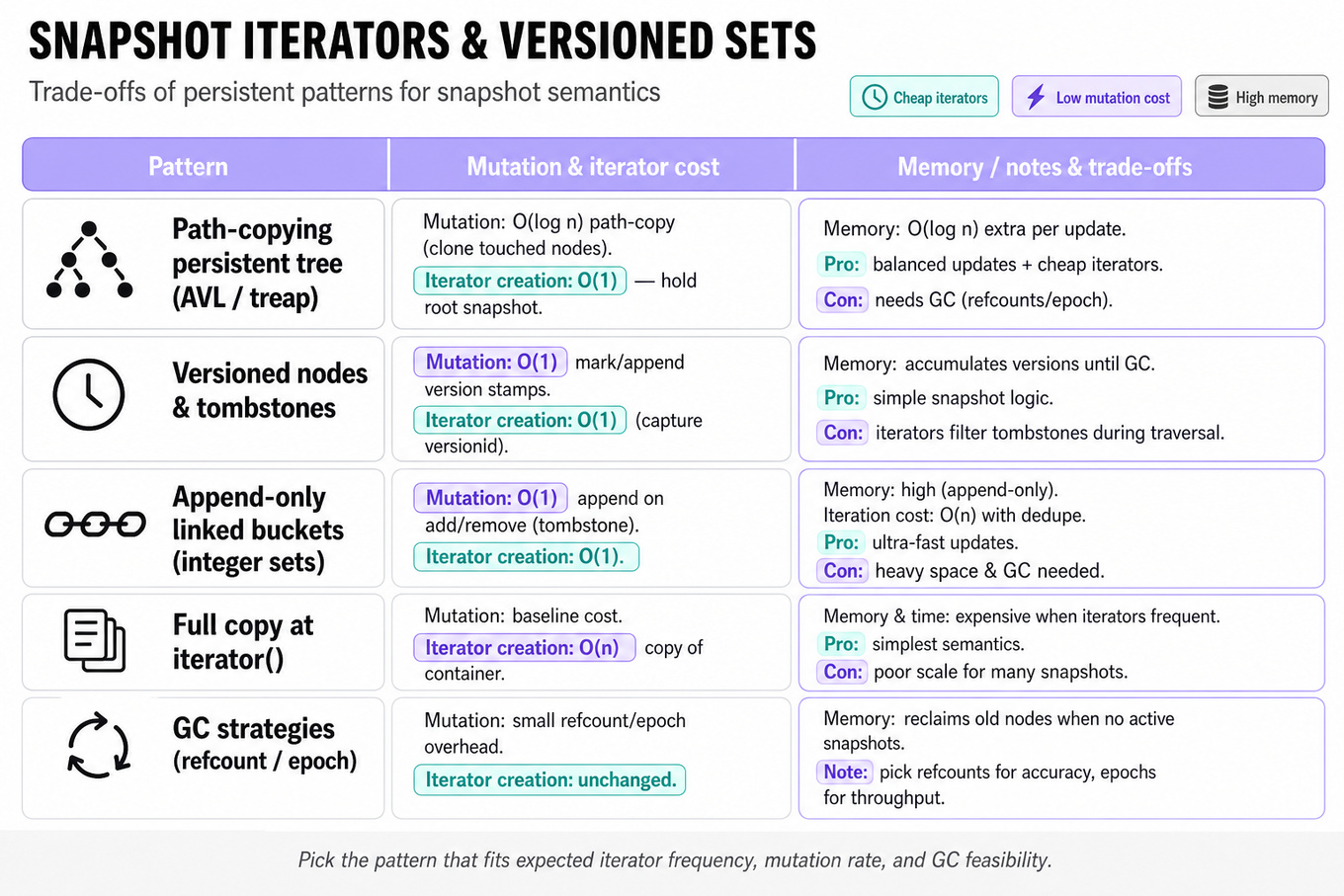
add()/remove()clone only touched nodes to give new version, enabling O(1) iterator creation and O(log n) mutation cost in trees. - Versioned nodes with integer
versionstamps: iterator captures currentversionId; nodes carrycreated/removedversions to decide visibility during traversal. - Tombstone marking: mark removals with a tombstone timestamp instead of physical delete; iteration filters by snapshot
versionId. - Path-copying persistent tree (e.g.,
AVL/treap): O(log n) amortized updates, iterators cheaply reference root at snapshot creation. - Append-only linked buckets for integer sets:
add()appends,remove()appends tombstone; iterators scan and dedupe, trading space for O(1) updates. - Garbage collection via refcounts or epoch-based reclamation: reclaim old nodes when no iterator references older versions.
- Complexity tradeoff template: iterator creation O(1) + iteration O(k) vs full-copy O(n) creation; pick based on expected concurrent iterators.
Common pitfalls
Pitfall: Returning a live iterator over the single backing container — it will reflect later mutations, violating snapshot semantics.
Pitfall: Naively full-copying at
iterator()for correctness — correct but often fails memory/time constraints when iterators are frequent.
Pitfall: Forgetting to reclaim old versions — leads to unbounded memory growth; track active snapshots or use epoch GC.
Practice these
The practice cards below cover the canonical variants — solve all of them and time yourself.
Practice questions
- Integer Set with O(1) Snapshot Iterators Unaffected by Later ChangesDatabricks · Software Engineer · Onsite · medium
- Implement a Snapshot Set IteratorDatabricks · Software Engineer · Technical Screen · hard
- Implement Snapshot Iterator Without Order GuaranteesDatabricks · Software Engineer · Technical Screen · medium
- Implement a snapshotable set with iteratorsDatabricks · Software Engineer · Onsite · medium
Related concepts
- Snapshotable Collections And IteratorsCoding & Algorithms
- Nested Iterators And Lazy Stack TraversalCoding & Algorithms
- Versioned Graphs And SnapshottingCoding & Algorithms
- Stateful In-Memory Ledgers and Versioned StoresCoding & Algorithms
- Stateful Data Structures And OOP API DesignCoding & Algorithms
- Mutable Data Structure DesignCoding & Algorithms