Randomized Multiset
Asked of: Software Engineer
Last updated
What's being tested
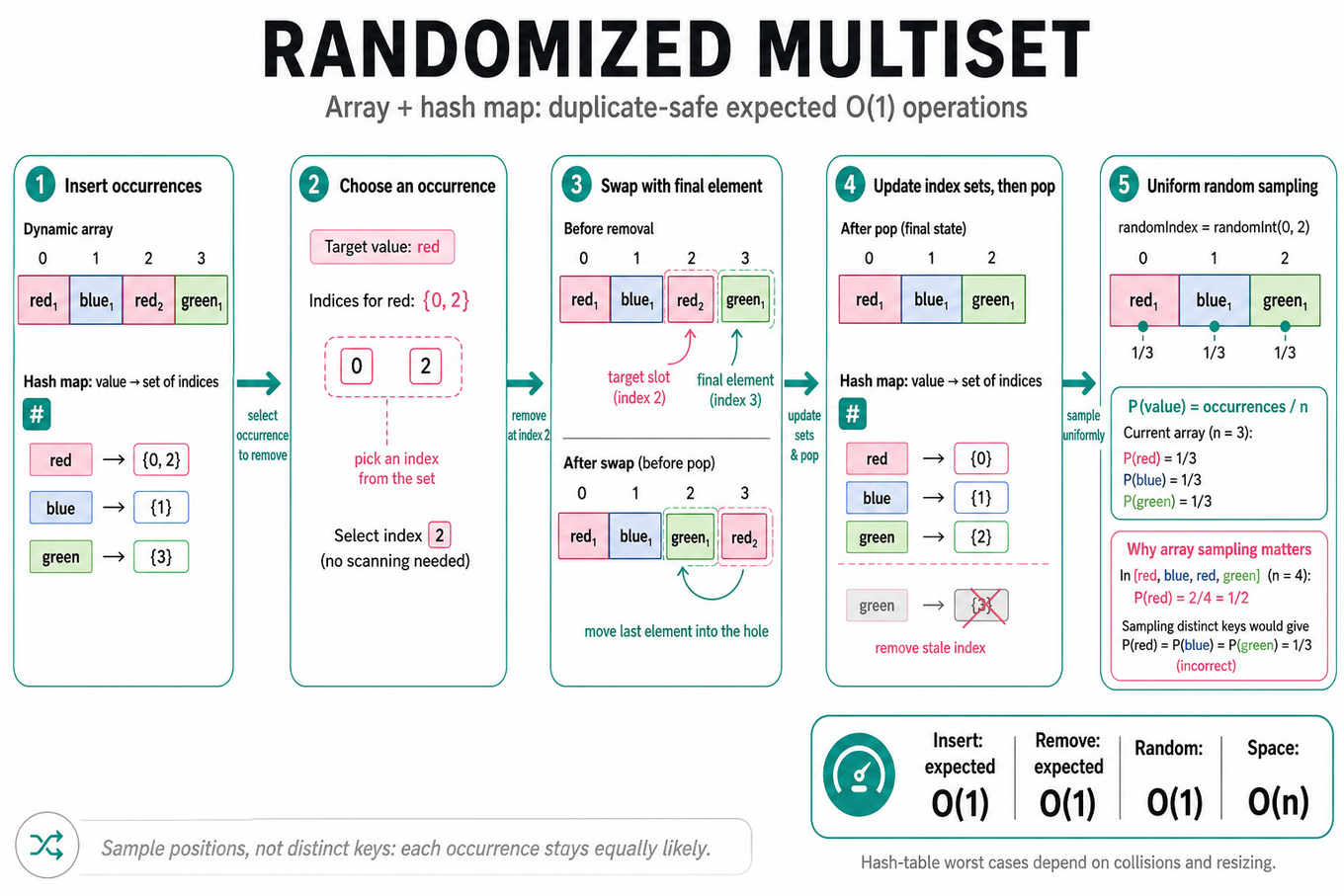
This tests the array-plus-hash-map pattern for supporting duplicate values with expected O(1) insert, remove, and random selection. You must maintain index bookkeeping correctly so deleting an arbitrary occurrence does not break uniform sampling or leave stale references.
Patterns & templates
-
Store every occurrence in a dynamic array; choose
randomIndex = randomInt(0, len(items) - 1)for uniformO(1)sampling. -
Map each value to a set of indices; duplicates therefore remain distinct while insert and lookup stay expected
O(1). -
Remove in
O(1)by swapping the target with the final array element, updating both values’ index sets, then popping. -
For frequency-weighted sampling, sample array positions rather than distinct keys; a value appearing
ktimes receives probabilityk / n. -
Use a stored index from the value’s index set; avoid scanning for an occurrence, which silently changes removal to
O(n). -
Handle the swapped element carefully when removing the final element itself; update its index only after determining whether indices coincide.
-
State complexity precisely: expected
O(1)operations,O(n)space, with hash-table worst cases depending on collision behavior.
Common pitfalls
Pitfall: Sampling from distinct keys makes values equally likely instead of making each stored occurrence equally likely.
Pitfall: Removing from the array without deleting and relocating index metadata leaves stale indices and causes later operations to corrupt state.
Pitfall: Assuming deterministic
O(1)hash-map performance; describe expected complexity and mention resizing or adversarial-collision considerations when relevant.
Practice these
The practice cards below cover the canonical variants — solve all of them and time yourself.
Practice questions
- Randomized String Multiset With Average O(1) Insert, Remove and Weighted Random PickLinkedIn · Software Engineer · Technical Screen · medium
- Design a Randomized MultisetLinkedIn · Software Engineer · Technical Screen · medium
- Scale a Distributed Randomized MultisetLinkedIn · Software Engineer · Technical Screen · medium
- Design O(1) insert/delete and frequency-weighted randomLinkedIn · Software Engineer · Technical Screen · medium
Related concepts
- Mutable Data Structures And O(1) DesignCoding & Algorithms
- Mutable Data Structure DesignCoding & Algorithms
- Composite Data Structures and O(1) OperationsCoding & Algorithms
- Weighted Random Sampling Data StructuresSoftware Engineering Fundamentals
- Randomized Sampling AlgorithmsCoding & Algorithms
- Hash Maps, Indexes, And Mutable State ModelingCoding & Algorithms