Hash Maps, Indexes, And Mutable State Modeling
Asked of: Software Engineer
Last updated
What's being tested
These problems test hash-map indexing, mutable state modeling, and choosing auxiliary structures that preserve required ordering while supporting fast updates, deletes, and lookups. You must explain invariants, complexity, ownership of state, and edge-case semantics rather than merely selecting containers.
Patterns & templates
-
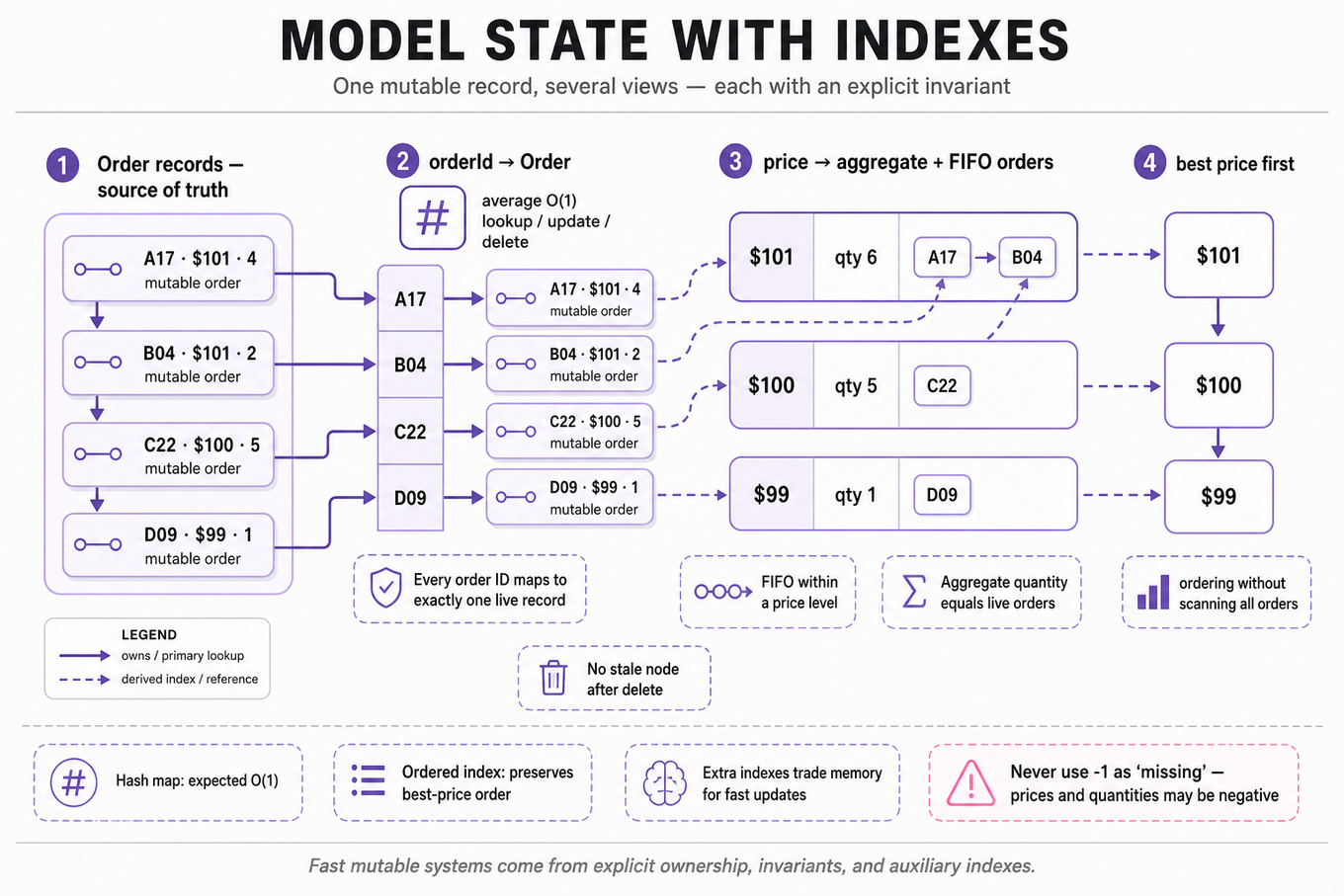
Use a hash map for direct identity lookup: symbol/order ID → record; target average
O(1)lookup, update, and deletion. -
Combine a map with a queue or ordered container when identity lookup and arrival/order semantics must coexist.
-
For latest-value conflation, map each key to one mutable node and remove stale nodes without scanning; define duplicate-key ordering explicitly.
-
For order books, separate price levels from individual orders: price → aggregate quantity plus FIFO orders, and order ID → order record.
-
Track counts or frequencies in maps for array intersection; choose set semantics versus multiplicity semantics before coding.
-
Explain hash-map behavior: bucket layout, collision resolution, load factor, resizing, tombstones, and expected
O(1)versus worst-caseO(n). -
For weighted sampling, maintain cumulative weights with a Fenwick tree: updates and samples cost
O(log n), using a uniform target in[0, totalWeight).
Common pitfalls
Pitfall: Mutating a map while iterating can invalidate iterators or skip entries; collect removals or use an iterator-safe deletion strategy.
Pitfall: Treating a sentinel such as
-1as “missing” fails when prices or quantities may legitimately be negative; use presence checks or an explicit variant.
Pitfall: Claiming
O(1)without stating average-case hashing, collision assumptions, resizing costs, and the extra memory required by auxiliary indexes.
Practice these
The practice cards below cover the canonical variants—solve all of them and time yourself.
Practice questions
- Two-Player Terminal Battleship: Ship Placement From Input, Then Turn-Based AttacksCitadel · Software Engineer · Technical Screen · medium
- Define a Reliable Trade-Reconciliation Library ContractCitadel Securities · Software Engineer · Technical Screen · medium
- In-Memory Order Book with Price-Time Order, Level Aggregation and Order CancelCitadel Securities · Software Engineer · Onsite · medium
- Conflating Quote Queue That Keeps Only the Latest Price per SymbolCitadel Securities · Software Engineer · Onsite · medium
- Design dynamic weighted random sampling with updatesCitadel · Software Engineer · Onsite · medium
- Simulate 2048 and pack board into uint64Citadel · Software Engineer · Onsite · medium
- Explain hash maps and solve array intersectionCitadel · Software Engineer · Online Assessment · medium
Related concepts
- Mutable Data Structure DesignCoding & Algorithms
- Mutable Data Structures And O(1) DesignCoding & Algorithms
- Hierarchical In-Memory Data StructuresCoding & Algorithms
- In-Memory Stateful Data ModelingCoding & Algorithms
- Hash Map Counting And Frequency AnalysisCoding & Algorithms
- Core Data Structures, Caches, And Clean ImplementationCoding & Algorithms