Hash Map Counting And Frequency Analysis
Asked of: Software Engineer
Last updated
What's being tested
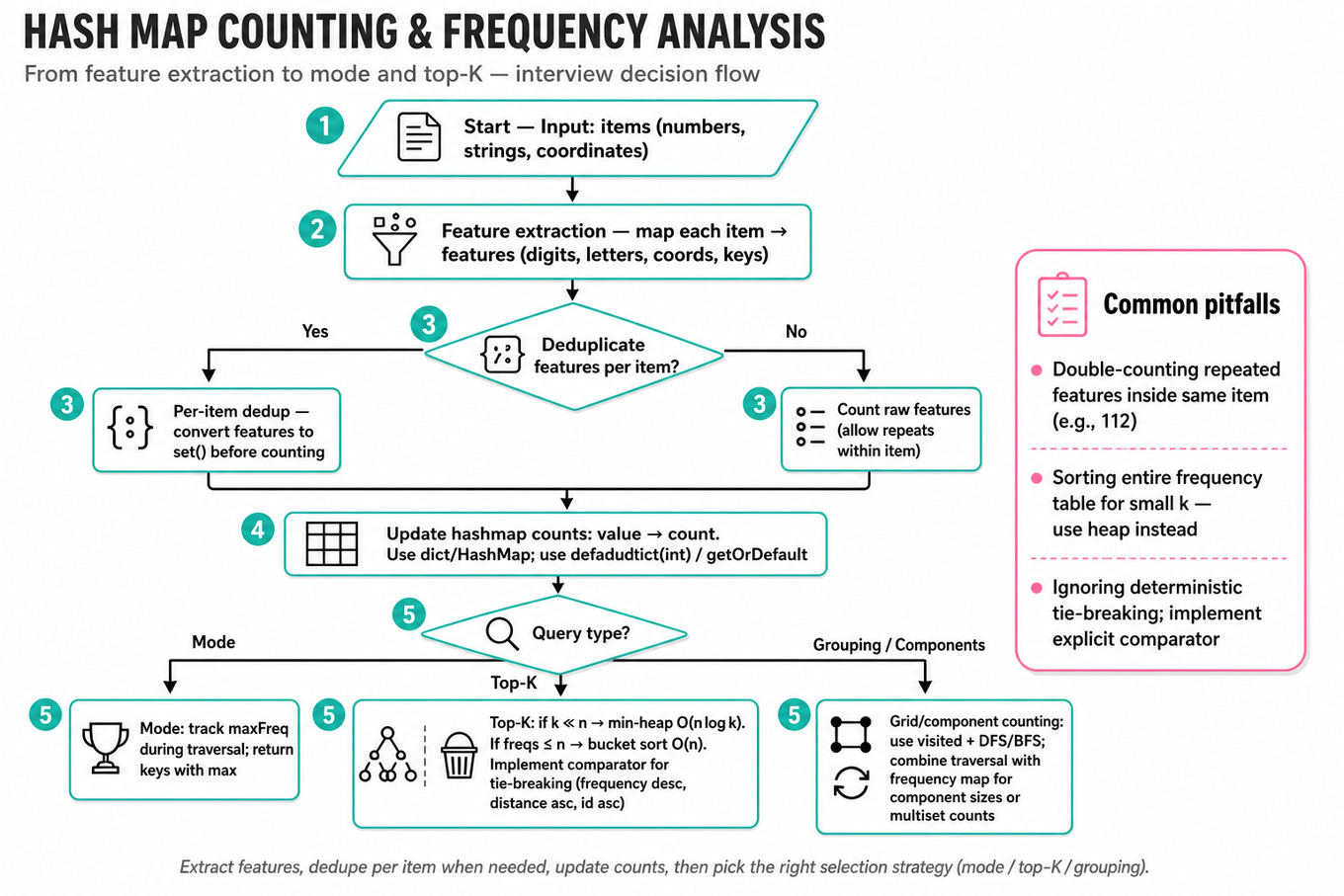
These problems test frequency analysis: converting raw inputs into counts, then using those counts to answer grouping, mode, subset, and top-K queries efficiently. Interviewers are probing whether you can choose the right hash map, avoid double-counting, and reason about ordering/tie-breaking under realistic constraints.
Patterns & templates
-
Hash map counting with
`dict`/`HashMap`— buildvalue -> countinO(n)time; initialize with`defaultdict(int)`or`getOrDefault`. -
Feature extraction before counting — map each item to digits, letters, coordinates, or keys; count features, not necessarily original values.
-
Set deduplication per item — for digit-sharing subsets, count each digit once per number;
112contributes once to digit1, not twice. -
Mode tracking during traversal — update
maxFreqwhile visiting tree nodes; avoid a second pass unless simpler and memory allows. -
Top-K selection using heap or bucket sort —
O(n log k)with heap; bucket works when frequencies are bounded byn. -
Composite ordering — implement comparator carefully for
(frequency desc, distance asc, id asc); tie-breaking bugs are common in top-K queries. -
Grid/component counting — use
visitedplus DFS/BFS; frequency maps may combine with traversal for island sizes or target-word multiset counts.
Common pitfalls
Pitfall: Counting repeated features within the same element, e.g. treating digit
7twice in707when the subset condition only needs membership.
Pitfall: Sorting the entire frequency table for top-K when
kis small; a size-`k`heap is usually cleaner and faster.
Pitfall: Ignoring ties for mode or top-K; Google interviewers often expect deterministic output or an explicit tie policy.
Practice these
The practice cards below cover the canonical variants — solve all of them and time yourself.
Featured in interview prep guides
Practice questions
- Find largest subset sharing a common digitGoogle · Software Engineer · Online Assessment · medium
- Implement frequency + distance top‑K queriesGoogle · Software Engineer · Technical Screen · medium
- Find largest digit-sharing subsetGoogle · Software Engineer · Online Assessment · easy
- Find largest group of two-digit numbers sharing digitsGoogle · Software Engineer · Online Assessment · easy
- Count same-color squares in a character gridGoogle · Software Engineer · Technical Screen · hard
- Find mode in a trinary search treeGoogle · Software Engineer · Technical Screen · medium
- Compute minimal transfers to settle group expensesGoogle · Software Engineer · Technical Screen · medium
- Solve Grid and Counting ProblemsGoogle · Software Engineer · Technical Screen · medium
Related concepts
- Hash-Based Counting And CanonicalizationCoding & Algorithms
- Arrays, Strings, Hash Maps, And Frequency CountingCoding & Algorithms
- Arrays, Strings, and HashingCoding & Algorithms
- Arrays, Strings, Hash Maps, And Sliding WindowsCoding & Algorithms
- Top-K, Heaps, Quickselect, And Frequency AnalysisCoding & Algorithms
- Word CountCoding & Algorithms