Stakeholder Leadership And STAR Storytelling
Asked of: Product Manager
Last updated
What's being tested
Interviewers expect a Product Manager to show STAR storytelling with precise stakeholder leadership: define the decision, align cross-functional partners, choose measurable success criteria, and drive to a data-backed outcome. They probe your ability to translate ambiguity into a scannable plan (priorities, risks, launch criteria), run or commission the right analyses/experiments, and defend tradeoffs—all while owning communication and follow-through. Capital One cares about reducing business and regulatory risk while delivering measurable customer value, so show rigor in metrics, safety/guardrails, and decision rights.
Core knowledge
-
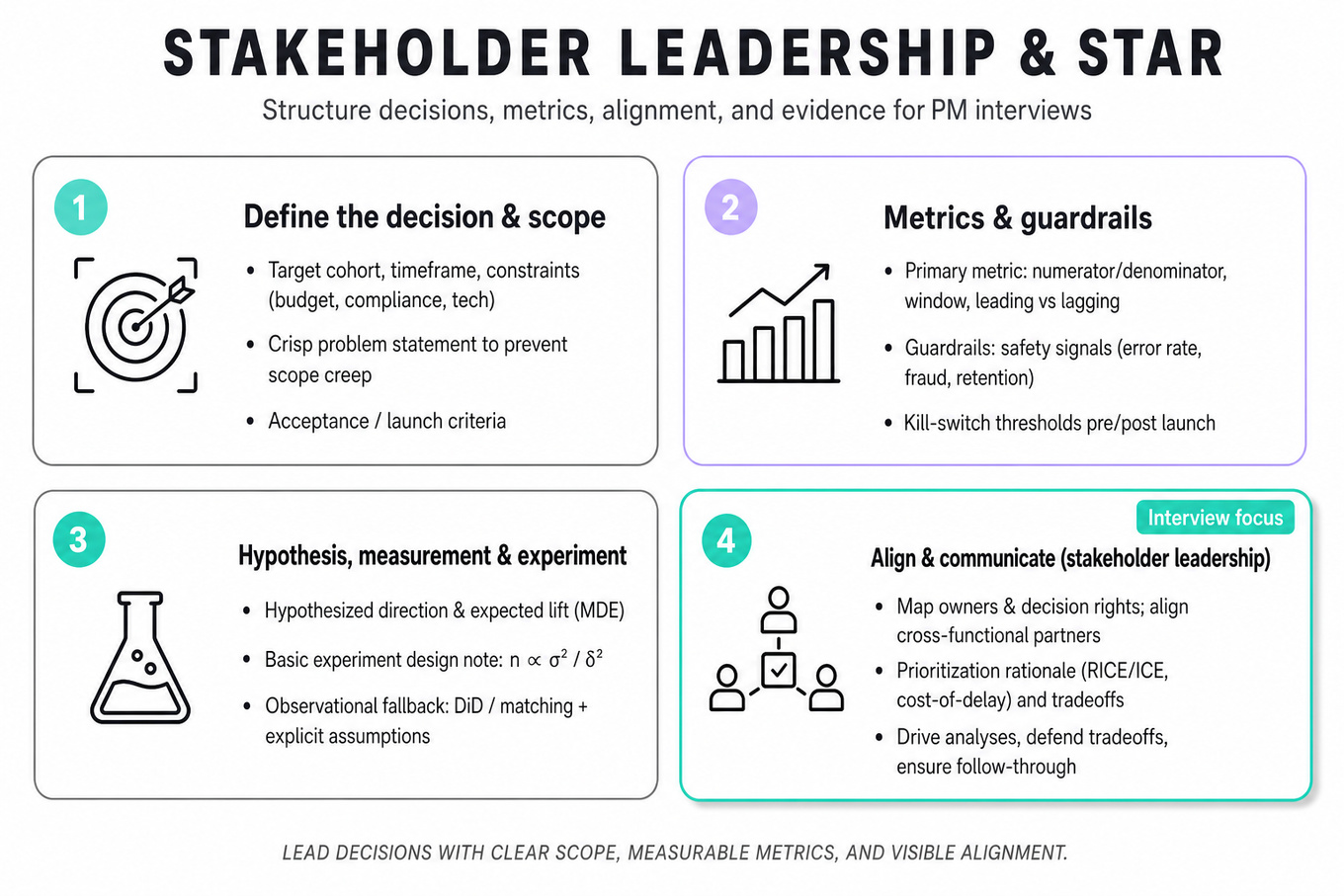
Problem framing — Always start by clarifying the specific decision: target cohort, timeframe, and constraints (budget, compliance, tech). A crisp problem statement prevents scope creep and misaligned success metrics.
-
Primary metric — The single outcome that answers the ask (e.g., change in
DAU, conversion rate). Define numerator/denominator, aggregation window, and whether it's leading or lagging. -
Guardrail metrics — Minimum set of safety signals (e.g., error rate, fraud flags,
MAUretention). Must be monitored pre/post-launch and used as kill-switch criteria. -
Hypothesis + measurement plan — State hypothesized direction and magnitude (expected lift). Translate to measurable targets and acceptable uncertainty (minimum detectable effect).
-
Basic experiment design — For randomized tests, know sample-size intuition: larger effect size needs fewer users; noisy metrics (high variance) require more samples. Rough formula: where is the detectable lift.
-
Statistical vs practical significance —
p-valueand confidence matter, but also quantify business impact (dollars, retention, cost). Small statistically significant lifts may not justify rollout. -
Observational decisions — When RCTs are infeasible, use quasi-experimental techniques (difference-in-differences, matching) and be explicit about assumptions and confounders.
-
Data quality & instrumentation — Validate event counts, freshness, duplicate events, and schema drift. Monitor missingness, sampling changes, and upstream backfills before trusting metrics.
-
Prioritization & tradeoffs — Use
RICE/ICEor cost-of-delay to justify scope. Call out build-time vs learn-time tradeoffs and iterative vs big-bang launches. -
Stakeholder alignment — Use a one-pager/PRD, clear decision RACI (
RACI), and an explicit launch criteria table (primary metric threshold, guardrails, rollback plan). -
Rollout strategy — Canary, percentage rollouts, or feature flags reduce risk. Define escalation paths and rollback triggers prior to launch.
-
Post-launch cadence — Define short-term (first 24–72 hours) and medium-term (2–12 weeks) monitoring dashboards and ownership for anomaly triage and iteration.
Worked example — "Describe a Product You Led"
First 30 seconds: ask clarifying questions—what was the business objective, who were the target customers, what constraints (compliance, tech, timeline) existed, and what primary metric the interviewer expects you to report. Structure the answer around five pillars: problem & user, hypothesis & solution, cross-functional stakeholders & governance, metrics & launch criteria, and outcomes + learnings. Describe how you aligned stakeholders: a one-pager with the decision RACI, weekly syncs with Engineering, Design, Analytics, and Risk, and an agreed rollout plan with guardrails. Call out a specific tradeoff you made (for example, launching an MVP to test behavioral change versus delaying for a scalable backend)—explain why speed-to-learn won or lost. Report measurable impact with exact numbers (e.g., +4.3% conversion, 95% CI [1.2%,7.4%]) and attribution method. Close with “if I had more time” items: plan for segment-level analysis, a retention cohort study, and automated anomaly alerts to sustain the gain.
A second angle — "How do you make data-driven decisions?"
Apply the same pillars but foreground the measurement plan: define the decision and the single primary metric, include guardrails, and state minimum detectable effect and acceptable risk before any analysis. Describe diagnostics you’d run: event count stability, funnel-level checks, pre-period balance, segment heterogeneity. If randomized experiments aren’t possible, describe the quasi-experimental fallback and residual uncertainty. Emphasize communication: present both the statistical result and the business translation (e.g., expected incremental revenue, customer lifetime value impact), and recommend an action (ship, iterate, kill) tied to the evidence and reversibility.
Common pitfalls
Pitfall: Cherry-picking metrics that make the change look good (e.g., touting click-through while ignoring retention harm).
If you track only vanity metrics, you’ll miss downstream regressions—always pair a primary metric with guardrails and a downstream cohort analysis.
Pitfall: Skipping stakeholder alignment and surfacing late objections.
Many candidates describe technical success but not who needed to sign off; state the decision owners, how you secured alignment, and the escalation path for unresolved tradeoffs.
Pitfall: Overloading with technical detail or using fuzzy measurements.
Don’t dive into implementation minutiae; instead, give crisp definitions (numerator/denominator, window), unbiased results, and practical conclusions with rollback plans.
Connections
Interviewers may pivot to adjacent topics like experimentation design (power calculations, sequential testing), metric design & monitoring (alerting, SLOs), or go-to-market and adoption (launch communications, incentives). Be prepared to hand off technical analysis to Analytics/DS while owning the decision and tradeoffs.
Further reading
-
[Trustworthy Online Controlled Experiments — Kohavi, Tang, Xu] — practical guidance on experiment design and pitfalls.
-
[Inspired — Marty Cagan] — frameworks for ownership, product discovery, and stakeholder leadership.
Practice questions
Related concepts
- Behavioral Ownership And Stakeholder InfluenceBehavioral & Leadership
- Behavioral Ownership, Conflict, Ambiguity, And GrowthBehavioral & Leadership
- Behavioral Leadership, Ownership, And ComplianceBehavioral & Leadership
- Leadership Principles And STAR StoriesBehavioral & Leadership
- Leadership Principles, Ownership, And Measurable ImpactBehavioral & Leadership
- Behavioral Leadership And Stakeholder ManagementBehavioral & Leadership