State-Space Search And Dynamic Pathfinding
Asked of: Software Engineer
Last updated
What's being tested
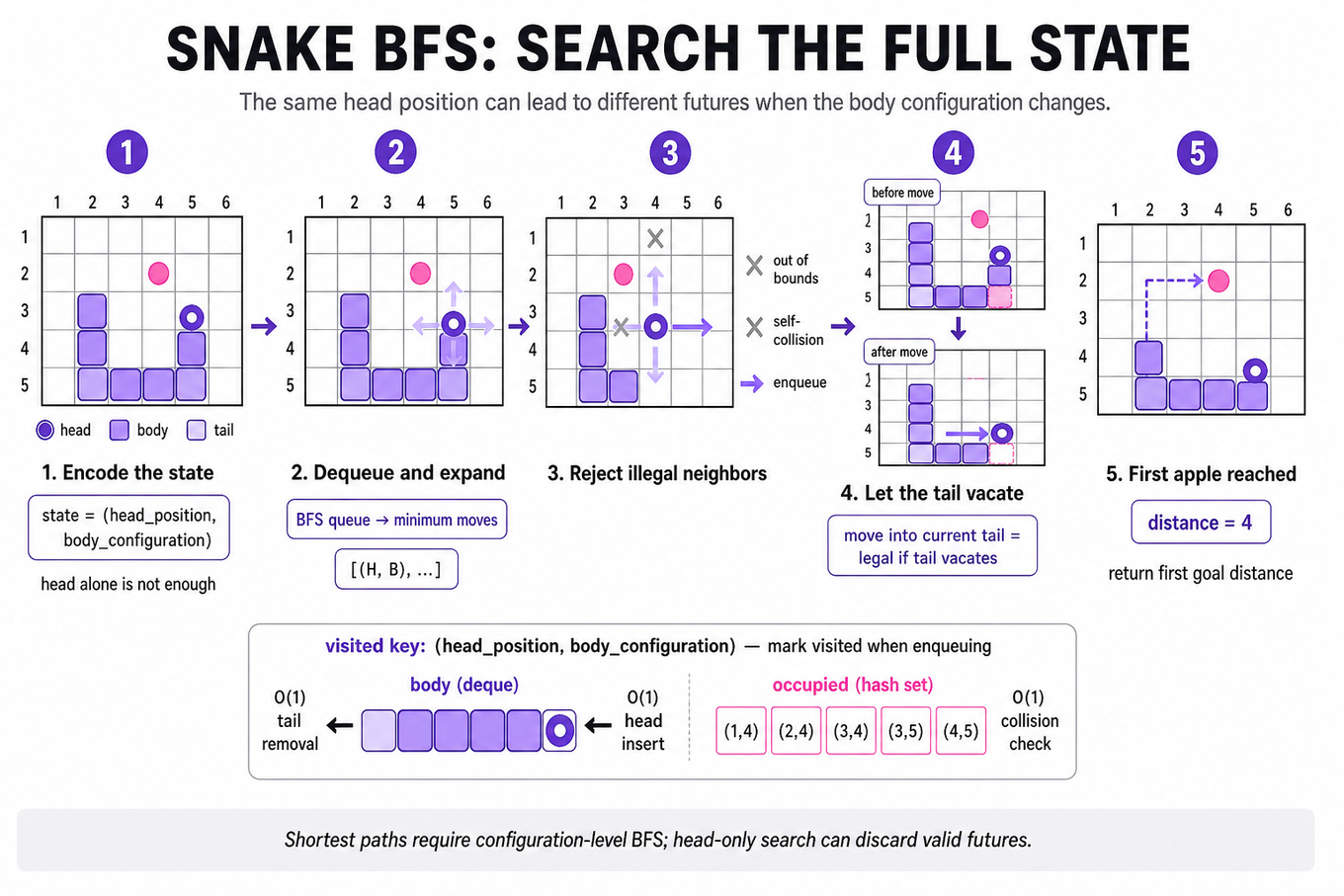
This tests state-space modeling and shortest-path search when the future depends on the entire snake configuration, not just the head position. You must encode legal moves, body collisions, wall boundaries, and dynamic tail movement precisely, then choose a correct BFS state representation with defensible time and space complexity.
Patterns & templates
-
Model each state as
(head_position, body_configuration); two states with the same head may differ because their future legal moves differ. -
Use BFS for minimum moves in an unweighted state graph; mark visited configurations when enqueuing, not when dequeuing.
-
Generate neighbors in four directions, reject out-of-bounds cells, self-collisions, and moves blocked by the body after movement.
-
Treat the tail carefully: moving into the current tail can be legal if that tail cell vacates during the same move.
-
Represent the body with a deque plus hash set for
O(1)head insertion, tail removal, and occupancy checks. -
If the full configuration space is exponential, state the bound explicitly; avoid pretending head-only BFS is correct unless body behavior is irrelevant.
-
Return the first BFS distance reaching the apple; return
-1or a specified sentinel when no legal path exists.
Common pitfalls
Pitfall: Marking only head coordinates as visited merges distinct body configurations and can incorrectly eliminate the optimal path.
Pitfall: Checking collisions against the old body without accounting for simultaneous tail removal rejects legal moves into the departing tail.
Pitfall: Using DFS or greedy Manhattan distance does not guarantee minimum moves and can loop without configuration-level visited tracking.
Practice these
The practice cards below cover the canonical variants — solve all of them and time yourself.
Practice questions
Related concepts
- Graph Search, State Space, And Path OptimizationCoding & Algorithms
- Dynamic Programming, Backtracking, and State-Space SearchCoding & Algorithms
- Graph Search, Connectivity, And State-Space AlgorithmsCoding & Algorithms
- Dynamic Programming and State-Space OptimizationCoding & Algorithms
- BFS, DFS, And Shortest Path SearchCoding & Algorithms
- Graph Search And Weighted PathsCoding & Algorithms