Stateful Event-Driven Simulation And Allocation
Asked of: Software Engineer
Last updated
What's being tested
These questions test deterministic event-driven simulation and time-ordered state management: advancing a timeline, processing timestamped events, and maintaining mutable resource state (capacities, temperatures, positions). Interviewers expect correct event ordering, efficient data structures for time/priority queries, and clear tradeoffs between greedy, exact, and approximate allocation algorithms.
Patterns & templates
-
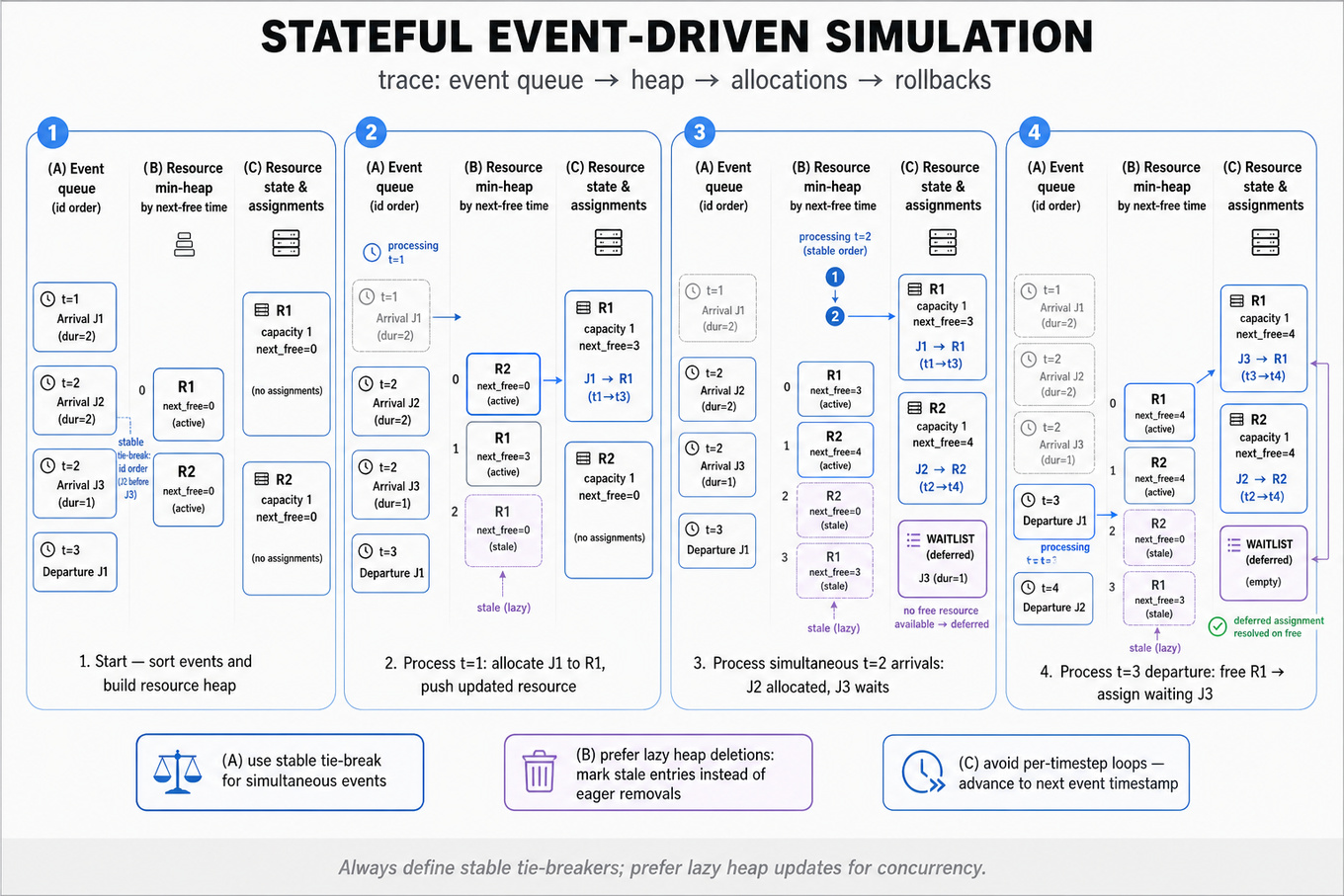
Discrete-event simulation: keep an event queue sorted by timestamp, process events in non-decreasing order; use stable ordering for simultaneous events.
-
Sweep-line / sort-by-time: sort arrivals/departures
O(n log n)then scan, updating state incrementally to avoid per-timestep loops. -
Priority queue / heap for allocation: push candidate resources, pop best-fit in
O(log n)per allocation; maintain lazy deletions when state changes. -
Greedy allocation by earliest-departure or best-fit: simple, fast,
O(n log n), often optimal for interval-capacity problems. -
Knapsack / DP for exact selection: use capacity-indexed DP when capacities × items reasonable; memory
O(capacity)orO(n·capacity). -
Approximation / heuristics: sort by value density or use FPTAS when exact DP is too slow; quantify error guarantees.
-
State snapshots & rollbacks: snapshot only mutable fields you need; for rollback use copy-on-write or version timestamps to keep
O(1)revert where possible.
Tip: prefer lazy updates (mark stale entries) over eager deletions in heaps to simplify concurrency and state changes.
Common pitfalls
Pitfall: mishandling simultaneous events — failing to define and implement a stable tie-breaker leads to non-deterministic behavior.
Pitfall: forgetting to decrement capacity or marking resources stale in the heap, causing over-allocation or duplicated assignments.
Pitfall: using per-timestep simulation for long intervals —
O(time_span)loops blow up; prefer event-driven advances based on event timestamps.
Practice these
the practice cards below cover the canonical variants — solve all of them and time yourself
Practice questions
- Design an Event-Driven CPU Overheat ControllerOptiver · Software Engineer · Online Assessment · hard
- Implement a Level-Aware Expiring Inventory StoreOptiver · Software Engineer · Online Assessment · medium
- Optimize flight and cargo bookings for profitOptiver · Software Engineer · Onsite · hard
- Implement a News Publishing System with Topic Subscriptions and Delivery LimitsOptiver · Software Engineer · Online Assessment · medium
- Cargo Order Allocation Across Departing PlanesOptiver · Software Engineer · Technical Screen · hard
- Reviewing a Freight-Scheduler Codebase: Bugs, Data Structures, and ConcurrencyOptiver · Software Engineer · Technical Screen · hard
- Design a balloon stability trackerOptiver · Software Engineer · Online Assessment · medium
- Decide and implement DP/heap and approximationOptiver · Software Engineer · Technical Screen · medium
- Design a Balloon Festival SimulatorOptiver · Software Engineer · Online Assessment · medium
Related concepts
- Stateful Simulation And Event OrderingCoding & Algorithms
- Load Balancing And Resource Lifecycle SimulationCoding & Algorithms
- Stateful Stream Processing And Time SchedulingCoding & Algorithms
- Concurrency, Scheduling, and State MachinesSoftware Engineering Fundamentals
- Intervals, Sliding Windows, And Time-Ordered StateCoding & Algorithms
- Distributed Job Scheduler SystemsSystem Design