Event-Driven Simulation And Queue State
Asked of: Software Engineer
Last updated
What's being tested
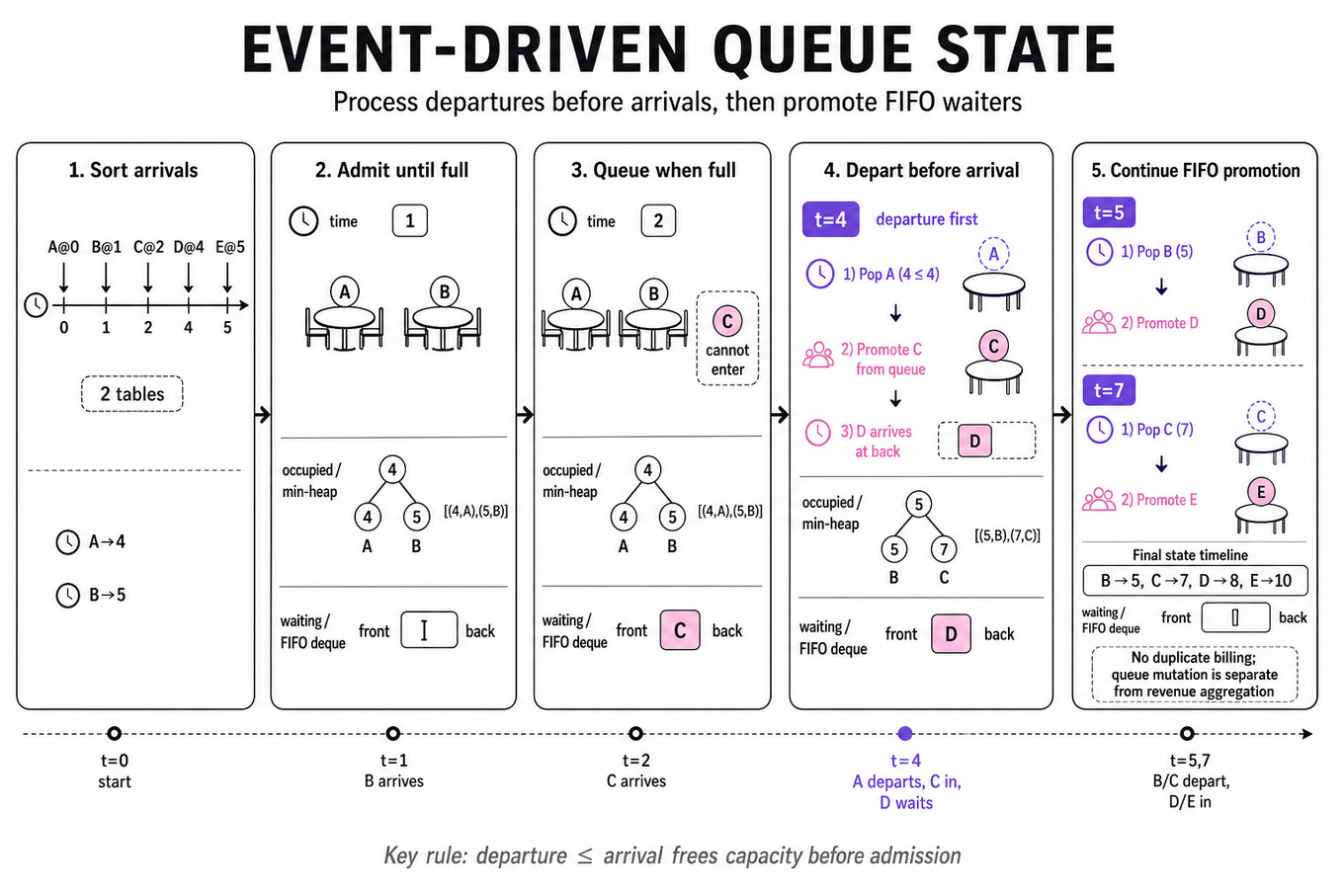
This tests event-driven simulation with explicit lifecycle state: processing arrivals and departures in chronological order while enforcing capacity and FIFO waiting. You must preserve event ordering, update occupancy correctly, and aggregate revenue without double-counting customers or mishandling simultaneous events.
Patterns & templates
- Sort customers by arrival time and maintain a departure-time min-heap for occupied tables; target
O(n log n)time andO(n)space. - For each arrival, pop departures with
departure <= arrivalbefore admitting the customer; this makes capacity available at exact departure timestamps. - Use a FIFO queue for waiting customers, storing arrival time and any immutable customer metadata required for later billing.
- Model state explicitly:
occupied,waiting,revenue, and each customer’s service/departure information; avoid inferring state from partial fields. - After every departure, admit queued customers in order while capacity remains; decide whether waiting time changes revenue or only service timing.
- Group or carefully order same-timestamp events; process departures before arrivals when a departing customer frees capacity immediately.
- Keep revenue aggregation separate from queue mutation, and use integer or decimal-safe currency arithmetic rather than binary floating point.
Common pitfalls
Pitfall: Treating the waiting queue as a priority queue by party size or departure time violates FIFO behavior; use a deque.
Pitfall: Processing arrivals before same-time departures incorrectly rejects customers when capacity should already be available.
Pitfall: Charging based on arrival time instead of actual service completion, or charging queued customers twice during promotion from the queue.
Practice these
The practice cards below cover the canonical variants — solve all of them and time yourself.
Practice questions
Related concepts
- Stateful Event-Driven Simulation And AllocationCoding & Algorithms
- Stateful Simulation And Event OrderingCoding & Algorithms
- Concurrency, Scheduling, and State MachinesSoftware Engineering Fundamentals
- Queueing Theory, Probability, And DistributionsStatistics & Math
- Load Balancing And Resource Lifecycle SimulationCoding & Algorithms
- Intervals, Sliding Windows, And Time-Ordered StateCoding & Algorithms