Tree Algorithms, Traversal, LCA, And Dynamic Programming
Asked of: Software Engineer
Last updated
What's being tested
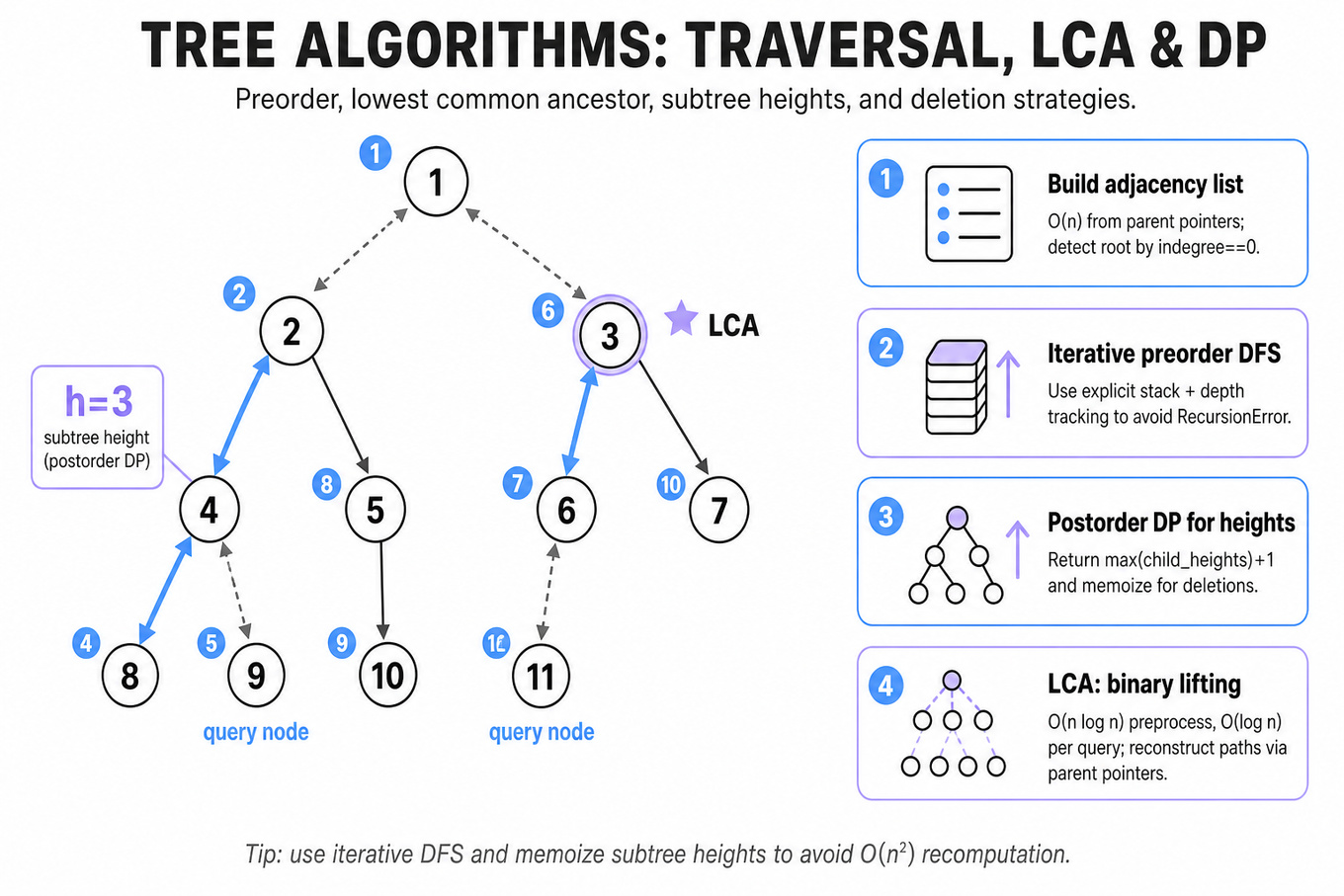
These problems test mastery of tree traversal and connectivity reasoning (preorder listing, path queries, deletions) plus lowest common ancestor (LCA) and search-based dynamic programming over trees. Interviewers probe ability to transform parent/child representations into usable graphs, reason about component reattachment after deletions, and produce correct, efficient traversals under edge constraints.
Patterns & templates
-
Build an
adjacency listfrom parent pointers in O(n) time; detect roots by missing parent orindegree==0. -
Use
dfs(recursive or iterative) for preorder with a runningdepthparameter to collect (id, depth) pairs in O(n) work and O(h) stack. -
Compute height with one postorder
dfsreturningmax(child_heights)+1; reuse results for deletion queries to avoid recomputation. -
For shortest-path between nodes: find LCA via parent pointers, then reconstruct paths up-to-LCA and down, O(h) time; precompute binary-lifting for repeated queries in O(n log n) preprocess.
-
For node-deletion with promotion: simulate local reconnection rules, then recompute component heights; prune search using subtree sizes and memoized heights to avoid exponential work.
-
For enumerating valid deletion sets: apply backtracking with early pruning (skip symmetric deletions), deduplicate by canonical ordering, bound by combinatorial limits.
-
Tip: prefer iterative
dfsor explicit stacks for trees deeper than ~10^4 to avoidRecursionError; track parent pointers when reconstructing paths.
Common pitfalls
Pitfall: Assuming node values are unique — many variants allow duplicate values or missing nodes; use node IDs or handle absence checks explicitly.
Pitfall: Recomputing heights from scratch per deletion without memoization leads to O(n^2) or worse; cache subtree heights and update incrementally.
Pitfall: Not addressing recursion depth or stack memory on very deep trees; always discuss iterative alternatives or tail recursion limits.
Practice these — the practice cards below cover the canonical variants — solve all of them and time yourself.
Practice questions
- Build a Top-Down Reporting Forest from Employee-Manager PairsSnowflake · Software Engineer · Onsite · medium
- Find Tree Height After Deleting Nodes and Promoting ChildrenSnowflake · Software Engineer · Technical Screen · medium
- Delete the Fewest Tree Nodes to Meet a Height LimitSnowflake · Software Engineer · Technical Screen · medium
- Implement topological sort and tree boundary traversalSnowflake · Software Engineer · Technical Screen · medium
- Compute height of tree with deleted nodes; minimize deletionsSnowflake · Software Engineer · Technical Screen · hard
- Compute height after deletions; enumerate valid delete setsSnowflake · Software Engineer · Technical Screen · medium
- Compute shortest path between tree nodesSnowflake · Software Engineer · Onsite · medium
- Transform tree using counterpart subtree sumsSnowflake · Software Engineer · Technical Screen · medium
- Set second tree values by subtree sumsSnowflake · Software Engineer · Technical Screen · medium
- Transform tree with subtree sum mappingSnowflake · Software Engineer · Technical Screen · medium
Related concepts
- Trees, Recursion, And BST TraversalCoding & Algorithms
- Tree And Linked Structure AlgorithmsCoding & Algorithms
- BST Algorithms And Lowest Common AncestorCoding & Algorithms
- Recursion, Dynamic Programming, And Implicit StructuresCoding & Algorithms
- Binary Tree AlgorithmsCoding & Algorithms
- Binary Tree Traversals, Vertical Order, And ViewsCoding & Algorithms