Undo/Redo And Command History
Asked of: Software Engineer
Last updated
What's being tested
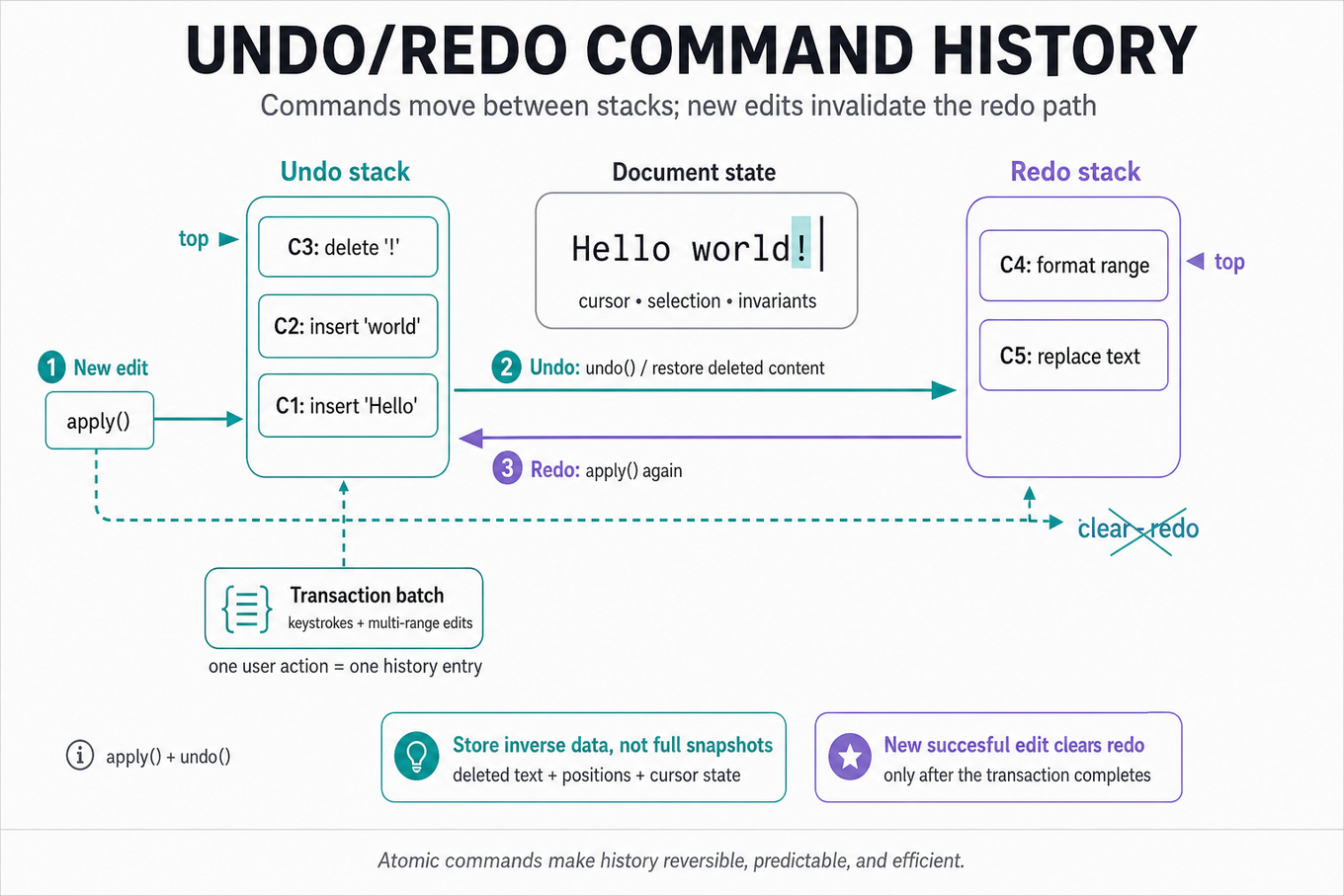
These problems test command history design: representing edits as reversible operations, maintaining undo/redo stacks, and defining exact semantics for new edits after undo. You must reason about batching, overlapping ranges, cursor/bookkeeping updates, failure handling, and performance as document size and history length grow.
Patterns & templates
-
Model each edit as a command with
apply()andundo(); store deleted text or an inverse operation rather than full document snapshots. -
Maintain undo and redo stacks: successful new edits push undo and clear redo; undo transfers one command to redo, while redo reverses that transfer.
-
Use transactional batching to group keystrokes or multi-range changes into one composite command with ordered forward and inverse operations.
-
For range edits, record coordinates and original content before mutation; process overlapping ranges consistently, often right-to-left to preserve offsets.
-
Prefer a gap buffer, piece table, or rope for large documents; snapshots are simple but cost
O(document size)per history entry. -
Compress adjacent compatible inserts/deletes, but preserve command boundaries required by explicit transactions, selection changes, or collaborative operations.
-
Make commands atomic: if applying or reversing a batch fails, restore prior state; target
O(k log n)forkedited ranges with a rope or interval structure.
Common pitfalls
Pitfall: Clearing redo after every internal operation in a batch, rather than after the completed user-level transaction.
Pitfall: Storing only positions when edits shift offsets; preserve deleted content and transform later ranges or apply them in descending order.
Pitfall: Treating undo as a raw inverse without updating selections, cursors, metadata, and invariants consistently.
Practice these
The practice cards below cover the canonical variants — solve all of them and time yourself.
Practice questions
Related concepts
- In-Memory Stateful Data ModelingCoding & Algorithms
- Caching And Stateful Data Structure DesignCoding & Algorithms
- Mutable Data Structure DesignCoding & Algorithms
- Stateful In-Memory Data Structures And Temporal SemanticsCoding & Algorithms
- Dynamic Programming And MemoizationCoding & Algorithms
- Stateful In-Memory Ledgers and Versioned StoresCoding & Algorithms